Star Wars: Galactic Racer leans into Burnout-style arcade destruction
Galactic Racer swaps Star Wars power fantasy for a Burnout-like demolition derby, and that chaos could give the license a sharper racing lane.

Star Wars: Galactic Racer is not trying to be another prestige lightsaber story with a cockpit attached. It takes the franchise into the Outer Rim’s illegal racing underworld, where the hook is collision, risk, and survival as much as speed, and that shift gives the game a much scrappier identity than the usual Star Wars power trip.
A Star Wars game built for wrecks, not reverence
The clearest thing about Galactic Racer is what it is not. It is not an open-world racer, and it is not another careful, lore-heavy action game dressed up with repulsorcraft. Official Star Wars materials describe it as a “runs-based, high-stakes reinvention of racing,” set after the Empire’s fall, when the Galactic League has become an unsanctioned circuit financed by syndicates and powered by chaos.
That setup matters because it changes the feel of the whole license. Instead of noble pilots or polished podracing spectacle, the game leans into a seedy underground circuit in the lawless Outer Rim. The result is a Star Wars setting that feels more like street racing than ceremonial franchise fan service, and that alone makes it stand out in a landscape where licensed games often play it safe.
Why Burnout is the right comparison
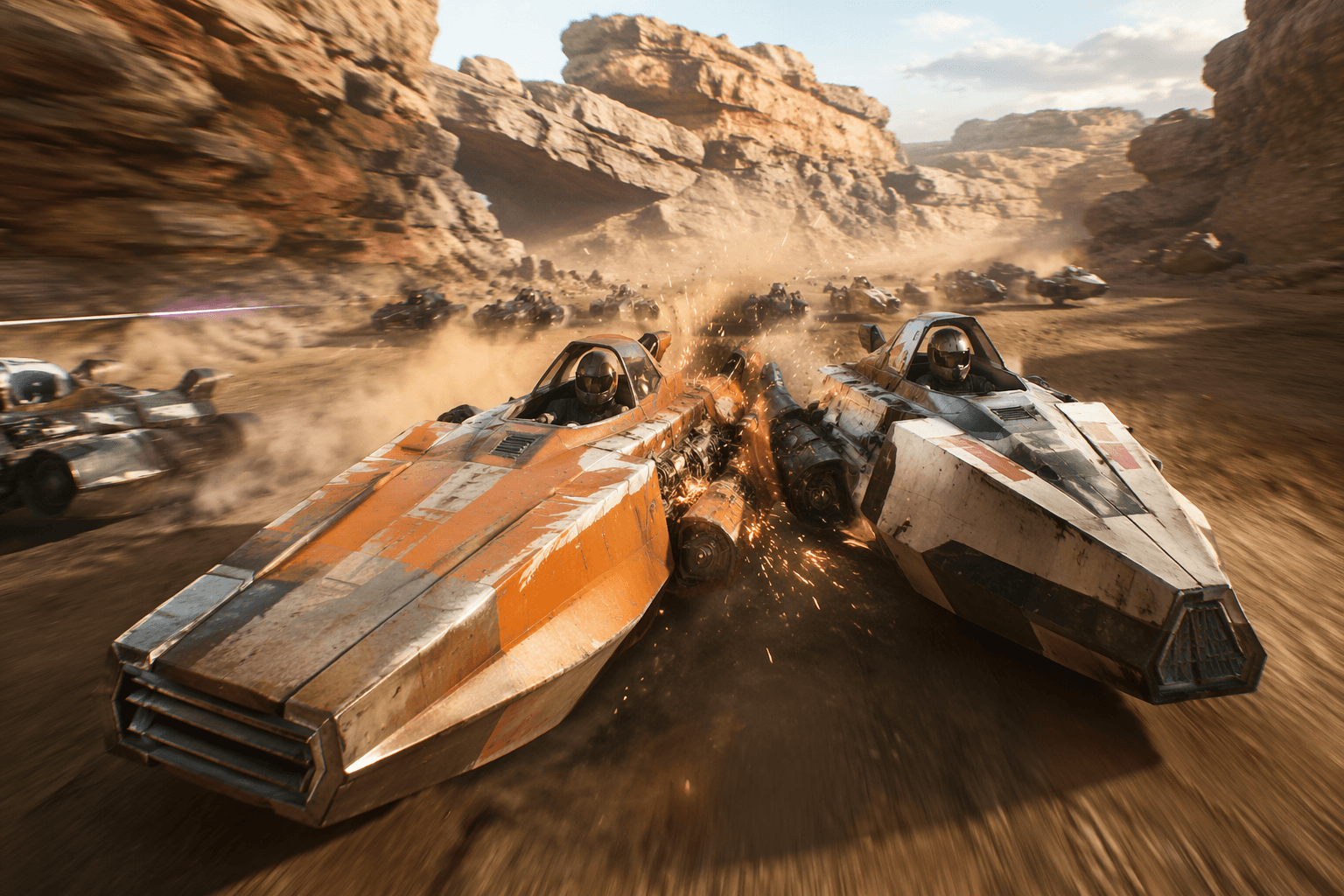
The Burnout comparison is not just lazy shorthand. After hands-on time, the game’s identity comes across as wreck-heavy arcade racing, where smashing rivals off the track is part of the core loop rather than a flashy side effect. The race is about takedowns, chain reactions, and keeping your machine alive through the mess, which is exactly the kind of tactile chaos that made Criterion’s classics so compulsive.
That matters because it gives Galactic Racer a sharper mechanical lane than the podracing nostalgia frame some players might expect. Podracing is the obvious Star Wars racing memory, but this game is being built around contact, damage, and deliberate spectacle. The point is not clean laps. The point is to survive the pileup and come out ahead.
The design inheritance also makes sense on the studio side. Fuse Games was founded by developers who previously worked on Need for Speed and Burnout, so the studio’s instinct for speed and destruction is baked into the project’s DNA. That pedigree shows up in the way the game handles, the way it presents itself, and the way it treats racing as an act of aggression rather than a pure test of line choice.
A structured racer, not an open playground
Even with all that Burnout energy, Galactic Racer is not a straight copy of Burnout Paradise. The game is structured rather than open-world, which gives it a different rhythm from the freeform crash-parade that defined Paradise. That distinction matters because it suggests a more directed campaign of events, story beats, and mode-specific goals rather than a single sprawling driving sandbox.
Fuse has also said the game layers in special abilities, story material, and podracing inside the larger race format. That combination gives it a broader toolset than a pure destruction racer. It is not only about ramming, because the game is trying to mix tactical race elements with its demolition identity, and that blend should help keep it from feeling like a one-note tribute act.
Matt Webster, Fuse Games’ co-founder and CEO, has framed the project as a response to a racing genre that is “crying out” for fresh ideas. That is the right diagnosis for a game like this. The market does not need another generic racer with a Star Wars skin, it needs something that justifies the license by changing the shape of the race itself.
Lucasfilm’s hand in the machine
Lucasfilm Games was involved in helping shape the racing machine, which is important because it signals that Galactic Racer is being treated as more than a one-off licensed stunt. That involvement helps explain how the game can borrow from the energy of older arcade racers while still fitting inside a broader Star Wars strategy built around interactive storytelling.
That story angle is already visible in the trailer material. StarWars.com has pointed to a character named Shade and teased Sebulba’s involvement, which connects the game to Episode I-era podracing nostalgia without making the whole thing a museum piece. Shade gives the project a fresh face, while Sebulba ties it back to one of the franchise’s most recognizable racing antagonists.
The bigger picture is that the game is trying to bridge eras. It borrows the dirty, destructive attitude of old arcade racers, but it packages that energy inside a Star Wars world that can still support story, characters, and recognizable franchise callbacks. That balance is what keeps it from collapsing into parody.
What ships, when it ships, and what comes with it
Galactic Racer is scheduled to launch worldwide on October 6, 2026. It is coming to PlayStation 5, Xbox Series X|S, and PC, which puts it squarely on current-gen hardware and gives it a wide launch footprint from day one.
Preorders include an additional livery for the repulsorcraft and a special player banner for multiplayer modes. Those bonuses are not the main reason to care, but they do tell you how the game is being positioned: style, identity, and online visibility are part of the pitch, not just raw speed.
The important part is that the game’s pitch is coherent. The Outer Rim setting, the syndicate-backed Galactic League, the destruction-first racing model, and the story nods to Shade and Sebulba all point in the same direction. This is a Star Wars game that wants to be remembered for how it drives, not just for what it references.
Why this version of Star Wars racing feels fresh
Galactic Racer works because it understands that the franchise does not always need to be treated like sacred ground. Sometimes the smartest use of a huge license is to find a subgenre that can carry its own weight, then let the IP sharpen the edges instead of sanding them down. Here, that means turning Star Wars into a crash-happy arcade racer where every turn can turn into a wreck.
That is a better fit than another action game trying to outdo the last one with more lore, more combat systems, and more checklist design. Galactic Racer is betting that the franchise can be exciting when it gets messy, and if it lands, the real payoff will be simple: a Star Wars game that feels dangerous in motion again.
This article was produced by Prism’s automated news system from verified source data, official records, and press releases, then run through automated quality and moderation checks before publishing. The system is built and supervised by the people who set the standards it runs under. Read our full AI policy.
Did this article answer your question?