Bleass Tides 1.3.5 Adds CLAP Support, New Delay Options and iOS Fixes
BLEASS Tides 1.3.5 cuts iOS CPU load by more than half with more efficient filters, and adds CLAP format for macOS and Windows — free for existing users.
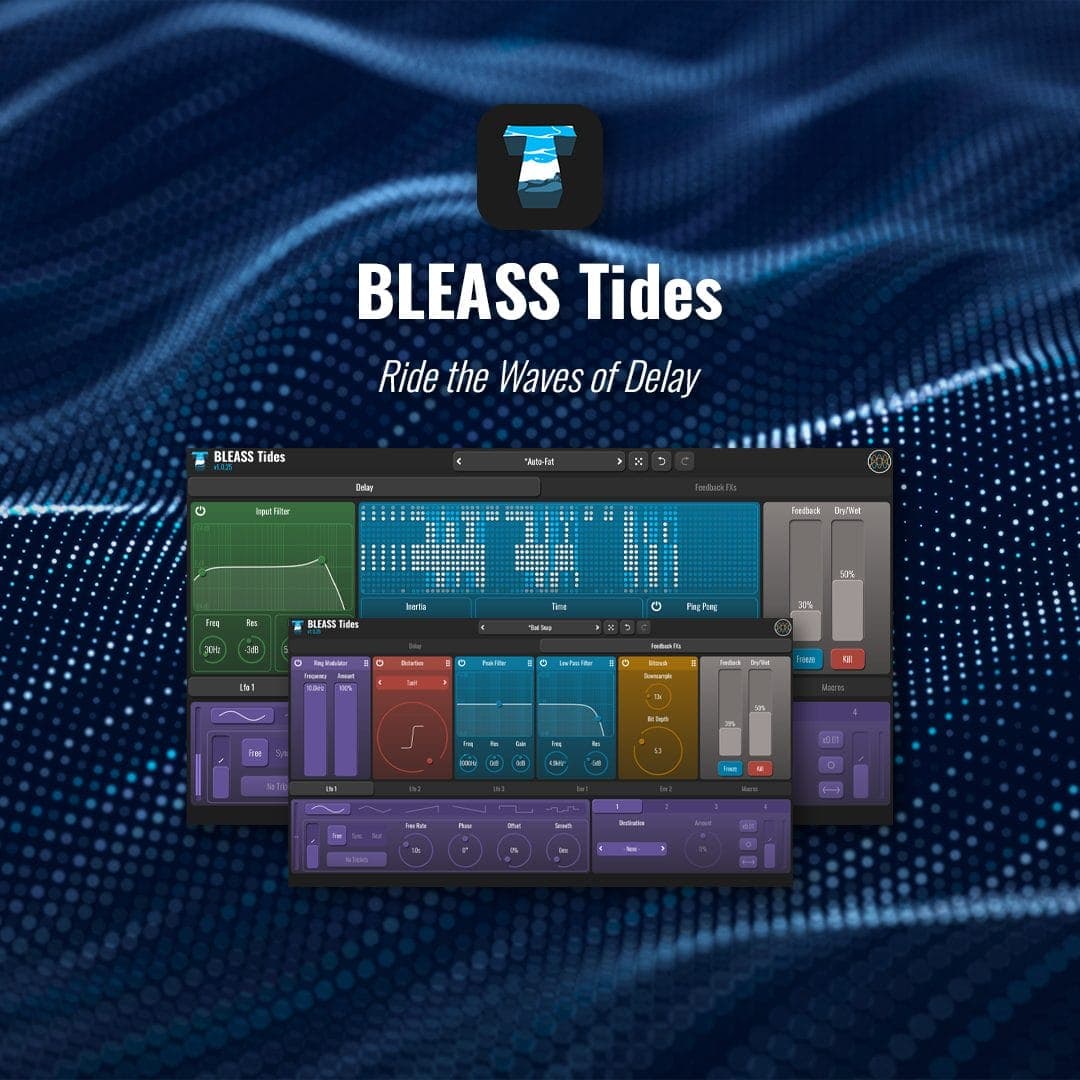
French developer BLEASS shipped version 1.3.5 of its Tides multi-FX feedback delay on March 22, 2026, and the headline number for iOS users is stark: more efficient filters that deliver the same high-quality sound while significantly reducing DSP usage, with the result being a CPU load reduction of more than half on iOS devices. For a plugin that earned early criticism for pushing hardware to its limits, that's a meaningful turnaround.
BLEASS, the French company behind Tides, released the delay plugin roughly a year ago for macOS, Windows, and iOS. The core concept is feedback manipulation: Tides' feedback path features five insert points into which any of 11 different effect processors can be loaded, including distortions, filters, pitch and frequency shifting, ring modulation, and even an additional delay processor. That architecture is what makes the runaway feedback behaviour both the plugin's greatest creative asset and its biggest performance liability on mobile hardware.
The 1.3.5 update is free for existing Bleass Tides users. On the feature side, modulation learn allows you to assign modulation to parameters faster, and there is a new sidechain input and hold parameter for extra vitality. Desktop users get one more addition: with Tides 1.3.5, the delay is now available as a CLAP plugin for macOS and Windows. Linux support is still missing, but would be very welcome, especially now that CLAP support is available.
The iOS improvements go beyond raw CPU numbers. The developers also improved iOS UI performance, delivering faster responses and smoother interactions across the interface. That matters practically for a plugin whose interface is built around touch interaction. Tides is the first plugin to use BLEASS' v2 plugin engine, with a reimagined interface designed to be as easy to use with touchscreens as with a mouse, including an interactive delay visualiser that produces frequency shifting effects when clicked or touched. Touching the left side of the visualiser produces a negative frequency shift; the right side produces a positive one. The further from centre you tap, the larger the shift, and it updates in real time as you drag across the panel.

The INERTIA processor, which adds a secondary delay line within the feedback path, ships with a frank warning from BLEASS: "Further realtime interaction comes in the form of momentary Freeze and Kill buttons that are perfect for creating spontaneous, organic effects, whether on stage, on the go, or in the studio." That Kill button earns its place specifically with INERTIA: BLEASS explicitly cautions that the processor can cause a runaway feedback loop that gets progressively louder, and instructs users to hit Kill to stop it. In Sync mode, INERTIA's delay time is set in note lengths; in Free mode, in milliseconds and seconds.
SYNTH ANATOMY's review of the update noted that early versions of Tides sent many patches quickly to extremes, but acknowledged that several iterative updates had addressed the issues before 1.3.5 landed. To mark the release, BLEASS launched a limited-time 25% discount on the desktop version, bringing it to $29/29€ from its regular $39/39€ price. The iOS version remains separately priced on the App Store.
Know something we missed? Have a correction or additional information?
Submit a Tip