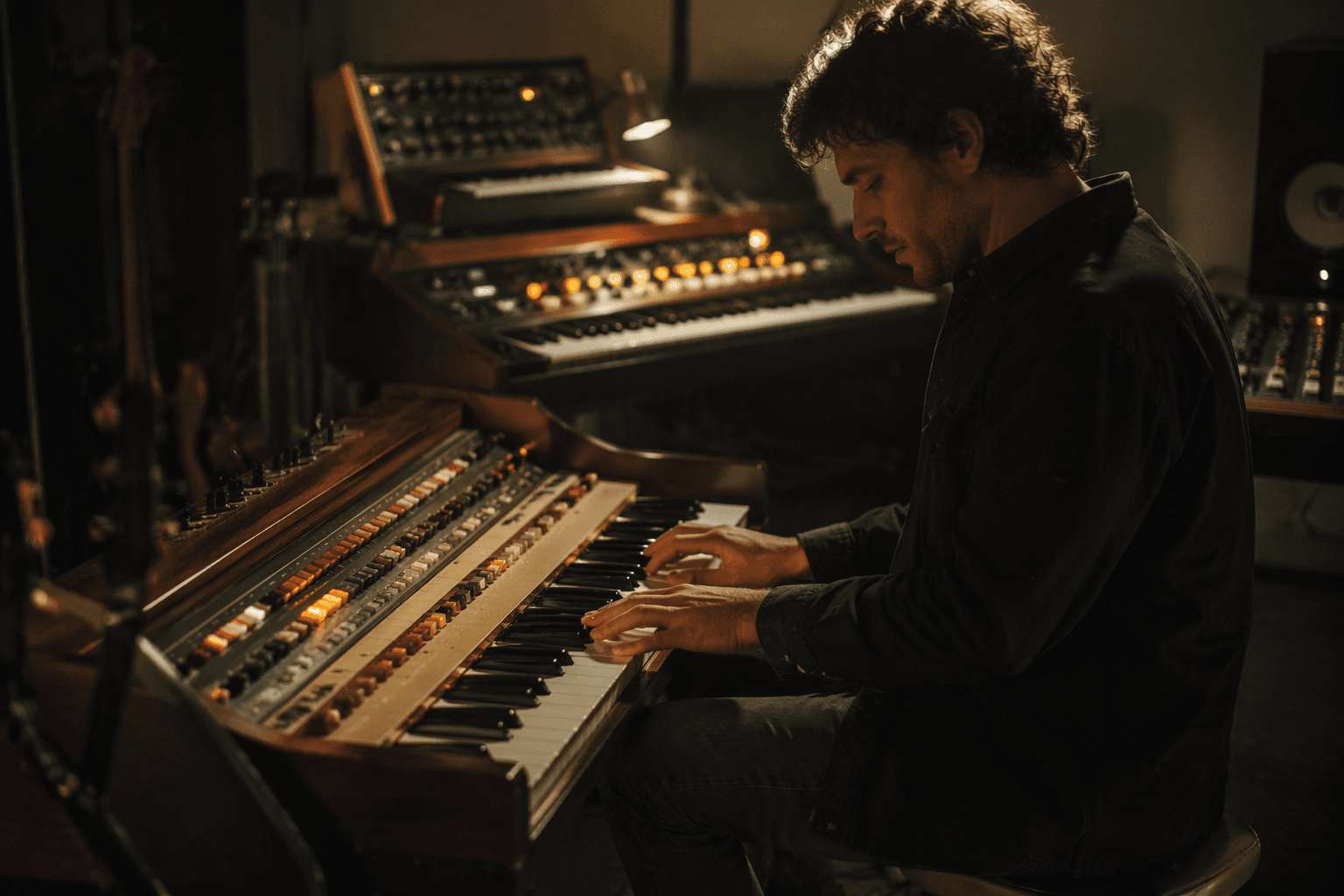
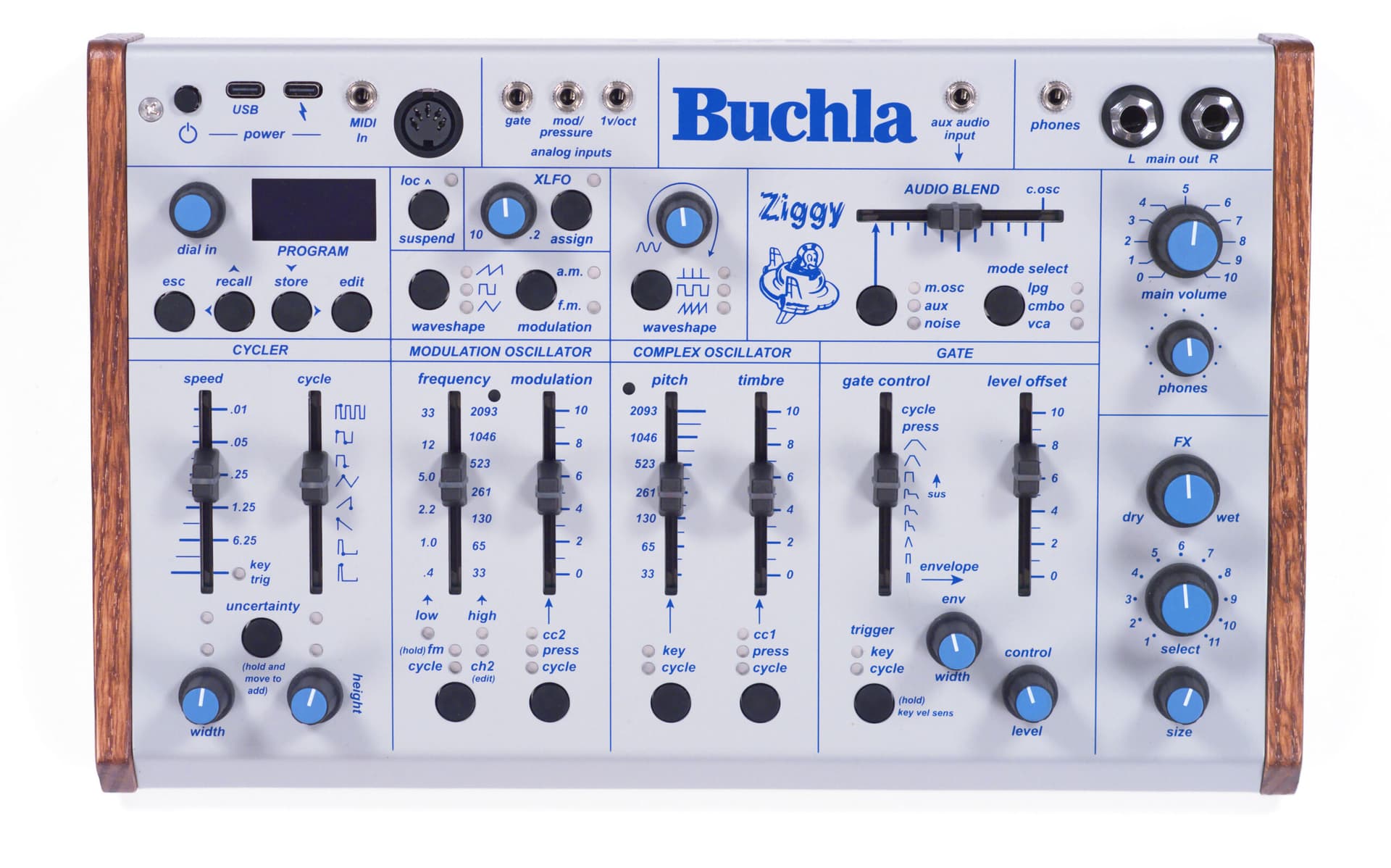
Buchla Ziggy condenses West Coast synthesis into a portable desktop instrument
Ziggy brings Buchla’s West Coast language to a $999 desktop, with analog voice, browser editing, and more than 100 presets.
Buchla has pushed its most famous idea into a size and price bracket that vintage-synth players will actually notice. Ziggy arrived as a self-contained desktop instrument, not a sprawling modular system, and Buchla priced it at $999 for preorder, a sharp break from the company’s long-running association with gear that usually lives far above the reach of first-time buyers.
The instrument still sounds like Buchla in the ways that matter. Its core voice is fully analog, built around a complex oscillator, a modulation oscillator, a low pass gate, and Buchla’s Cycler plus an extra LFO. That architecture keeps the emphasis on motion, timbre, and voltage control rather than the familiar subtractive chain of oscillator, filter, envelope. Buchla has also made clear that it wants Ziggy described as an instrument rather than a conventional synthesizer, which fits the company’s old West Coast habit of treating the panel as a performance surface, not just a sound source.
What changes the equation is the digital layer wrapped around that analog path. Buchla said Ziggy uses digital control for preset storage and browser-based editing through WebMIDI, with more than 100 factory and user programs available to save and recall. It also supports USB-C, 5-pin DIN, TRS MIDI, 1V/oct, gate, and modulation connections, so it can sit on a desk by itself or talk to a modular rig without feeling like a dead-end box. Onboard effects go well beyond the basics too, with reverb, delay, chorus, pitch shift, flanger, and distortion-like processing, plus tuning options that include western and non-western scales.
For Buchla watchers, the pricing tells the real story. The company’s other standalone performance instruments sit much higher, with the Easel Command at $2,999, the Music Easel at $4,999, and the LEM218 at $1,299. That makes Ziggy the most accessible entry point Buchla has offered in this lane, and it lands in a lineage the brand knows well. Buchla has already used the Easel Command and 208C to shrink the classic Music Easel into a desktop format, led by Joel Davel, while the original Music Easel dates to 1973 as a portable instrument built from a 218 touch keyboard controller and a 208 stored program sound source.
That is why Ziggy matters to vintage-curious players. It does not recreate the full mystery of a large Buchla modular, and it gives up some of the open-ended sprawl collectors chase. But it does preserve the company’s sound logic while adding preset memory, browser editing, and modern MIDI hookups. At $999, Ziggy looks less like a museum piece wearing a new face and more like a real bridge into Buchla thinking, one that finally makes the West Coast idea feel portable enough to live on a desk.
This article was produced by Prism’s automated news system from verified source data, official records, and press releases, then run through automated quality and moderation checks before publishing. The system is built and supervised by the people who set the standards it runs under. Read our full AI policy.
Did this article answer your question?