Catalyst Audio’s MIG modular uses Soviet vacuum tubes for chaotic sound
Catalyst Audio's MIG turns surplus Soviet 1J24B tubes into a full Eurorack voice. The chaos feels like real lineage, not cosplay.
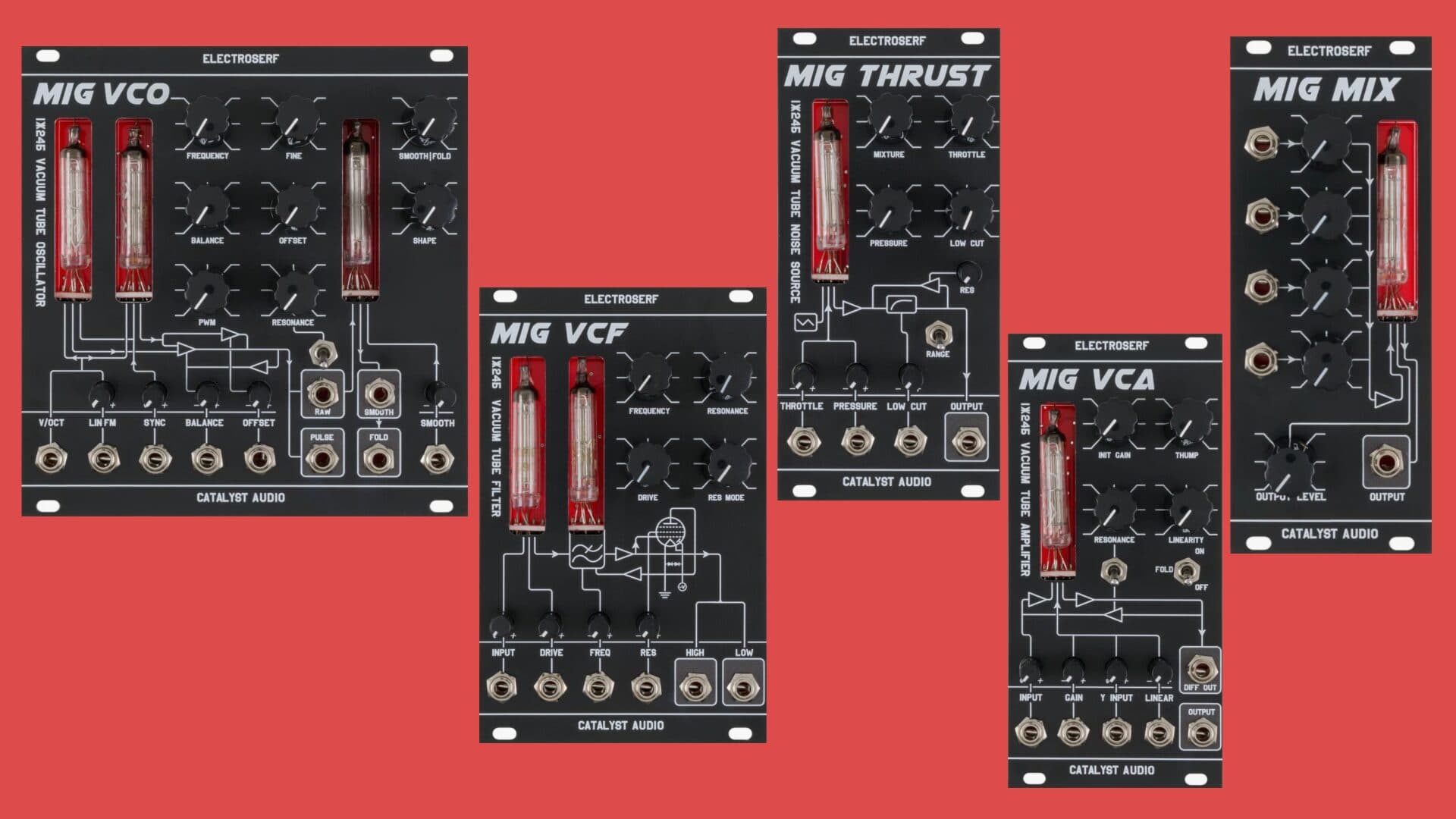
Catalyst Audio’s MIG series lands in a sweet spot vintage-synth readers actually care about: it is not pretending to be old, it is built from old parts that still have a distinct electrical personality. The collaboration with Electroserf centers on NOS Soviet-era 1J24B, or 124, subminiature vacuum pentodes originally tied to Mikoyan-Gurevich MiG fighter programs, and the whole line uses them as active circuit elements, not decoration. That difference matters because MIG is asking a harder question than most “tube” modules do: can a repurposed Cold War component family become the voice of a modern instrument?
Why this lineage feels real
Catalyst first floated the MIG concept at Buchla and Friends 2024, where the company described a VCO, mixer, VCF, VCA and noise source built around NOS tubes from Soviet fighter jets. That already put the project on a different track from the usual retro-leaning Eurorack reveal, because the appeal was hardware provenance rather than graphic design or nostalgia paint. The June 18, 2026 demo reel pushed that line further, calling the parts “Mig Series Demo Reel V01” and naming them “NOS soviet military tubes,” which makes the project’s identity plain: these are surplus components being turned into a synth voice.
The tube itself is the reason the story has legs. The 124 is a Soviet vacuum pentode with a 1.2-volt filament, and reference material places its original use in battery-powered military and space equipment. That low-voltage, rugged, compact pedigree is exactly why it makes sense in Eurorack, where space and power are always at a premium. Some NOS stock was still being described as available as late as 2011, with tubes dated to 1991, which explains how a 2026 modular project can still source a part that first looks like an artifact and then behaves like a usable modern ingredient.
What the MIG modules actually do with the tubes
The important thing about MIG is that the tubes are not a branding layer sitting on top of a conventional modular voice. Catalyst’s VCO uses three former Soviet tubes and adds internal feedback paths plus 1V/oct tracking, so it is built to be played like a proper oscillator rather than treated as a novelty noise box. The VCF also puts three tubes into the signal path, while the VCA and mixer lean into tube gain control and saturation instead of clean, transparent gain staging.
That architecture is where the lineage shows up in sound. Tube circuits are already associated with compression, soft clipping and interaction between stages, but MIG seems designed to make those behaviors central rather than incidental. The whole line is built to encourage distortion, push-pull instability and unpredictable response, which is a very different promise from a pristine analog clone or a polite utility module. If you are used to tube gear being sold as a warm finish on top of an otherwise standard synth voice, MIG is more aggressive than that.
The standout is the Thruster. Catalyst describes it as a fully analog voltage-controlled vacuum tube noise source, and the more vivid description is that it is engineered to be so unstable that harmonic output collapses into chaotic noise. That is not a side effect you hide behind a demo patch. It is the point of the module, and it is the most obvious place where the old component family is not just preserved but allowed to misbehave musically.

What vintage-synth readers should hear in it
MIG is not a clone of a famous keyboard, and that is exactly why it has a shot at interest beyond the modular bubble. There is no preexisting Oberheim, Moog or Polymoog reference point here, so the value is not in fidelity to a known panel. Instead, the appeal comes from the specific behavior of a specific part family, used with enough seriousness that its flaws and nonlinearities become the instrument’s identity.
That makes the project interesting to collectors in a different way. The draw is not only “new gear,” it is the fact that the design is anchored to a defined historical component lineage, one with military and aerospace roots, a 1.2-volt filament, and the kind of low-power ruggedness that modern builders rarely need to think about. For players who normally chase used-market bargains because nothing new scratches the same itch, MIG offers a different proposition: a contemporary system that preserves the weirdness of the source material instead of imitating the surface finish of an old synth.
Synthtopia’s June 21, 2026 preview and Synth Anatomy’s account both echoed the same core picture: this is a ground-up tube modular family, not a cosmetic tube add-on. That consistency matters, because it suggests Catalyst is not selling the romance of Soviet surplus as a gimmick. It is using the actual component behavior, the saturation, the compression and the instability, as the design brief.
The real test of the concept
David Small and the Catalyst-Electroserf collaboration have framed MIG as a full voice made from old industrial parts, and that is the right way to think about it. The strongest vintage-synth stories are the ones where the lineage is audible, not just legible in the spec sheet, and MIG at least appears to understand that distinction.
If the modules deliver what the public demos promise, the attraction will not be that they look retro. It will be that they translate Soviet tube history into a modular voice with enough character to stand apart from standard transistor and op-amp designs. That is the line MIG has to clear, and on paper it is aiming at the right target: not nostalgia, but a living piece of hardware history that still knows how to make a mess.
This article was produced by Prism’s automated news system from verified source data, official records, and press releases, then run through automated quality and moderation checks before publishing. The system is built and supervised by the people who set the standards it runs under. Read our full AI policy.
Did this article answer your question?