Pylobolus unveils Alkove, 12-voice binaural hybrid synth at SynthFest France 2026
Pylobolus’s Alkove brings 12 voices, binaural stereo and hybrid formant synthesis to SynthFest France, turning a boutique tease into a serious new instrument.
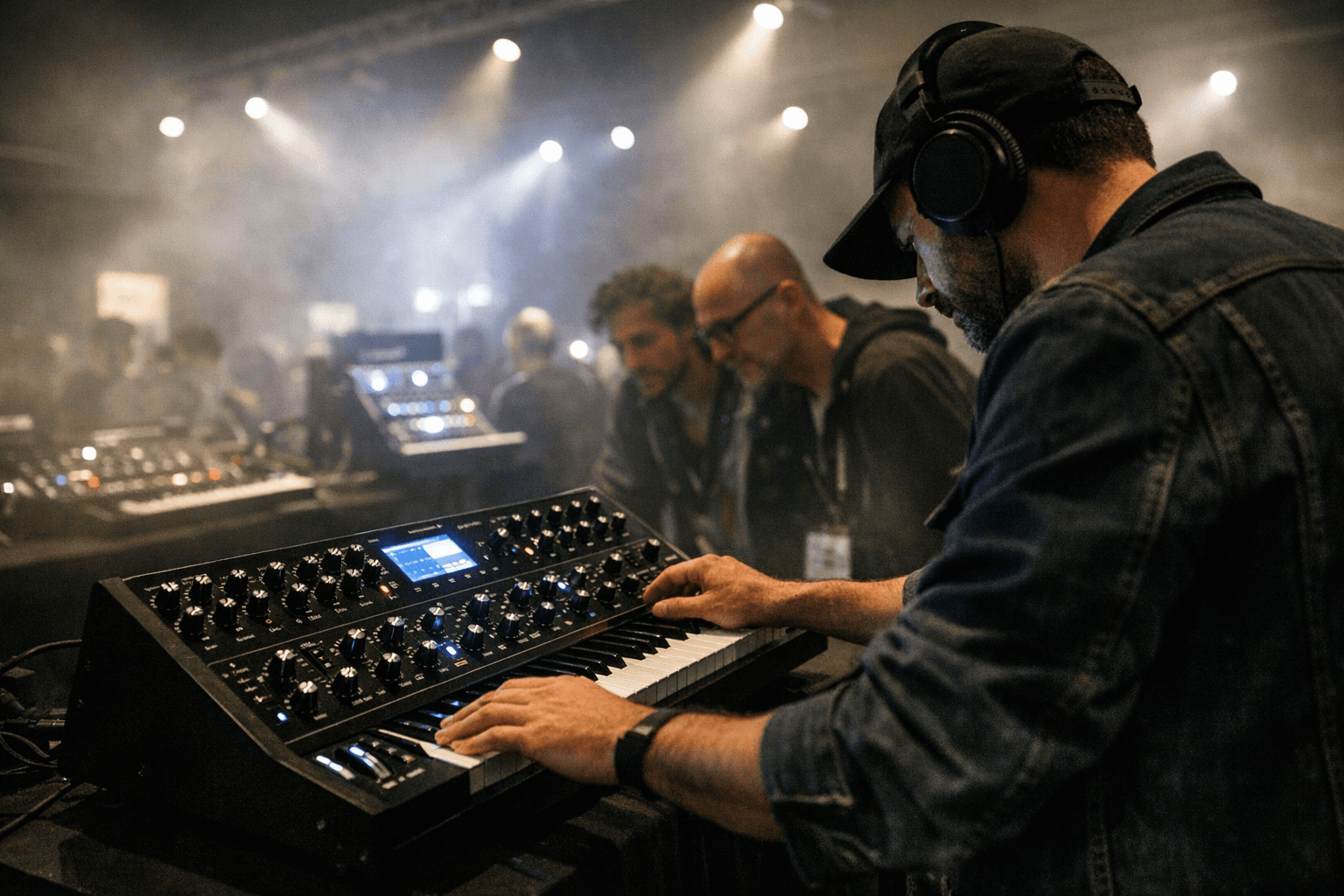
Pylobolus did not bring a nostalgia box to Nantes. At SynthFest France 2026, the French builder unveiled Alkove, a desktop 12-voice binaural hybrid synthesizer that feels rooted in the polysynth era while pushing hard into modern stereo design.
For vintage-synth readers, the lineage is easy to hear. Alkove carries the large-format ambition of classic polyphonic instruments, but it breaks from the old template by combining analog VCA dynamics, formant synthesis, subtractive synthesis and real-time DSP in a single performance instrument. Pylobolus also describes it as stereo multitimbral, which gives the machine a different goal from the usual one-voice-at-a-time desktop box: it is built to move sound around, layer it and shape its depth as part of the composition.
That spatial idea is the hook. The “binaural” label is not just marketing language here. Alkove is aimed at creating a wide, layered image rather than a flat source, and its published architecture backs that up with VOSIM oscillators, polymorphic filters including Ladder, SEM, SVF and Comb, three DADSR envelopes per voice, MPE support, two synchronized arpeggiators and an integrated effects engine. It can also be set up as up to three independent parts, layered or split, which puts it closer to a miniature performance system than a straightforward synth module.
The new instrument also has a clear family tree. Alkove is the successor to Pylobolus’s earlier prototype, Alkohol, which surfaced at SynthFest France 2025 with a 9x2-voice concept and a binaural stereo idea of its own. Lionel Gély, who previously worked for RSF and helped develop the preset expander for the Kobol, gives the project a line back into French synth history that vintage fans will recognize immediately.
Early reaction has focused on the look as much as the engine. Gearnews described Alkove as striking-looking and singled out its unusual interface, while community discussion around the prototype has lingered on how much the design has matured. That matters, because the most interesting new instruments rarely win on spec sheets alone. They win when the layout, the sound engine and the musical intent all point in the same direction.
SynthFest France ran April 17-19 in the Nantes area, with the show’s raffle alone carrying more than €22,000 in prizes and 2,500 tickets. In that crowded boutique-synth environment, Alkove stood out because it did more than promise another flavor of analog tribute. It treated the vintage poly idea as a starting point, then rebuilt the concept around stereo space, hybrid synthesis and a very modern sense of instrument design.
This article was produced by Prism’s automated news system from verified source data, official records, and press releases, then run through automated quality and moderation checks before publishing. The system is built and supervised by the people who set the standards it runs under. Read our full AI policy.
Did this article answer your question?