Recreating Vintage Synth Sounds With Intentional Imperfections and Drift
The "old" sound isn't warmth: it's modulation and bandwidth limits. Here are 5 copy-paste vintage tone recipes ready in 10 minutes.
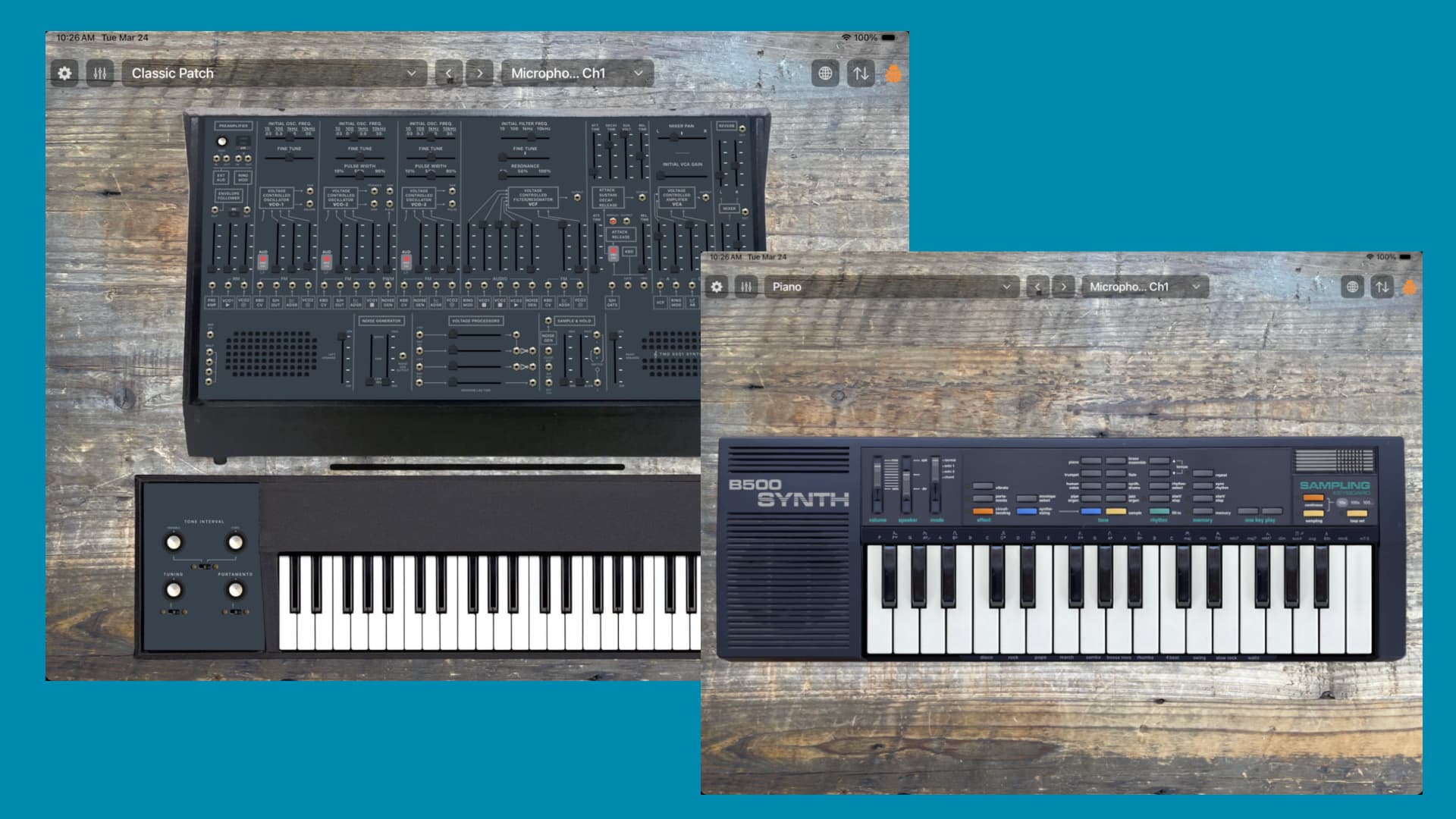
The Counterintuitive Secret Behind Every Vintage Synth Tone
Here is the single most disorienting thing you will learn in this guide, and the reason to share it with every synth friend you have: vintage synthesizers do not sound "warm" because of some magical analogue warmth fairy. They sound the way they do because of bandwidth limits, modulation instability, component tolerances, and outright noise. Chasing "warmth" as a destination is a dead end. Chasing controlled imperfection is the recipe that actually works. That reframe changes everything about how you build patches.
The practical framework below breaks down what Rory Dow mapped out in a long-form Sound On Sound workshop into five specific processing chains you can replicate on any modern hardware or software synth in roughly ten minutes each. Every recipe uses a before/after structure so you can hear the transformation as you work.
Recipe 1: Oscillator Drift (The "Slop" Foundation)
*Before:* A single sawtooth wave, waveform reset enabled, perfectly in tune. Clinical. Sterile. Immediately modern-sounding.
*After:* Disable waveform reset on your oscillator so the phase starts from a random point with each new note. Add a slow LFO, set to triangle wave, routed to overall pitch. Keep the rate extremely low, somewhere around 0.1–0.3 Hz, and the depth subtle, no more than 3–5 cents. Critically, make the LFO global rather than per-note so that every voice drifts together as a single organism rather than each note doing its own independent wobble. Sequential named their dedicated parameter for this "Slop," which is as accurate a description as any.
- Set LFO rate: 0.1–0.3 Hz
- Depth: 3–5 cents maximum
- Waveform: triangle or random (S&H for a grittier instability)
- Global LFO, not per-voice reset
The result is subtle but immediately recognizable. Play a chord and hold it; you will hear the pitch relationship between voices slowly breathe.
Recipe 2: Per-Voice Detune for Analogue Unison
*Before:* Two sawtooth oscillators, perfectly tuned in unison. No movement between them.
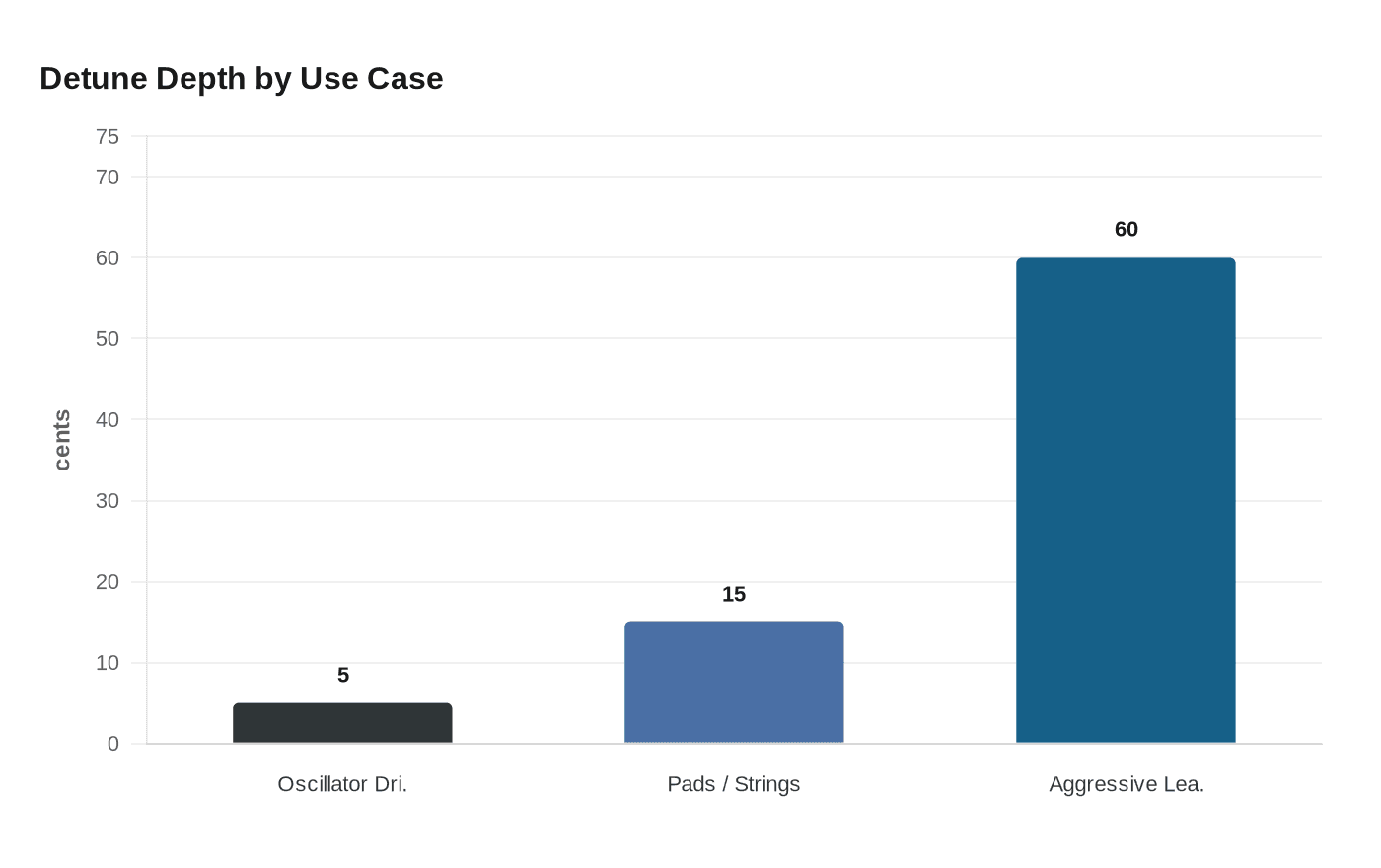
*After:* Detune the second oscillator by 5–12 cents. If your synth has a unison or voice-stack mode, apply small incremental detuning across voices, keeping the spread asymmetrical rather than mathematically even. Detuning oscillators against each other by 40–60 cents works for aggressive leads, but for pads and strings, tighter intervals of 5–15 cents produce the slower, undulating beating pattern that defined 70s polysynths. Add a second, independent slow LFO per oscillator with a slightly offset rate to prevent the modulation from ever falling into a predictable cycle.
- OSC 1: base pitch, no LFO
- OSC 2: +7 to +12 cents, independent slow LFO at 0.15 Hz
- OSC 3 (if available): -5 cents, LFO at 0.2 Hz
- Waveform reset: off on all voices
This is the patch foundation for almost every classic string machine and polysynth pad from the 1970s.
Recipe 3: Filter Drive and Time-Variable Cutoff
*Before:* Clean filter, cutoff set and static, resonance moderate, zero saturation.
*After:* Insert soft saturation or gentle overdrive before the filter input, not after. This is important: pre-filter drive thickens harmonics before they enter the frequency-shaping stage, mimicking how older filter circuits responded to hot signal levels. Adding tiny amounts of noise to the resonance while routing a triangle or random LFO to cutoff frequency destabilises the filter in the way vintage resonant peaks actually behaved. Add a slow envelope with a moderate attack (80–200ms) on filter cutoff to simulate the thermal response lag of older components.
- Drive/saturation: pre-filter, 10–20% gain
- Noise mod to resonance: very subtle, -2 to +2%
- LFO to cutoff: triangle, 0.2 Hz, ±3–8% depth
- Filter envelope: slow attack 80–200ms, moderate sustain
The envelope snap, or lack of it, is what separates a modern filter from a vintage one. Old filters didn't spring open instantly.
Recipe 4: Envelope Snap Control (Attack Transient Shaping)
*Before:* Sharp, fast attack on both amplitude and filter envelopes. The note appears immediately and brightly.
*After:* Vintage hardware, particularly early polysynths, had envelope generators with measurable response lag caused by capacitor charge times and op-amp slew rates. You replicate this by softening the attack on the amplitude envelope to 5–20ms rather than zero, and by adding a very slight curve to the attack stage if your synth allows it. For the filter envelope, push the attack to 15–40ms and reduce the sustain level slightly to suggest a component that never quite reaches its target before beginning its decay. The resulting transient is rounder, less assertive, and far more period-accurate.
- Amp envelope attack: 5–20ms (not zero)
- Filter envelope attack: 15–40ms
- Filter envelope decay: 200–400ms
- Slight velocity sensitivity on filter depth for organic variation
This single adjustment transforms aggressive modern pads into something that feels like it was recorded to tape in 1977.
Recipe 5: Chorus and BBD-Style Modulation
*Before:* Dry signal, full stereo, no modulation effects.
*After:* BBD (bucket-brigade device) circuits, used in chorus pedals and onboard effects units across 1970s and 80s polysynths, introduced a characteristic widening and movement that became as much a part of those timbres as the oscillators themselves. To replicate it, use a chorus plugin or send with a short delay time in the 5–25ms range, modulation rate between 0.3 and 0.8 Hz, and depth kept subtle enough that the pitch variation never becomes obvious as vibrato. Two-voice chorus sounds more authentic than four-voice for most vintage applications. Crucially, roll off the high end of the wet signal above 8–10 kHz: BBD circuits applied a low-pass filter at their output to smooth the stepped signal, which inherently cut high-frequency content and contributed significantly to the rounded, non-sparkly top end that defines the vintage character.
- Chorus delay time: 8–18ms
- Modulation rate: 0.3–0.6 Hz
- Depth: subtle (avoid audible vibrato on wet signal)
- High-cut on wet signal: 8–10 kHz
- Mix: 40–60% wet
Recipe 6: Bandwidth Limiting and High-End Rolloff
*Before:* Full-range signal with extended top end. Sounds crisp, modern, and clean.
*After:* This is where the most counterintuitive takeaway lives. EQ-ing and filtering to roll off the high end is one of the most effective steps in adding vintage flavour, alongside recording to analogue media and using simple sequencer or chord memory approaches. A gentle low-pass filter set around 8–12 kHz on the master bus, combined with a subtle high-pass around 40–60 Hz to reduce subsonic content, transforms the spectral footprint of a modern synth patch into something that reads as period-accurate. You are not adding warmth; you are removing the extended bandwidth that old gear simply could not reproduce.
- Master high-cut: 8–12 kHz, gentle slope (6–12 dB/oct)
- High-pass: 40–60 Hz to remove infrasonic content
- Optional: gentle 2–4 dB boost around 200–400 Hz to suggest tape saturation
Recipe 7: Aliasing and Sample-Rate Artifacts as Texture
*Before:* Clean digital waveforms, full sample rate, no artifacts.
*After:* Early digital synthesizers and samplers operated at sample rates well below the 44.1 kHz that became standard, and the aliasing that resulted became part of their sonic identity. Some modern synths include a "lo-fi" or sample-rate reduction mode; set it to simulate 22–32 kHz if you want the characteristic graininess of early-80s digital without going fully degraded. A small amount of white noise mixed into the signal, at -30 to -40 dB relative to the main signal, adds the noise floor of older equipment without being consciously audible.
- Sample-rate reduction: 22–32 kHz equivalent
- Noise floor: white noise at -30 to -40 dB
- Optional bit-depth reduction: 12–14 bit for harder digital grit
The Before/After Framework in Practice
The most productive way to use these recipes is to build a patch clean first: single oscillator, no effects, flat EQ, snappy envelopes. Play it back and commit that sound to memory or a recording. Then apply each recipe step in sequence, bouncing or recording after each change. The cumulative effect of all seven layers applied simultaneously tends to be dramatic enough that individual contributions become hard to isolate; working step by step reveals what each processing chain is actually contributing.
Modern synthesizers increasingly include dedicated parameters for vintage behavior, from disabling waveform reset to oscillator slop controls, making these techniques easier to apply than ever, but the underlying principle works on any synthesis platform. The fundamentals translate directly from hardware to software to modular.
The central lesson holds across all of it: the old sound is modulation and bandwidth limits, not warmth. Chase the imperfection, not the adjective.
This article was produced by Prism’s automated news system from verified source data, official records, and press releases, then run through automated quality and moderation checks before publishing. The system is built and supervised by the people who set the standards it runs under. Read our full AI policy.
Did this article answer your question?