Supercritical Synthesizers Adds Free Polyphonic Sequencer to Redshift 6 Firmware
Firmware 1.6 gives Redshift 6 owners a free 32-step polyphonic sequencer and eight global macros, making a complete track sketch possible without touching a DAW.
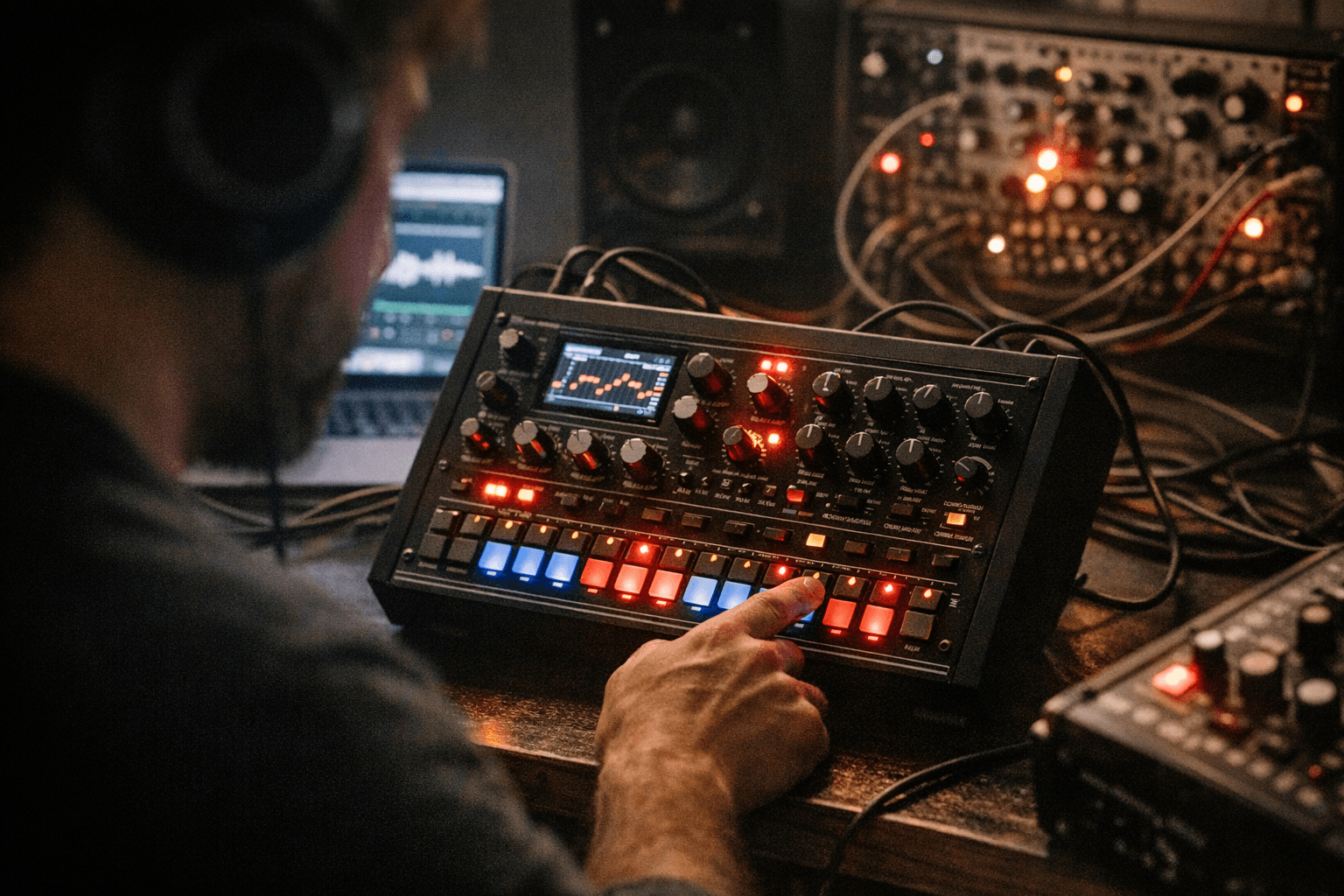
Supercritical Synthesizers shipped Firmware 1.6 for the Redshift 6 on March 30, and the update does something that price tags usually accomplish: it fundamentally expands what the instrument can do. The headline addition is SEQ: POLY, a 32-step polyphonic sequencing engine that supports up to six-voice polyphony per step, and it is free for all existing owners.
The technical scope of SEQ: POLY is considerable. Each multitimbral part of the Redshift 6 gets its own sequencer, meaning that in multitimbral mode, up to six independent 32-step polyphonic sequences can run simultaneously. For a desktop analog polysynth already carrying 16 oscillators per voice, that is a compositional density that previously required a dedicated hardware sequencer or DAW automation to approximate. Writing a full track sketch, bassline through chord voicing through melodic lead, can now happen entirely on the hardware.
The second headline feature is the new Macro page, which exposes eight global macros as assignable modulation sources. Each macro can be routed through the modulation matrix or mapped directly to a performance control, and three configurations in particular illustrate what the system makes possible for live players.
For a vintage drift effect, assign a single macro to control oscillator detune depth across multiple voices simultaneously; one knob turn introduces the pitch instability that modular setups require multiple CV sources to replicate. A PWM sweep macro works cleanly by routing one macro to pulse width modulation rate and depth together, turning a single gesture into the kind of animated pad motion that previously demanded separate LFO programming on each part. The most harmonically complex option is a filter-and-FM morph: one macro sweeping filter cutoff while simultaneously modulating FM depth produces a characteristic formant-shifting quality that sits between analog warmth and digital aggression, especially with Drive now added as a modulation destination in 1.6.
Before updating, close every MIDI application running on the host computer. Supercritical's release notes flag serial and USB driver conflicts as the primary source of failed installs across Windows, macOS, and Linux, with the troubleshooting section written platform by platform. There is no rollback package mentioned in the release notes, which makes backing up the current patch library before proceeding mandatory rather than optional.
The update also delivers MIDI clock stability fixes, new factory presets, and several UI refinements. Synth makers who continue shipping substantive firmware updates well after the original sale are doing something the vintage market has always rewarded retroactively: building instruments that appreciate in capability rather than depreciate in usefulness. The Redshift 6 is a younger machine, but 1.6 makes a strong case that its most interesting chapter may still be ahead.
Know something we missed? Have a correction or additional information?
Submit a Tip