Synth-80 recreates Roland’s MKS-80 Super Jupiter with deep modeling
Synth-80 aims at the Rev. 4 MKS-80 Super Jupiter, using more than 100 measurement routines and editor-librarian tools for the original rack.
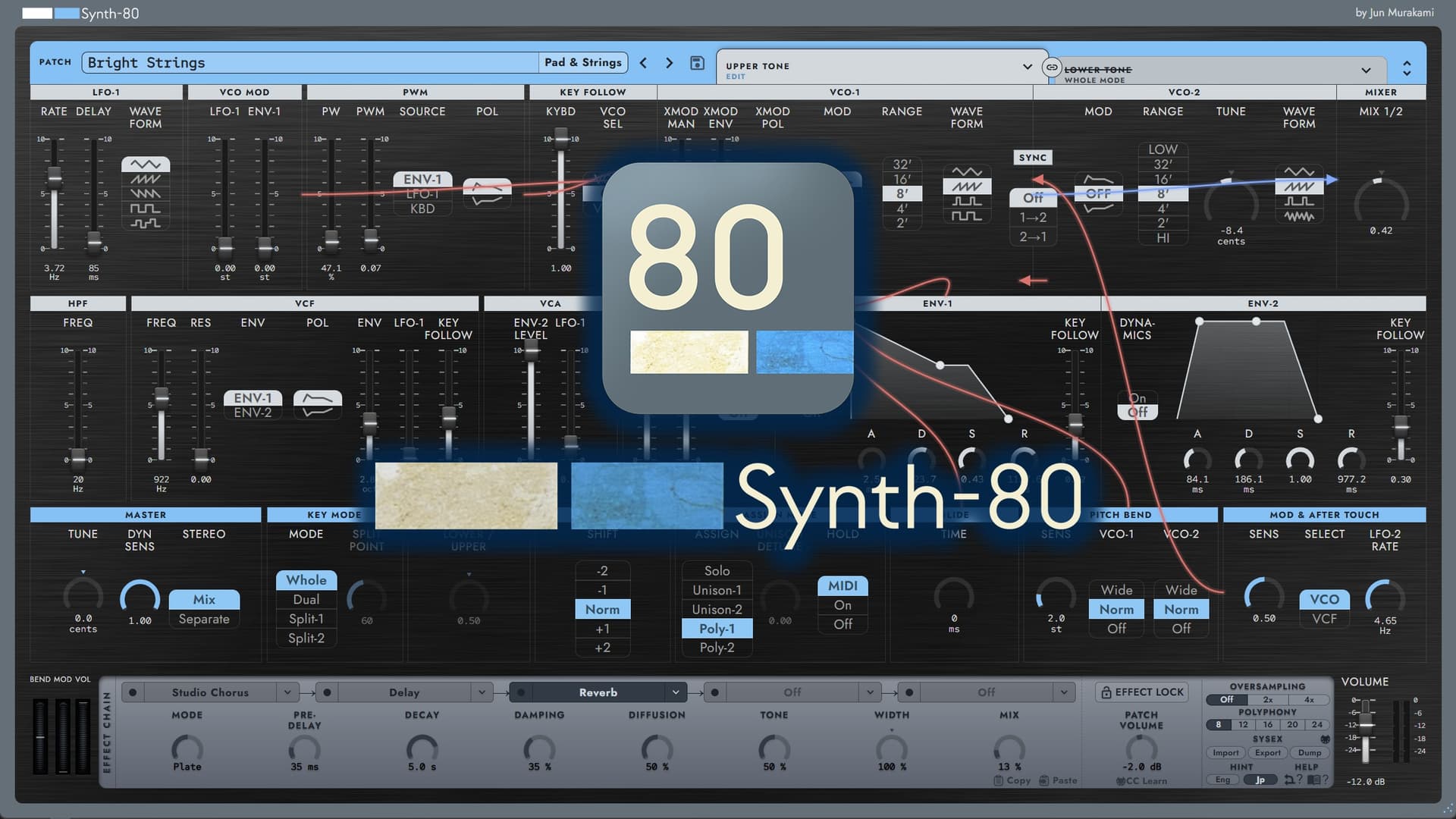
Jun Murakami’s Synth-80 landed as a software recreation of Roland’s MKS-80 Super Jupiter, and the pitch is aimed straight at players who care about the original rack’s pedigree rather than another wave of retro wallpaper. Roland places the MKS-80 in the Jupiter line alongside the Jupiter-6, with the Super JUPITER arriving in 1984, and vintage references put the run at 1984 to 1987 with an original U.S. list price of $2,495.
That history matters because the MKS-80 was not just another poly module. It was an 8-voice analog rack synth that sits in the narrow space between Jupiter-6 and Jupiter-8 thinking, and the Rev. 4 version in particular has its own following for a reason: CEM3340 oscillators, IR3109 filters, and CEM3360 VCAs. Rev. 5 moved to Roland’s own IR3R03 oscillators and IR3R05 combination filter and VCA chips, so an emulation built specifically around Rev. 4 is making a clear choice about which corner of Roland history it wants to preserve.

Synth-80 is built with that kind of specificity. Murakami said the instrument was modeled with more than 100 automated measurement programs that covered the original hardware’s circuits and parameters, with DSP tuning informed by long-term analysis of an actual MKS-80 Rev. 4 unit. That is the sort of heavy-lift modeling that vintage-synth users notice fast, because it suggests a focus on behavior and response, not just a nameplate and a nice preset bank.
The workflow looks tuned for people who like to see what the machine is doing. The interface keeps all parameters on one screen and uses hover-based highlighting to show signal-flow connections, while the package also includes a separate Synth-80 FX plug-in with four chorus models, reverb, delay, EQ, and compression. It ships with more than 150 factory presets and runs in Standalone, VST3, AU, and AAX formats.
For owners of the real rack, the most practical angle may be the editor-librarian side. Synth-80 can handle patch bulk dumps, bank building, and parameter exchange for the MKS-80, and Roland’s support archive still hosts factory patch files for the synth. A browser-based WebAssembly version can also be auditioned against recordings of the original hardware, which keeps the comparison honest. At $59 until July 7, 2026, before returning to $99, Synth-80 is positioning itself as a working tool for a rare, serviced-at-your-own-risk classic, not just a nostalgic badge.
This article was produced by Prism’s automated news system from verified source data, official records, and press releases, then run through automated quality and moderation checks before publishing. The system is built and supervised by the people who set the standards it runs under. Read our full AI policy.
Did this article answer your question?