Imperial Knights guide unveils honour-bound houses, painting, and first buys
Imperial Knights are the rare army that asks you to paint fewer models, but every one is a centerpiece. Here’s who should start now, and how to begin without wasting money.
Should you start Knights now?
Imperial Knights are one of those armies that looks simple from a distance and gets more interesting the closer you get. You are not buying a normal combined-arms force here. You are buying a tiny roster of towering engines, each one carrying a huge chunk of the army’s identity, table presence, and hobby workload. That is the tradeoff: fewer models, far more impact, and a playstyle that feels very unlike most Imperium forces.
If that sounds appealing, Knights are a smart army to start now. If you want a broad toolbox, lots of infantry, and a forgiving pile of spare units, they will probably bounce off you. But if the idea of fielding a handful of massive centerpiece models, painting heraldry, and leaning into a feudal, chivalric war machine fantasy sounds exciting, Knights are exactly the kind of army that rewards commitment.
What Imperial Knights actually are
The faction’s story starts long before the Imperium, when human scouting and colonisation fleets left Terra in the Dark Age of Technology. Those expeditions were given Standard Template Construct designs for bipedal walking machines to help them cross hostile terrain, move raw materials, and defend fragile colonies. Over time, those machines became the hereditary Knight Houses of the 41st millennium, tied to noble bloodlines, duty, and inherited responsibility.
That history matters because Knights are not just big robots. They are feudal machines bonded to pilots through the Throne Mechanicum, the arcane interface that links noble and engine. The result is a faction defined by houses, oaths, lineage, and sacrifice as much as by armour plating and volcano lances. They fight like towering engines of destruction, but the soul of the army is still a story about who sits in the cockpit and what that family owes the wider Imperium.
How they play on the table
Knights have a very unusual battlefield rhythm. You are usually activating far fewer units than the average army, but each one is fast, hard-hitting, and hard to ignore. Warhammer Community describes them as having an almost impossible combination of speed and grace for their size, which is exactly why they feel so different from other Imperial armies.
That unusual profile is part of the appeal. You spend less time managing chaff and more time making every move matter. A mistake with a Knight is expensive in points and in momentum, but a good turn with one can dominate space in a way that infantry-heavy armies simply cannot. If you like decisive movement, target priority, and the feeling that every model on the board is a star, Knights deliver that in spades.
They also have a useful support role outside a full Knights army. Games Workshop says Imperial Knights can be taken as allies in other Imperium forces for extra firepower, so a single big engine can become a dramatic centerpiece in a Space Marines or other Imperium collection without forcing you into a full household right away.
The easiest way in
If you want the cleanest entry point, start with Combat Patrol. Imperial Knights gained a Combat Patrol in White Dwarf 509, and that format uses a pair of Armigers as an elite beginner force. That is a strong signal about how the army works at small scale: even your “starter” force still feels imposing, but it is much less intimidating than jumping straight into a full Questoris-heavy build.
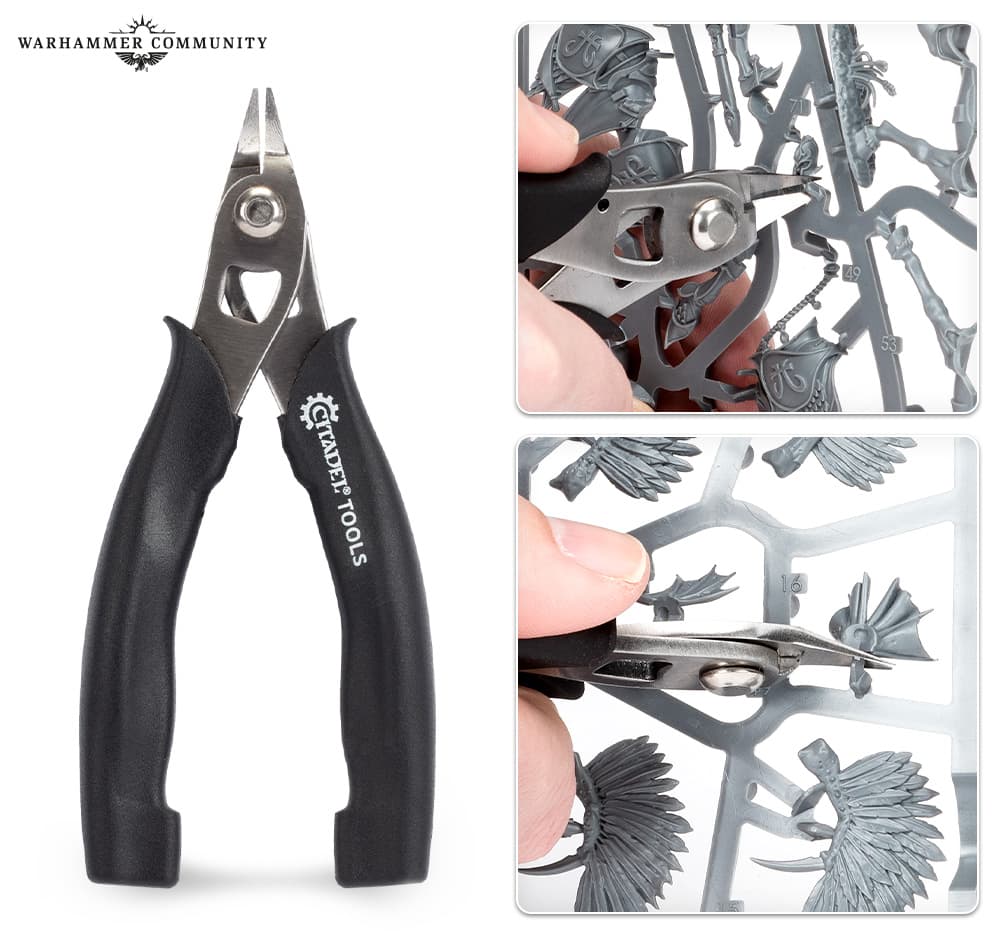
Combat Patrol is also the official fast lane for learning the game. Warhammer’s rules describe it as the quickest and simplest way to start collecting and playing Warhammer 40,000, with games typically lasting up to one hour. For Knights, that matters more than usual, because a low-model army can otherwise feel like a lot of money and commitment before you have even rolled a dice. A pair of Armigers gives you a playable beginning without asking you to paint a giant centerpiece first.
What to buy next
The current Knight Questoris kit is the real keystone purchase. It builds one of six configurations, including the Knight Defender, which gives you flexibility if you want to commit to the faction without locking yourself into one exact battlefield role on day one. That kind of modularity is helpful in an army where each kit carries so much weight, because you want your first big buy to stay relevant as your collection grows.
The practical route is simple: 1. Start with the Combat Patrol if you want the lowest-friction way to learn the army. 2. Add a Knight Questoris kit once you know you enjoy the faction’s rhythm. 3. Expand into more Armigers or other Knights depending on whether you want more board control or more centerpiece power.
That path keeps you from overbuying too early. Knights can get expensive fast because each model is large and visually complex, so the smartest plan is to build in stages rather than trying to buy an entire household in one go.
Why painting Knights is rewarding, and why it scares people
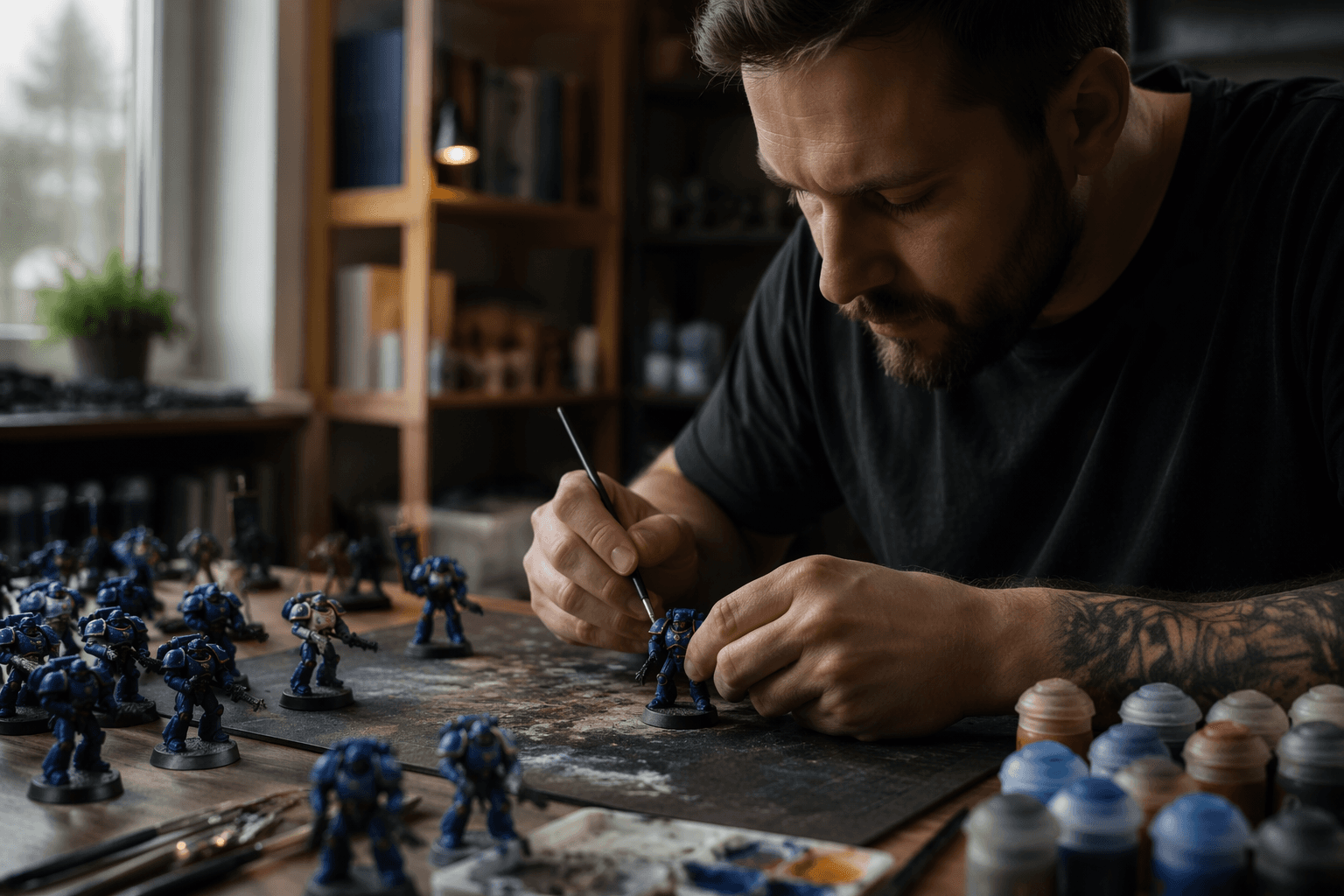
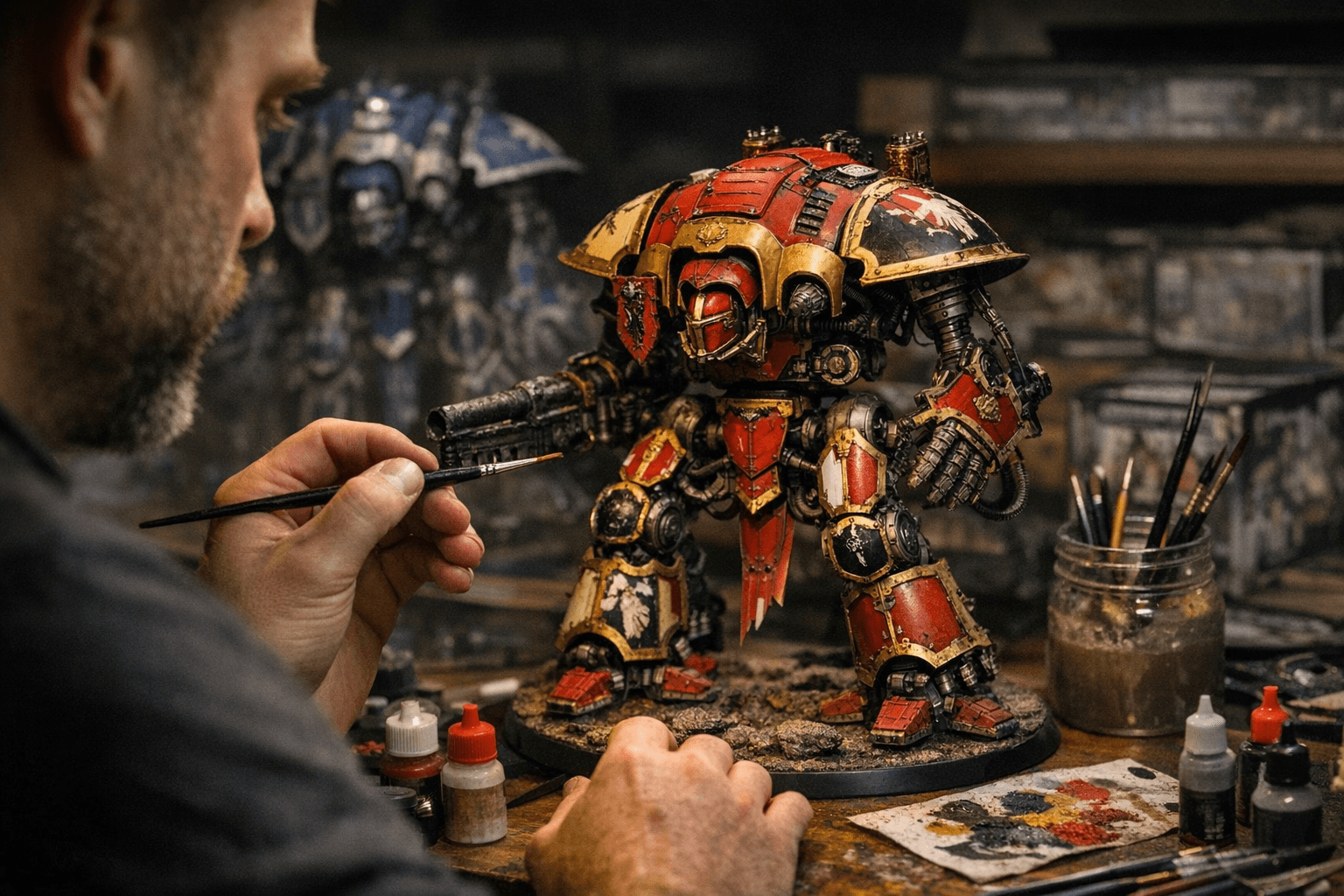
Knights are intimidating on the hobby desk for a reason. These are not quick troop boxes. The panels are large, the details are prominent, and every mistake is easy to see because there is nowhere for the eye to hide. At the same time, that is exactly why they are so satisfying. One well-painted Knight can look like a trophy piece, and a small army can feel more impressive than a much larger force.
This is where the faction really separates the patient painter from the casual batch-painter. You do not need to flood the army with endless rank-and-file work. You need to decide on a scheme, commit to it, and make each machine look like it belongs to a specific house. That is why Imperial Knights are so good for hobbyists who enjoy centerpiece projects and visual storytelling. Every model matters, and every coat of paint lands harder because the model is so large and so exposed.
The lore and iconography that make them click
If you care about heraldry, Knights are one of the richest Imperial factions you can pick. White Dwarf 523 includes an extensive guide to the heraldry of House Terryn and House Taranis, which tells you exactly where official support is heading: not just “big robots,” but named dynasties with distinct visual identities. That is a major part of the faction’s long-term appeal, because it gives you a reason to build, paint, and narrate your army as a household rather than a random pile of engines.
The new codex support only sharpens that feeling. Warhammer Community updated the Imperial Knights index on 18 June 2025, and later in 2025 published Codex: Imperial Knights, a 112-page book with datasheets, Detachments, lore, art, miniature photography, and Crusade rules. The Freeblades get special attention there, and the Crusade rules let your pilots progress through Chivalric Quests, with an Armiger pilot potentially rising to a full Questoris Knight in exceptional cases. That is exactly the sort of narrative ladder that makes Knights feel like a living household instead of a static list.
Who will love Knights, and who will hate them
You should start Knights if you like low model count armies, dramatic centrepiece hobbying, and a battlefield style built around pressure, movement, and big decisions. You will probably love them if you enjoy painting heraldry, personalizing house colours, and seeing your army look finished fast because each model pulls so much visual weight.
You should think twice if you want lots of units to tinker with, if you dislike large kits, or if you want a cheap entry into 40k. Knights are not a budget army, and they are not an easy army to hide mistakes on. But if you want an elite force that feels honour-bound, brutal, and unmistakable from across the table, Imperial Knights are still one of the most compelling ways to start collecting Warhammer 40,000.
This article was produced by Prism’s automated news system from verified source data, official records, and press releases, then run through automated quality and moderation checks before publishing. The system is built and supervised by the people who set the standards it runs under. Read our full AI policy.
Did this article answer your question?