Third Edition Deathwatch Rules Show How Modern 40K Took Shape
The original Deathwatch rules were tiny, scrappy, and packed with ideas that still define the faction. Modern 40K’s elite xenos hunters started as a Chapter Approved experiment.
The 2003 seed of a modern kill-team
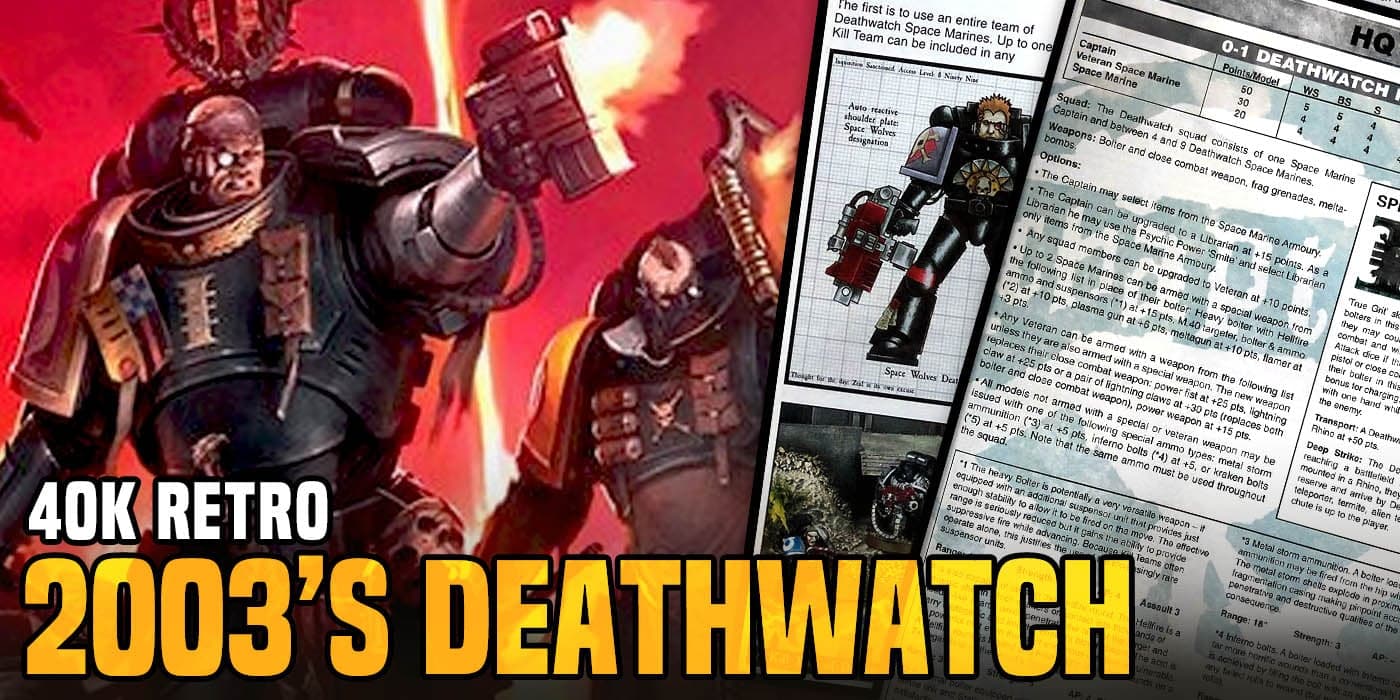
The original Deathwatch rules show just how much of today’s 40K was built in the margins before it was ever locked into a codex. What looks like a fully realized elite faction now began as a compact, experimental rules package in the 2003 Chapter Approved, Book of the Astronomicon era, and that small start says a lot about how the game was changing around it.
This was third edition territory, the period when Warhammer 40,000 settled into the company-level miniature battle game most players recognize today. The shift away from the older, more skirmish-RPG-adjacent feel did not happen all at once, and Deathwatch is a clean example of that transition in motion.
Why Chapter Approved mattered so much
Chapter Approved was more than a side column. It was a regular White Dwarf outlet for officially approved background and rules material, which made it one of the main places where the Warhammer 40,000 design team tested ideas in public. The 2003 compilation, subtitled The Third Book of the Astronomicon, gathered some of the most important developments from that magazine-era flow of content.
That matters because the early 2000s hobby scene was being shaped by a very specific kind of pipeline. Goonhammer has described Chapter Approved in that period as a tool used by Andy Chambers, Andy Hoare, Phil Kelly, Pete Haines, and Gav Thorpe to introduce new ideas, answer rules questions, publish errata, and trial rule changes. In other words, it was not just a home for leftovers or curiosities, but a place where Games Workshop could test what would eventually harden into canon.
What the original Deathwatch actually looked like
The 2003 Deathwatch material was tiny compared with the faction identity players know now. Rather than a standalone army concept, it worked as a very small-scale addition to a Space Marine force, with a kill-team or even individual veterans attaching to a chapter after they had served the Watch and returned home. That structure is important, because it shows Deathwatch first as a role and a mission, not yet as the fully separate military machine it later became.
Even at that early stage, the core fantasy was already visible. The article highlights special issue ammunition as one of the defining hallmarks, alongside the image of these warriors as the elite of the elite. That sense of hyper-specialized anti-xenos violence is the thread that runs through every later version of the faction, from lore to tabletop identity.
The old rules also carried the sort of flavorful oddity that made third edition-era design so memorable. The heavy bolter suspensor option, along with the small-unit format itself, is a good example of how evocative the rules could be even when they were not the most efficient choice on the table. That is a key part of the appeal here: the original Deathwatch were not polished to the sharp, modern faction profile players know today, but they were already doing the conceptual work.
What was preserved, and what changed
The most striking through-line from 2003 to now is the basic premise: veteran Space Marines gathered from across the Chapters to fight a specific alien threat. Warhammer Community now describes the Deathwatch as veteran warriors drawn from many Chapters, stationed in hidden watch fortresses under the Long Vigil, and serving as the Chamber Militant of the Ordo Xenos. That is a much broader and more defined institutional identity than the original material had, but the core idea is still the same.
What changed is scale and certainty. The early version feels like a design sketch, with narrative fragments and rules experiments laying the groundwork for a later faction. The modern version has a fully articulated purpose, a clearer organizational role, and a stronger place inside the wider Imperium’s machinery of war.
That evolution is visible in the weapon profile too. Lexicanum’s current background on the Infernus heavy bolter describes it as a Deathwatch-only specialized combi-weapon that merges a heavy bolter and a heavy flamer, with suspensors used to offset the weight. That is exactly the kind of high-tech, brutally specific anti-xenos gear the 2003 rules were already hinting at, only refined into a more distinct and recognizable signature.
What the early rules preserved about the faction’s identity
The old material did something important that still defines Deathwatch today: it made them feel like specialists first and line troops second. A kill-team built from veterans, deployed for a narrow purpose, communicates precision, experience, and a willingness to leave home Chapter loyalties behind for a larger war. That is the emotional core of the faction, and it was already present in the earliest rules framing.
It also established the faction’s tone. Deathwatch were not just “Space Marines with better gear.” They were the rarest kind of problem-solvers, the people called in when the Imperium wanted an xenos threat erased with maximum discipline and minimum noise. The special issue ammunition, the suspension hardware, and the tight squad format all reinforced that story in practical table-top terms.
What was lost along the way
Some of the charm of the original Deathwatch sits in how provisional it all felt. Third edition and Chapter Approved were full of ideas that could be experimental, weirdly specific, or slightly inelegant, and that gave the faction a handmade quality. As Deathwatch matured into a dedicated army and a more fully codified part of the setting, some of that loose, magazine-column energy naturally disappeared.
That tradeoff is familiar across 40K’s history. The game gained clarity, identity, and cleaner faction boundaries, but it also left behind a little of the improvisational feel that came from rules being trialed in print before they had a permanent home. Deathwatch are a perfect case study because they retained the flavor while shedding the rough edges that made the early version feel so distinctly third edition.
Why this still matters to 40K now
The real lesson of the 2003 Deathwatch material is that modern 40K did not arrive fully assembled. It was assembled piece by piece through White Dwarf columns, Chapter Approved articles, trial rules, and background fragments that gave the hobby room to evolve in public. Deathwatch, in that sense, are not just a faction history story. They are evidence of how the whole game learned to build its future.
That is why this old material still lands. It shows a recognizably modern faction being assembled from test pieces, and it shows Games Workshop using its magazine-era ecosystem to shape the game players know today. Deathwatch began as a small, sharp idea in a rules anthology, and the fact that so much of that idea survived tells you how powerful the original concept was.
This article was produced by Prism’s automated news system from verified source data, official records, and press releases, then run through automated quality and moderation checks before publishing. The system is built and supervised by the people who set the standards it runs under. Read our full AI policy.
Did this article answer your question?