Warhammer 40,000 evolved from Rogue Trader’s wild 1987 origins
Rogue Trader launched 40k in September 1987 as a Rick Priestley rulebook, and every later edition reshaped the same brutal core.
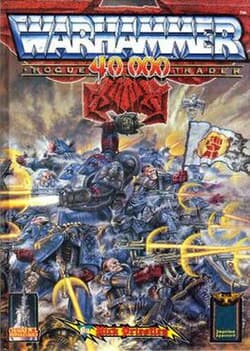
The first 40k players did not meet a polished grimdark empire. They met Rogue Trader, the first core rulebook for Warhammer 40,000, released in September 1987 and written by Rick Priestley. White Dwarf issue 93 carried that launch into the hobby, and the result was a setting that already mixed military sci-fi, gothic excess, black comedy, satire, and over-the-top violence.
Rogue Trader was the game before 40k became a brand
Warhammer 40,000 did not arrive as a fixed aesthetic with every icon already locked in place. The original Rogue Trader rulebook, later referenced as a 286 or 287-page tome, was closer to a sprawling invitation than a sealed canon. It gave the hobby a future war with chainswords, bolters, aliens, mutants, and fanatical humans, yet it still carried the scrappy, anything-goes energy of late-1980s Games Workshop.
The early identity was not just “grimdark” in the modern sense. It was playful in its own warped way, full of black comedy and exaggerated violence, with enough satire to make the Imperium feel absurd as well as terrifying.
White Dwarf 93 is where the launch hit the wider hobby
White Dwarf issue 93 introduced Warhammer 40,000 to readers. White Dwarf was where rules, miniatures, battle reports, and artwork met players who were still trying to understand what this new game wanted to be. The game did not just appear on a shelf and settle in. It arrived through magazine culture, previews, and a first edition that still felt wide open.
Games Workshop’s history and timeline pages fold that moment into a larger company story. They present 40k not as a one-off release from the 1980s but as a long-running setting that has been continuously refreshed. The launch year is still 1987, but the franchise now carries decades of accumulated art direction, fiction, and tabletop design.
The setting became clearer without losing its violence
Over time, Warhammer 40,000 sharpened its visual language. The Imperial side grew more cathedral-like and authoritarian, Chaos became more recognisable as a force of corruption and ruin, and alien factions were given silhouettes that could be identified at a glance. Later editions did not erase the old weirdness, but they made the universe easier to read across miniatures, books, and artwork.
That shift is especially visible in the way Space Marines became the visual face of the franchise. In the early years, they were part of a bigger and stranger landscape. Over time, they became the emblem players picture first, the armoured shorthand for the setting’s scale, power, and relentless warfare. Even now, that image sits beside others that feel equally specific: an Ork mob, a Necron phalanx, a Tyranid swarm, or a Tactical Squad each tells a different story about how the galaxy functions.
Gothic cathedrals, chainswords, bolters, daemon engines, ancient machines, and human fanaticism form the setting’s visual vocabulary.
Why the army on your desk feels like a piece of the setting
An army is more than a gaming list. A 40k force is a miniature diorama of the universe’s ideology, technology, and decay. A Tactical Squad suggests drilled obedience and military order. An Ork mob turns war into riotous excess. A Necron phalanx speaks to ancient, cold persistence. A Tyranid swarm makes the galaxy feel like food.
The rules cycle may change, but the pillars stay intact: the Imperium is oppressive and decaying, Chaos is seductive and catastrophic, and every faction is trapped in endless war.
This article was produced by Prism’s automated news system from verified source data, official records, and press releases, then run through automated quality and moderation checks before publishing. The system is built and supervised by the people who set the standards it runs under. Read our full AI policy.
Did this article answer your question?