AAW online class finishes waterfall burl lidded container project
The second half of AAW’s waterfall burl container class zeroes in on the lid, finial, and finish. If your burl work needs more control and polish, this live session is built for that fix.

The lid is where a natural-edge burl container either comes together or falls apart. In AAW’s online Waterfall Natural Edge Burl Lidded Container, part 2 of a 2-part series, Cindy Drozda takes that critical stage from rough promise to finished form on Friday, May 30, 2026, from 1:00 PM to 4:00 PM Eastern, hosted online through her site. For turners chasing cleaner lidded forms, tighter proportion, and a more convincing final surface, this is the part of the project that matters most.
Why this session matters now
Part 2 is not a standalone demo. It continues a structured build that already established the burl blank, selected and cut the wood to create a balanced natural edge, and fit and finished the contrasting wood pedestal in a collet jam chuck. That foundation matters because waterfall burl work only looks effortless when the shape, grain, and support system are all working together. The second session shifts to the spots where many containers lose their finesse: lid fit, finial proportion, and the finishing sequence that makes the piece read as a deliberate studio object instead of just a turned vessel.
That is why the session should land with you if you are working on lidded containers and want more control over the last stages of the project. Natural-edge burl forms are rewarding, but they demand a sharper eye than a standard hollow form. The lid has to sit right, the finial has to feel intentional, and the finish has to amplify the figure without flattening it.
What Drozda is covering in part 2
AAW says the session will move into shaping and fitting the lid, finial turning, and finishing. Those are the exact areas that decide whether a burl container holds its visual balance. If the lid is too heavy, too flat, or slightly off in proportion, the whole piece starts to feel top-heavy. If the finial is overscaled or underdeveloped, the silhouette loses the refinement that makes this style so strong.
Drozda is also leading attendees through one of her favorite burl coloring methods using transparent dyes. AAW notes that her color process uses alcohol-based dye that penetrates unevenly with the grain, which creates layered color effects instead of a flat surface tone. That matters on burl because the movement in the grain is part of the appeal, and the coloring method is meant to work with that figure rather than cover it up.
The session also includes bleaching to get a more vivid color, plus an exploration of topcoat options. That combination makes this more than a shape-and-go demo. It is a practical finishing clinic for turners who already know burl can be beautiful, but want to control how that beauty reads under final light and sheen.
The workflow behind the project
The appeal of this class is that it treats the container as a complete workflow. In part 1, the burl was selected and cut to produce a balanced natural edge, and the contrasting pedestal was fitted and finished in a collet jam chuck. That setup is important because the base, lid, and finial are not separate problems. They are a single design conversation, and part 2 finishes that conversation.
For turners building confidence with this kind of work, the sequence is the lesson: 1. Establish the blank and natural edge so the burl’s shape feels deliberate. 2. Fit the pedestal cleanly so the lower half supports the form. 3. Shape and fit the lid so the top echoes, rather than fights, the body. 4. Turn the finial with proportion in mind. 5. Finish with color, bleach, and topcoat choices that enhance the figure.
That is the practical value here. You are not just watching a vessel get finished. You are watching how a known demonstrator makes the final design decisions that control the entire read of the piece.
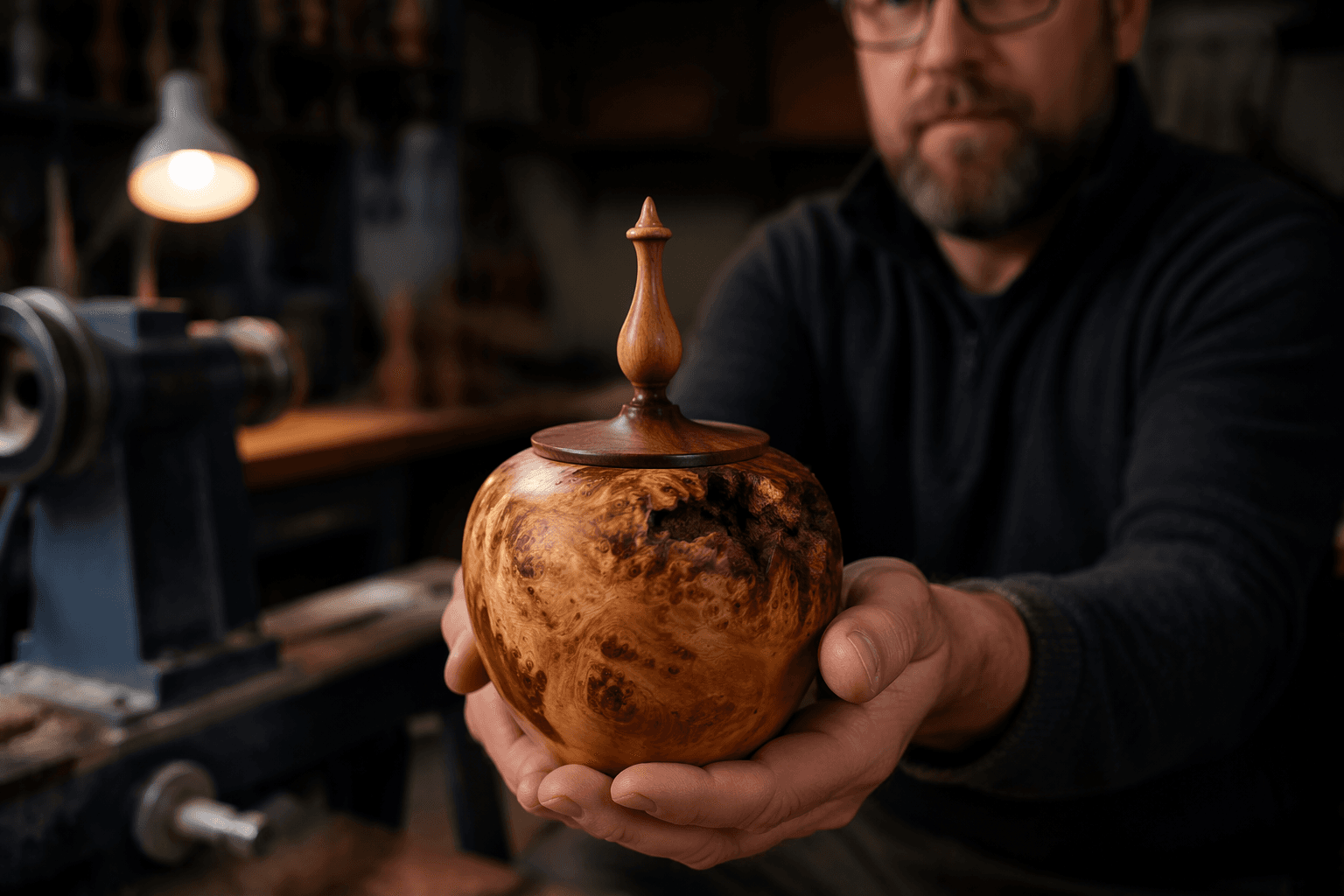
Why Drozda is a fit for this kind of class
Cindy Drozda’s AAW biography describes her as an international demonstrator and teacher. AAW also notes that she is a member of the American Association of Woodturners, the American Craft Council, and two AAW chapters. That combination fits the kind of session she is teaching here: technical, design-driven, and grounded in actual presentation rather than broad theory.
AAW has previously described her as well known for perfectly proportioned finials and elegant forms, and her own site describes her work as “museum quality” lidded finial vessels and urns. That emphasis shows up directly in this project. A natural-edge burl container can carry dramatic figure on its own, but the lid and finial are what elevate it into a more resolved form. If you want to understand why some pieces feel balanced and others feel merely ambitious, this is the territory Drozda works in.
Her site also says she offers live online instruction and downloadable handouts, which helps explain why this remote format works so well for a technique-heavy project. You are not just getting a quick look at the finished piece. You are getting a guided pass through the choices that matter most when you are trying to make the design hold together.
The bigger AAW context
The American Association of Woodturners is a Minnesota nonprofit based in Saint Paul, dedicated to advancing the art and craft of woodturning worldwide through education. AAW says it has more than 13,000 members and over 365 local chapters globally, which gives this class the weight of a broad education network rather than a one-off feature demo. That makes the session part of a much larger push toward remote learning that still feels hands-on and project-based.
It also lands just before another major date on the AAW calendar. The 2026 AAW International Woodturning Symposium is set for June 4 through June 7, 2026, in Raleigh, North Carolina. For turners already tracking the season’s biggest gathering, this online class functions as a timely technical lead-in, especially if burl work, finials, and finishing are on your list of things to tighten up before the symposium rush.
What you should take from the class
If your lidded containers have been close but not quite crisp enough, this is the kind of session that can sharpen your decisions fast. The value is in seeing how a veteran demonstrator handles the exact details that make natural-edge burl work feel controlled: the lid fit, the finial line, the color build, and the final surface. That is where the piece stops being a rough turning and starts reading as a finished form.
For anyone trying to get more authority out of burl, more confidence out of the lid, and more polish out of the finish, part 2 is the point where the whole project either locks in or slips away.
This article was produced by Prism’s automated news system from verified source data, official records, and press releases, then run through automated quality and moderation checks before publishing. The system is built and supervised by the people who set the standards it runs under. Read our full AI policy.
Know something we missed? Have a correction or additional information?
Submit a Tip

