Center driving demystified, the foundation of spindle turning
If a spindle chatters or slips, the first suspect is often the drive center, not the gouge. The right bite, alignment, and tailstock pressure keep long-grain work true.
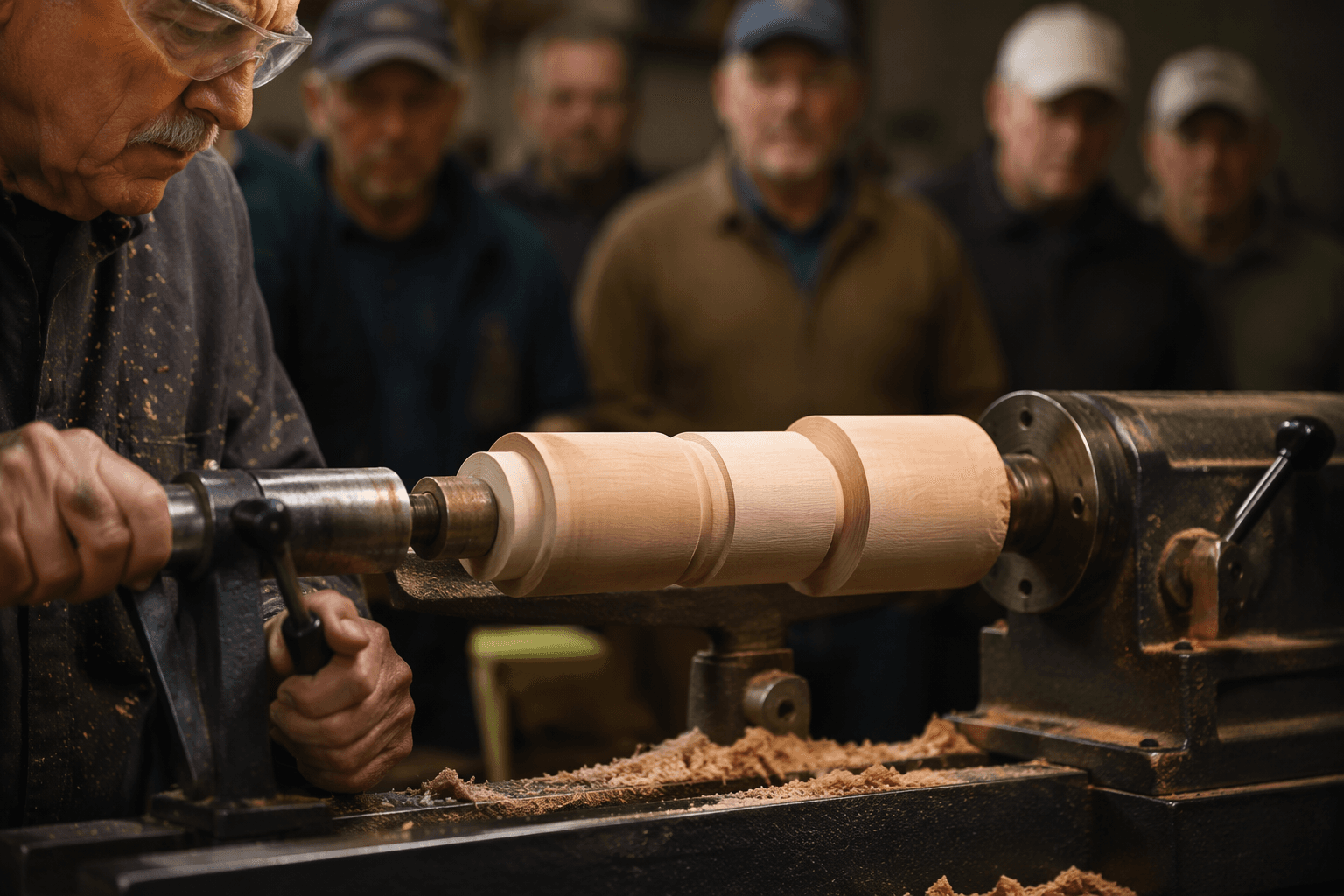
A square spindle blank that still needs to be brought to round will show a bad center drive immediately: vibration, slipping, and cuts that feel harder than they should. The fix usually lives in the setup, not the tool handle, and the fastest way to find it is to check the drive center, the seating, the alignment, and the pressure before you chase anything else.
Why centers still sit at the heart of spindle turning
Woodturning is an ancient craft known to many cultures worldwide. For many hundreds of years leading up to the Industrial Revolution, the foot-powered woodturning lathe was the only woodworking machine in common use. Turning between centers is still one of the most direct ways to put a spindle under control. At its simplest, the method needs a set of centers, a sharp tool, and some means of rotating the work.
That simple setup is why center driving remains so useful on tool handles, candlesticks, rolling pins, chess pieces, chair spindles, and other long-grain work. A center at the headstock transmits torque into the blank, and a supporting center at the tailstock keeps the piece on axis while you rough it down. When that support is sound, the lathe feels calm and predictable. When it is not, the blank tells on the setup immediately.
Choosing the right drive center for the blank
Not every drive center bites the same way, and that is where many problems begin. Spur-style centers grab aggressively and are useful when you need positive drive on rough stock, especially a square blank that still needs to be brought to round. Steb centers are designed to reduce splitting and slippage on some work, which can matter on stock that is more fragile or less forgiving.
Center choice is not interchangeable. The 2020 Woodturning FUNdamentals issue featured “Drive centers... demystified.” A dry, brittle spindle blank does not always want the same bite as a green blank, and a piece that has already been partially trued may need less aggression than fresh rough stock. The practical question is not whether a center fits the lathe, but whether it matches the condition of the wood in front of you.
That variety is visible in the shop marketplace. Woodcraft’s inventory includes a Multi-Tooth Drive Center, a #2 Morse Taper Multi-Tip Live Center Set - 4 Piece, and a 60 Degree Ball Bearing Live Tailstock Center.
Seating, alignment, and pressure are the real test
A center only works well when it is seated cleanly. The drive center needs to bite into sound wood without skating, and the blank has to be mounted so the center line stays true from headstock to tailstock. If the point is off, the spindle begins with a wobble that no amount of confidence at the gouge can erase.
Tailstock pressure is just as important. Too little, and the blank can chatter or slip. Too much, and you can crush fibers, bruise the work, or make the lathe feel like it is fighting itself. The sweet spot is firm support without over-tightening, especially once the piece has been partially turned and the fibers no longer have the same resistance they had in the rough square blank.
A quick shop check can save a lot of frustration:
- Mark the centers accurately before mounting the blank.
- Seat the drive center cleanly so it bites, rather than skids.
- Bring the tailstock up until it supports the work without forcing it.
- Keep the tool rest close enough to control the cut.
- Start at a conservative speed until the blank is running true.
Why center driving still beats the complications of other workholding
Scroll chucks have changed spindle work, but centers still offer a direct, rigid, efficient way to start many jobs. They hold the blank on axis, support long stock while you rough it down, and avoid the extra setup that comes with jaws, mortises, or glue blocks. That simplicity is especially useful when you are turning a long, narrow form where the blank itself is the structure you need to preserve.
Woodcraft’s WoodRiver 60 Degree Ball Bearing Live Tailstock Center can be used for holding a workpiece with a hole from 1/8 inch to 1-1/8 inch in diameter.
The 2015 Woodturning FUNdamentals issue table of contents included “From Green Blank to Lathe.” From the moment a rough blank comes off the saw, centers hold it on axis while you turn it into a spindle.
Safety belongs in the setup, not after the cut begins
AAW’s safety guidance is clear: woodturning safety is your responsibility, and a full-face shield should be used for all woodturning operations any time the lathe is turned on. That instruction fits center driving especially well, because a poorly seated blank or a center that loses grip can turn into a sudden and forceful problem long before the finish cut begins.
The safer habit is to think of the drive center as part of the whole machine setup, not a temporary clamp you can ignore once the lathe starts spinning. If the blank is dry and brittle, if the bite feels uncertain, or if the tailstock pressure is doing more squeezing than supporting, stop and reset before you reach for the gouge.
This article was produced by Prism’s automated news system from verified source data, official records, and press releases, then run through automated quality and moderation checks before publishing. The system is built and supervised by the people who set the standards it runs under. Read our full AI policy.
Did this article answer your question?