Chippewa Valley Woodturners Guild March Newsletter Covers Threads, Lids, and Exotic Woods
Joe Nycz's rare 60° thread-cutting demo headlines the Chippewa Valley Woodturners Guild's March bulletin, paired with a Tibetan cherry wood spotlight and a lidded box series.
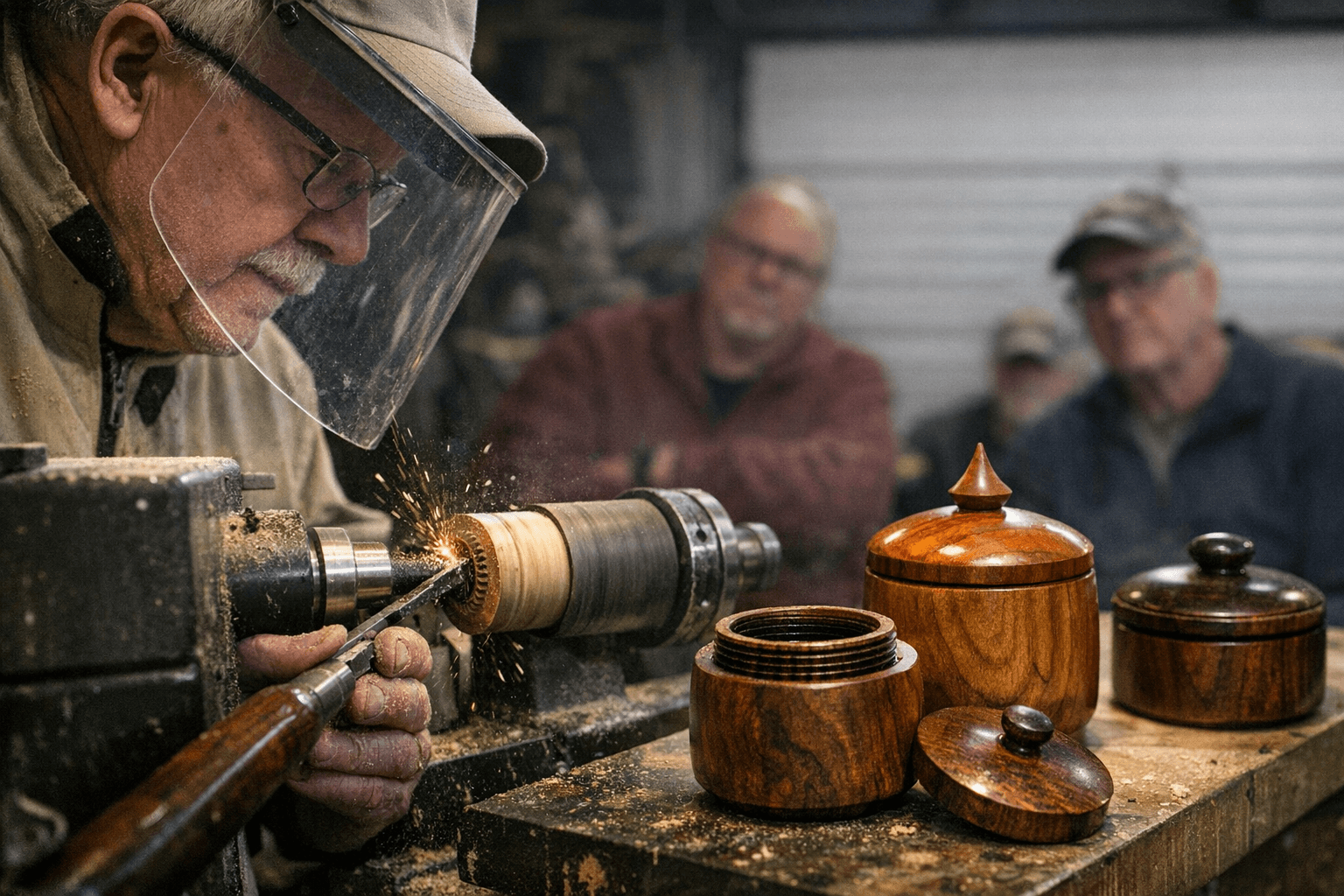
Thread chasing with a 60° cutter is the kind of advanced technique that sends most turners reaching for a bag of threaded inserts instead. Joe Nycz's hands-on demonstration of the method was among the highlights the Chippewa Valley Woodturners Guild documented in its March 2026 bulletin, published April 4 at cvwg.org.
Nycz walked members through the geometry of the 60° included-angle cutter, the same profile used in unified (UTS) and metric (ISO) machine thread standards. In woodturning, that angle is adapted through thread-chasing tools or V-profile cutters, and the technique demands that the turner synchronize tool movement with lathe speed in real time. The payoff is a clean, snug thread profile ideal for lidded box applications, where the fit between lid and body defines the finished piece. Most turners skip thread chasing entirely in favor of friction fits or purchased inserts, which makes a club-level walkthrough like Nycz's a comparatively rare opportunity regardless of where a member sits on the experience curve.
Lidded boxes formed a through-line across the March content. The form demands precise internal and external diameter matching, consistent wall thickness, and, when threaded, the kind of lathe-control discipline Nycz demonstrated. The multi-part structure of the box demo series suggests the guild treated it as sequential curriculum rather than a single session.
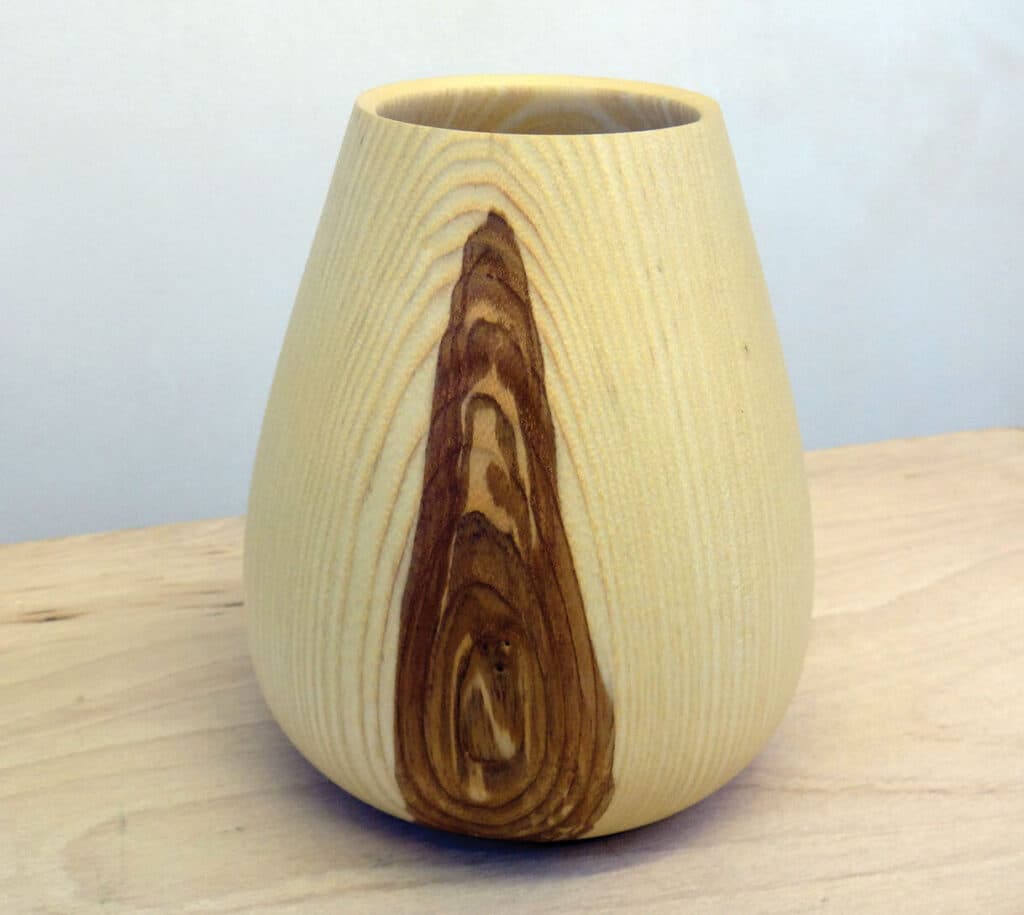
The newsletter also ran a wood spotlight on Tibetan cherry, botanically Prunus serrula, a species native to western China and Tibet. The tree is prized in horticulture for its copper-red to mahogany bark, which peels in horizontal bands with a near-metallic sheen. As turning stock it is fine-grained and moderately dense, responsive to sharp tools and capable of taking an excellent natural finish. Its practical limitation is scale: as a landscape ornamental, Prunus serrula rarely exceeds 30 feet in height and 12 inches in trunk diameter, which makes it best suited for exactly the kind of smaller-scale work the March issue emphasized: lidded boxes, finials, and spindle forms. Freshly harvested material also opens the door to bark-inclusion techniques for turners who want to work the species' most striking feature into the finished piece.
David Kulberg assembled the March issue, which also included a multi-part feature called "Ghost House" and documentation of the President's Challenge, the club's monthly themed turning competition in which members bring a piece fitting a set criterion and vote on the results. That format is a staple across regional chapters affiliated with the American Association of Woodturners, the national nonprofit that supports more than 350 local clubs and has published its journal American Woodturner since 1986. It functions as a reliable engine for skill development and peer accountability in clubs like CVWG.
The Chippewa Valley Woodturners Guild operates in the region centered on Eau Claire in west-central Wisconsin. The March newsletter and the club's April meeting calendar are posted at cvwg.org.
This article was produced by Prism’s automated news system from verified source data, official records, and press releases, then run through automated quality and moderation checks before publishing. The system is built and supervised by the people who set the standards it runs under. Read our full AI policy.
Did this article answer your question?