Spalted Elm Burl Reveals Hidden Grain Patterns on the Lathe
Spalted elm burls rot aggressively and rarely show clean zone lines, making the hidden grain revealed mid-turning here an unusually striking find.
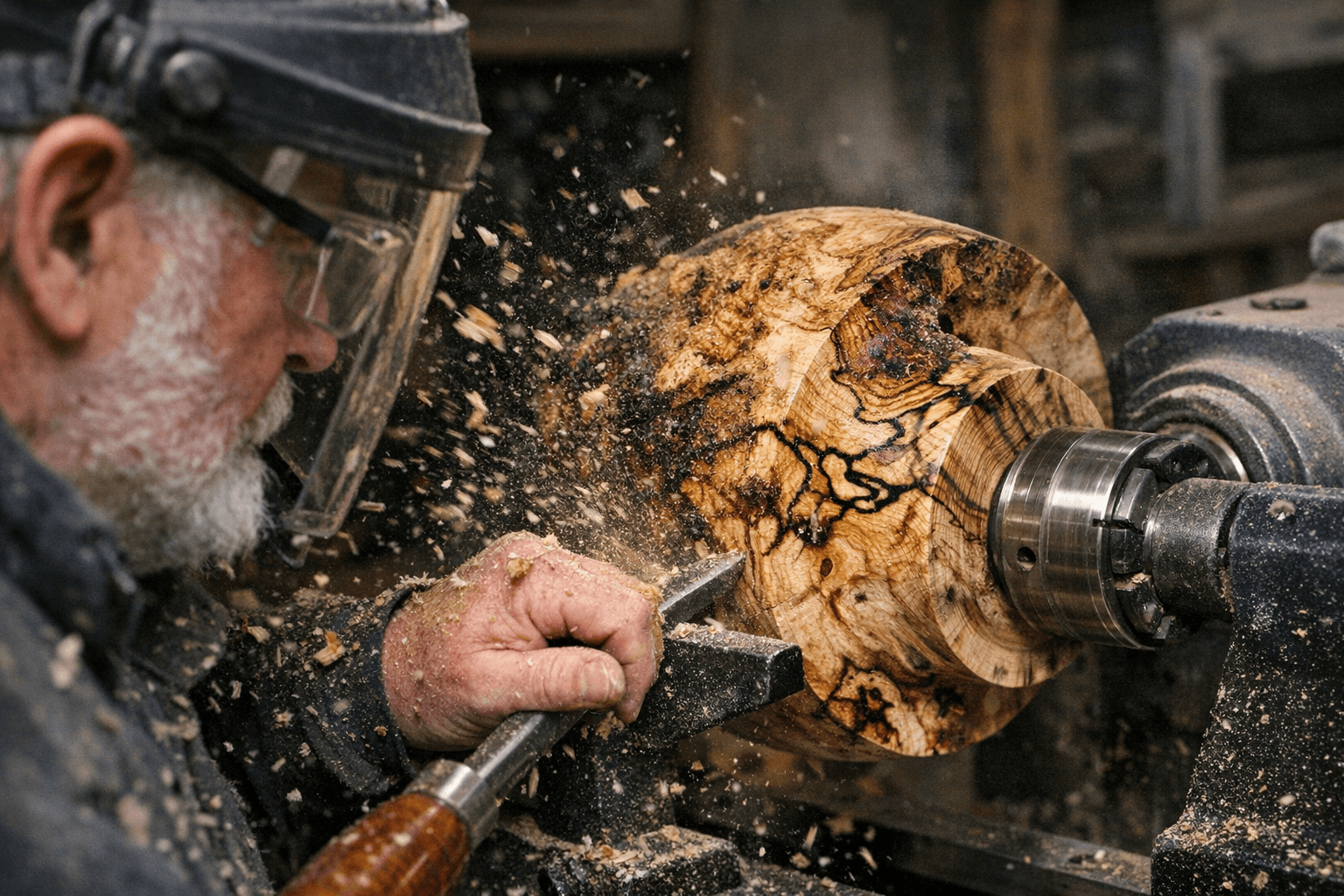
The moment that makes a burl turning worthwhile almost never happens at the bandsaw. It happens mid-roughing pass, when the oxidized outer surface falls away and the wood underneath becomes something you didn't see coming. That's the central beat of this clip: a spalted elm burl that read, from the outside, like a modest chunk of figured wood, then opened up on the lathe as something considerably more dramatic.
Why Spalted Elm Is Such a Rare Starting Point
Elm is a notoriously uncooperative spalting species. AAW forum contributors, including woodturning blogger Derek Andrews of The ToolRest, have noted that elm "tends to rot very easily, creating large grey areas and less pretty black lines" compared to species like beech, which forum members rate as excellent for spalting quality, or yellow birch, rated good. What this means practically: most elm that's sat long enough to develop any spalting has also sat long enough to develop significant punky, soft areas, often without producing the dramatic zone lines that make a blank worth the effort.
A well-preserved spalted elm burl with readable zone lines is the exception. When you find one that has held together structurally while still developing figure, that blank deserves careful handling from the first tool contact.
The Science Inside Those Black Lines
Those sharp black lines are not a surface feature and not the product of a single fungus doing predictable work. According to Penn State University Extension's educational resources on spalted wood, spalting occurs in three distinct categories: pigmentation, white rot, and zone lines. The zone lines, the feature turners most prize, are fungal boundary markers where competing fungi erect barriers to protect their territory and resources. Some form where two different colonies meet; others are laid down by a single fungus delineating its own patch.
White rot is the other major player, and it creates the spongy, compressible areas that behave unpredictably under the gouge. It causes measurable strength and weight loss in affected wood fibers, and if left uncontrolled, white rot will eventually render a blank structurally useless. Brown rot is the least useful to turners: it doesn't degrade lignin, leaves a crumbly and cracked surface, and cannot be stabilized regardless of what consolidant you apply.
How a Burl Forms
The figure inside a burl is a biological record, not decoration. Burls form when a tree undergoes significant stress, and one of the most common causes is the crown gall bacterium, Agrobacterium, which carries extra DNA in a plasmid that infiltrates the tree's tissue and disrupts its growth hormones. Cells divide irregularly rather than in the orderly parallel strands of normal grain. The result is wood that turners describe as a "ball of yarn": grain that twists, contorts, and folds back on itself, producing dense figure that catches light differently at every angle.
The scale these formations can reach is worth noting: the largest known burls, found on coast redwoods (Sequoia sempervirens), reach 26 feet (8 meters) in circumference, with notable specimens near Port McNeill, British Columbia. Burl poaching from living trees has become a recognized environmental problem in some of these areas, which adds conservation weight to the decision to work from legally sourced blanks.
The Unexpected Turn
The pivotal moment in the clip is the grain reveal: roughing progresses, the exterior surface comes away, and zone lines and burl figure appear at a scale and clarity the outside of the blank didn't advertise. This is the turn that changes the rest of the session. The demonstrator moves to scrapers for the densest sections of burl figure, where grain direction is least predictable and a catch from a gouge could fracture an adjacent void. The sanding sequence slows not to follow a fixed grit schedule, but to protect the contrast between dark zone lines and lighter surrounding wood. Aggressive sanding at this stage blurs zone lines irreversibly.
What likely drove the unexpected behavior: the combination of stress-deformed burl grain and active spalting means the blank has no consistent density across its cross-section. A white-rot pocket can sit immediately beside a section of hard, sound wood, and the tool reads each differently. That boundary is invisible from the exterior.
Stabilization: What Actually Works
The standard consolidant for punky spalted sections is water-thin cyanoacrylate (CA) glue, which floods into softened cell structure and hardens it enough to take a clean cut. AAW forum members note this approach is effective for smaller pieces like pens, but becomes cost-prohibitive on large vessels where significant volumes of CA would be required. Minwax wood hardener is cited on the forums as a lower-cost alternative for broader consolidation work.
For visible cracks and voids, tinted epoxy offers both structural repair and aesthetic integration. Mixing black pigment or black sawdust combined with wood glue into epoxy to fill gaps produces a result that mimics the appearance of natural zone lines. What starts as a structural fix becomes a designed detail, and the piece looks like it was always meant to carry it.
Burl Failure Modes: A Quick Reference
Before mounting a burl blank, these are the conditions most likely to end a turning session early:
- Unchecked white rot near the center: sounds hollow under a tap, feels spongy, and won't support consistent tool pressure
- Bark inclusions with hidden void pockets: the bark may appear sound but can detach mid-cut, especially at higher RPM
- A structural crack bisecting the blank at the mounting axis: turning stress can propagate an existing crack outward fast
- Brown rot sections: crumbly, cross-grained, and cannot be stabilized regardless of consolidant choice
- An undried core beneath a dry exterior: movement during turning can open new cracks in sections that looked stable
A 4,000-Year Craft in the Short-Form Era
The AAW, established in 1986 and headquartered in Saint Paul, Minnesota, is the primary professional and hobbyist body for woodturning in the United States, with more than 16,000 members and nearly 350 affiliated chapters worldwide. The accumulated forum knowledge on elm spalting behavior, CA consolidation, and void management represents decades of hands-on discovery. Woodturning itself goes back approximately 4,000 years: the earliest documented lathe, dated around 1300 BC in ancient Egypt, required two people to operate, one to rotate the workpiece and another to cut. The craft saw its modern hobby resurgence after World War II as affordable lathes reached workshop benches, and again from the 1960s onward as prominent turners pushed it toward fine-art recognition.
The MSN clip lands in an environment where short-form video has become the dominant format for craft education and discovery. YouTube Shorts alone records approximately 70 billion daily views globally, and ad spending on short-form video is projected to reach $1.04 trillion in 2026, up 5.1% year-over-year. That distribution reach is why a hobbyist bench-turning session filmed in a private shop can now reach audiences far outside dedicated craft communities, and why a well-documented elm burl reveal carries more instructional weight than any single step-by-step tutorial.
The blank's exterior rarely tells the full story. That's the part of this craft that 4,000 years of lathe work still hasn't changed.
This article was produced by Prism’s automated news system from verified source data, official records, and press releases, then run through automated quality and moderation checks before publishing. The system is built and supervised by the people who set the standards it runs under. Read our full AI policy.
Did this article answer your question?