Craft Supplies USA Explains the 40-40 Bowl Gouge Grind and Jig Setup
The 40/40 can cut fast and leave a clean finish, but only if your gouge profile and sharpening setup can match its geometry. Craft Supplies USA’s new jig is meant to make that switch less intimidating.
Why the 40/40 keeps getting attention
The 40/40 bowl gouge grind keeps showing up in turning conversations for a reason: when it is set up right, it can feel almost unfairly efficient. Craft Supplies USA’s guide leans into that reputation, tracing the profile back to Stuart Batty and the way he pushed the grind into broader use. That history matters because the 40/40 is not popular just for the look of the bevel lines, but because it promises something turners always want more of, faster cutting with a surface that needs less cleanup.
That promise is why the grind has picked up almost mythic status among turners who hear about it from friends, demos, and videos. The guide makes the case that the appeal is practical, not mystical: you get an aggressive cutter that can still leave a finish-ready surface if the geometry is right and the tool is used with control. The catch is obvious to anyone who has spent time at the grinder. This is not a grind that rewards guesswork.
What the 40/40 actually is
The profile is defined very specifically. Craft Supplies USA describes it as a 40-degree nose bevel with 40-degree straight wings, and that geometry is the whole point of the grind. The shape is designed to present a consistent cutting edge, which is why the wings and nose are treated as parts of one system rather than separate ideas.
Just as important, the guide stresses that the flute shape has to match the grind. A 40/40 depends on a gouge with a parabolic or elliptical flute, not a traditional V-flute or a U-shaped bottoming gouge. That detail separates a tool that can truly be sharpened to the profile from one that will fight you no matter how carefully you set the grinder. In other words, the steel in your hand matters as much as the sharpening technique.
That is the first practical decision point for anyone thinking about the switch. If your current gouge does not have the right flute form, the 40/40 is not just a different grind, it is a different tool strategy altogether. The guide makes that clear enough that you do not waste time trying to force a profile onto a gouge that was never meant for it.
Why turners chase the cut
The original job for this grind was not fancy bowl finishing, but speed. Craft Supplies USA notes that the 40/40 was developed for production spindle turning, where the cutter had to remove material quickly while still leaving a finish-ready surface on end-grain fibers. That is the kind of workload that explains the grind’s reputation immediately, because it was built for efficiency first and elegance second.
That production background also explains why the grind is so attractive to people turning by hand in a small shop. If you are hogging off waste, shaping a form, or trying to get to final surface quality with fewer passes, the 40/40 can do both jobs in the same move. The guide also argues that the grind can reduce fatigue because it takes less physical effort than more conventional profiles, which is a bigger deal than it sounds once you are several hours into a turning session.
Still, the appeal comes with a condition. The 40/40 rewards a turner who can reproduce the geometry accurately, and that is where many people stall out. The cut is efficient because the profile is consistent; if the grind is inconsistent, the tool can lose the very qualities that make it worth considering. That is why the setup discussion in the guide matters as much as the grind itself.
What changes at the grinder
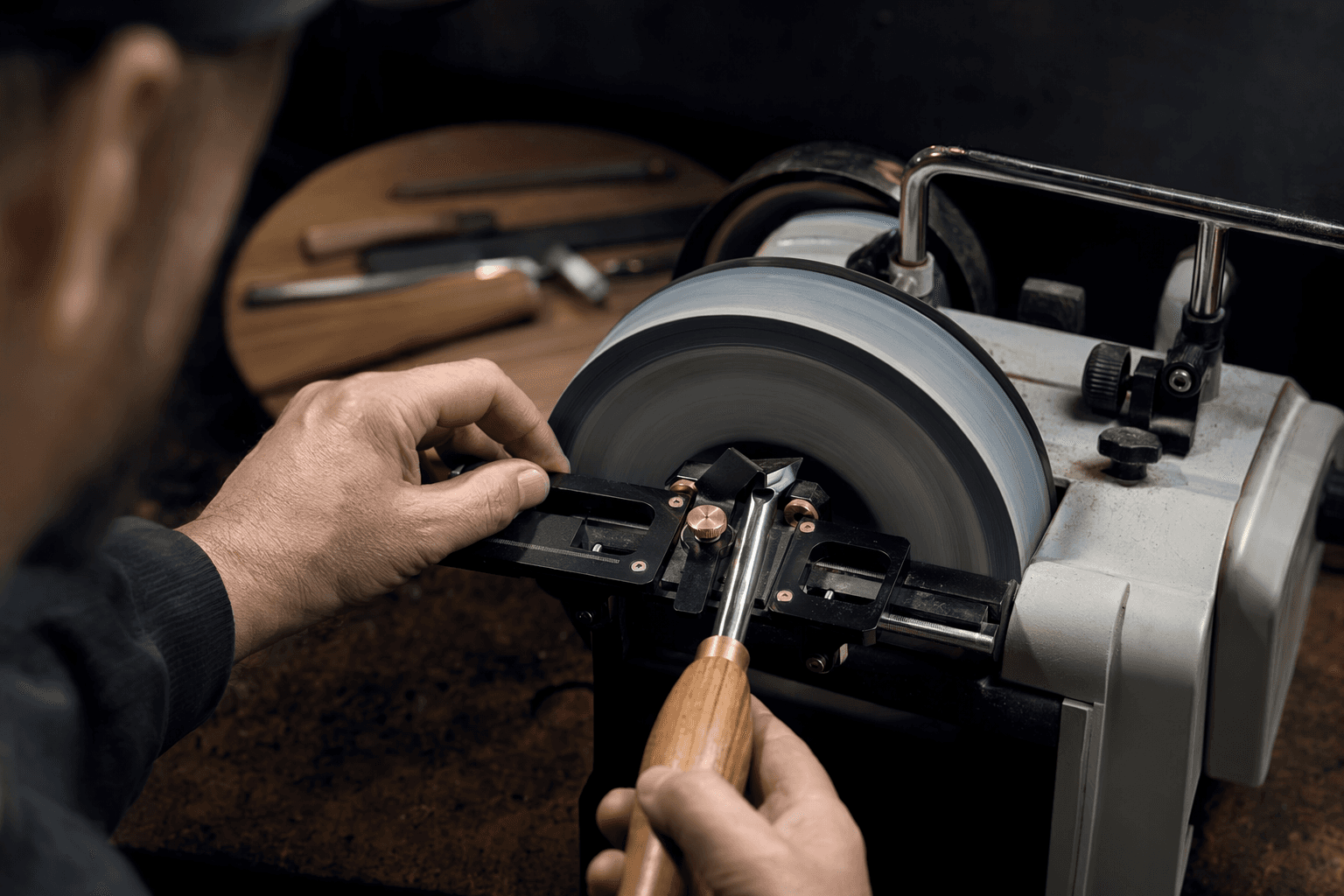
Craft Supplies USA’s answer to the setup challenge is its 40/40 Raptor Jig, which is presented as a way to make the geometry more repeatable. The point is not to turn the grind into a push-button operation, but to make a previously intimidating freehand shape more approachable for ordinary hobbyists. If you have avoided the 40/40 because it looked too exacting, the jig is clearly meant to lower that barrier.
The setup sequence in the guide is the part that turns theory into something you can actually do in the shop. First comes establishing straight wings on the sharpening platform, then setting tool protrusion, then dialing in the V-arm. After that, the wings are refined in the jig to keep the grind consistent from sharpening to sharpening. That order matters because it moves the process from rough positioning to final shaping in a controlled way.
What this means in practice is that the 40/40 stops being a “trust your eye and hope” grind. The jig is there to standardize the angles and make the result repeatable, which is especially helpful if you sharpen often or want your gouge to behave the same way every time you reach for it. For hobbyists who want better cutting control and less time at the grinder, that is the real selling point.
Should you switch grinds?
If you do a lot of spindle work, want a cutter that can remove material efficiently, and care about a cleaner surface straight off the gouge, the 40/40 starts to make a lot of sense. It is especially appealing if your current grind feels sluggish or tiring and you are willing to match the tool to the profile it was designed for. The guide’s message is not that the 40/40 is magic, but that it is extremely capable when the setup and the use case line up.
If your gouge has the wrong flute shape, or if you prefer a more forgiving grind that does not demand such precise geometry, the switch may be less worthwhile. The 40/40 is not a universal answer, and Craft Supplies USA does not present it that way. It is a specialized profile with a strong payoff, but only when the turner and the tool are both ready for it.
That is the real takeaway for bowl turners watching the 40/40 trend from the sidelines: the grind earns its praise, but it also earns its limits. The new jig does not erase those limits, it simply makes the setup more repeatable, which is exactly what turns a shop experiment into a workable part of the routine.
This article was produced by Prism’s automated news system from verified source data, official records, and press releases, then run through automated quality and moderation checks before publishing. The system is built and supervised by the people who set the standards it runs under. Read our full AI policy.
Did this article answer your question?