Five giants who turned woodturning into modern art
These five pioneers still shape what you see on the lathe: Prestini’s precision, Stocksdale’s restraint, Moulthrop’s scale, Lindquist’s hollowing, and Osolnik’s teachable form.
Woodturning did not become modern art by accident. The American Association of Woodturners frames the movement as a craft reborn in war and social upheaval, and these five names still mark the moment when bowls, vessels, and hollow forms stopped reading as workshop objects alone. If you want the clearest map of that shift, start with James Prestini, Bob Stocksdale, Ed Moulthrop, Melvin Lindquist, and Rudy Osolnik.
James Prestini: precision made visible
Prestini’s wooden bowls in the 1940s are the AAW’s starting point for artistic woodturning because they established that a turned form could be a serious art object, not just useful ware. Smithsonian American Art Museum identifies him as James Prestini, 1908-1993, and Craft in America places him in the Bauhaus tradition, where craft and function were never separate ideas.
What still shows up on the shop floor is the discipline. Craft in America says Prestini became best known from 1933 to 1953 for lathe-turned bowls so thin they seem closer to glass or ceramics, and the AAW notes that he worked with a metal lathe whose gear-driven tool post gave him mechanical control over the forms he created. When a contemporary turner chases a cleaner wall, a quieter rim, or a bowl profile that looks resolved before any surface treatment goes on, that is Prestini’s fingerprint.
His reach was not limited to the turning bench. Craft in America says he produced more than 400 sculptures over a 50-year career, and the Los Angeles Times reported that at least 260 of his works sit in permanent collections worldwide, including the Museum of Modern Art, the Metropolitan Museum of Art, and the Smithsonian Institution. That kind of institutional footprint explains why a Prestini bowl still feels like a lesson in restraint every time one appears in a gallery or on a lathe bed.
Bob Stocksdale: the power of restraint
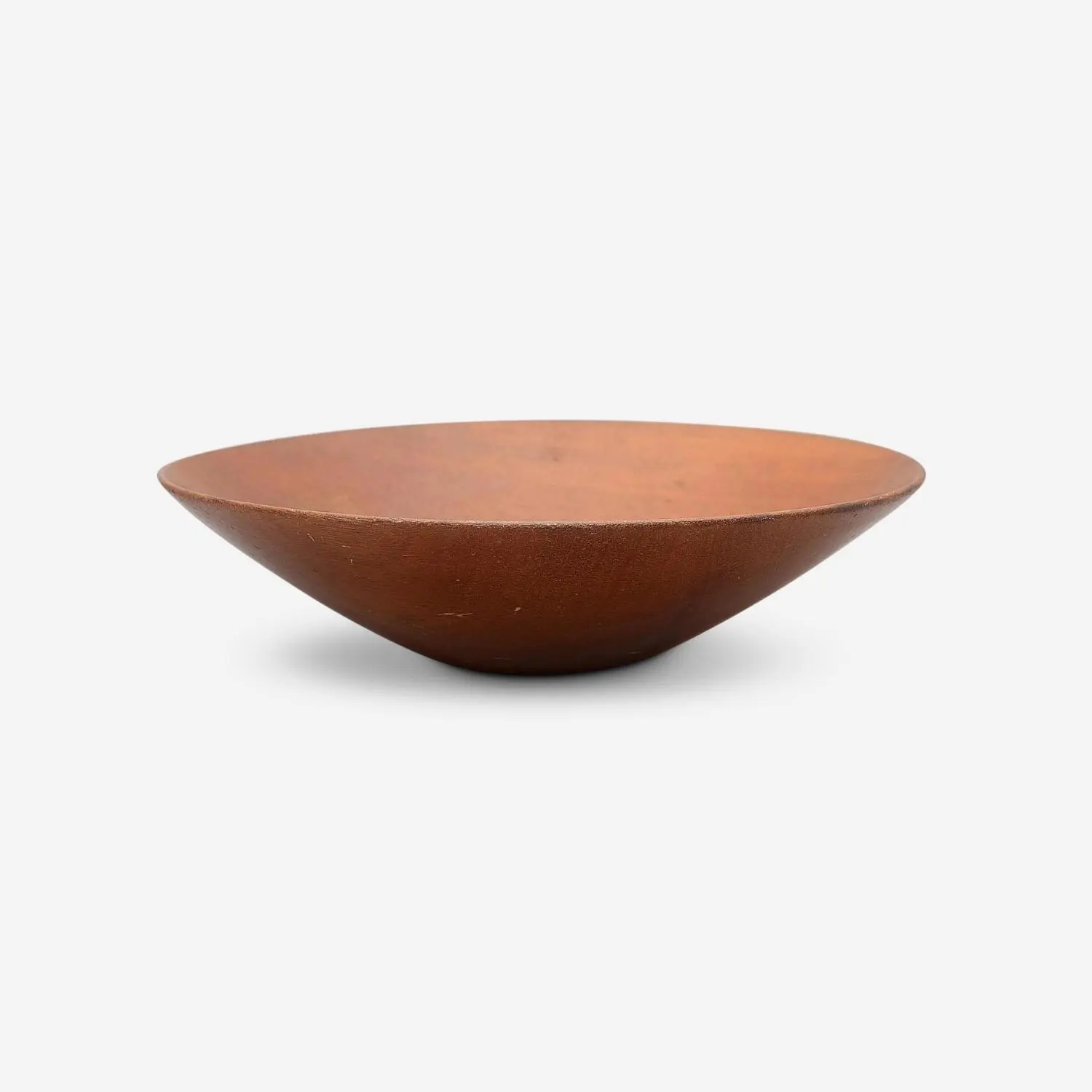
Bob Stocksdale gives the modern turner a different lesson: a bowl does not need ornament to carry authority. The Museum for Art in Wood calls him an internationally renowned pioneer of contemporary wood turning and identifies him with striking lathe-turned bowls formed from exotic woods, while Smithsonian American Art Museum keeps an artist page for him in its collection record.
The important shop-floor detail is how little he needed to do beyond shape, proportion, and surface. Smithsonian’s object records note that Stocksdale enjoyed experimenting with new shapes and worked across a wide range of bowl forms, which is exactly why his work still matters when you are trying to decide whether a rim is too heavy or a curve falls too flat. A Stocksdale-minded bowl relies on proportion so clean that the wood itself, especially a dramatic species, becomes the finish.
That approach still has a direct payoff for present-day turning. If you want one idea from Stocksdale to take back to the lathe, let the blank do more of the talking and keep the form honest enough that the grain, figure, or color carries the piece without rescue work. His bowls are the reminder that elegance in woodturning often comes from subtraction, not addition.
Ed Moulthrop: scale without apology
Ed Moulthrop expanded what the field thought a turned vessel could be. Craft in America identifies him as Edward Moulthrop, 1916-2003, a self-taught woodturner often called the father of modern woodturning, and says he bought his first lathe as a teenager before studying architecture and later resigning from architecture in the 1970s to pursue woodturning professionally.
His legacy lives in scale. Craft in America says Moulthrop became famous for large-scale turned bowls made from domestic woods with polished clear finishes, and that he built all of his own equipment to handle that work. ASU Art Museum describes the Moulthrops as a dynasty of artists spanning grandfather, son, and grandson, which matters because his influence did not stop with one studio, one generation, or one size of blank.
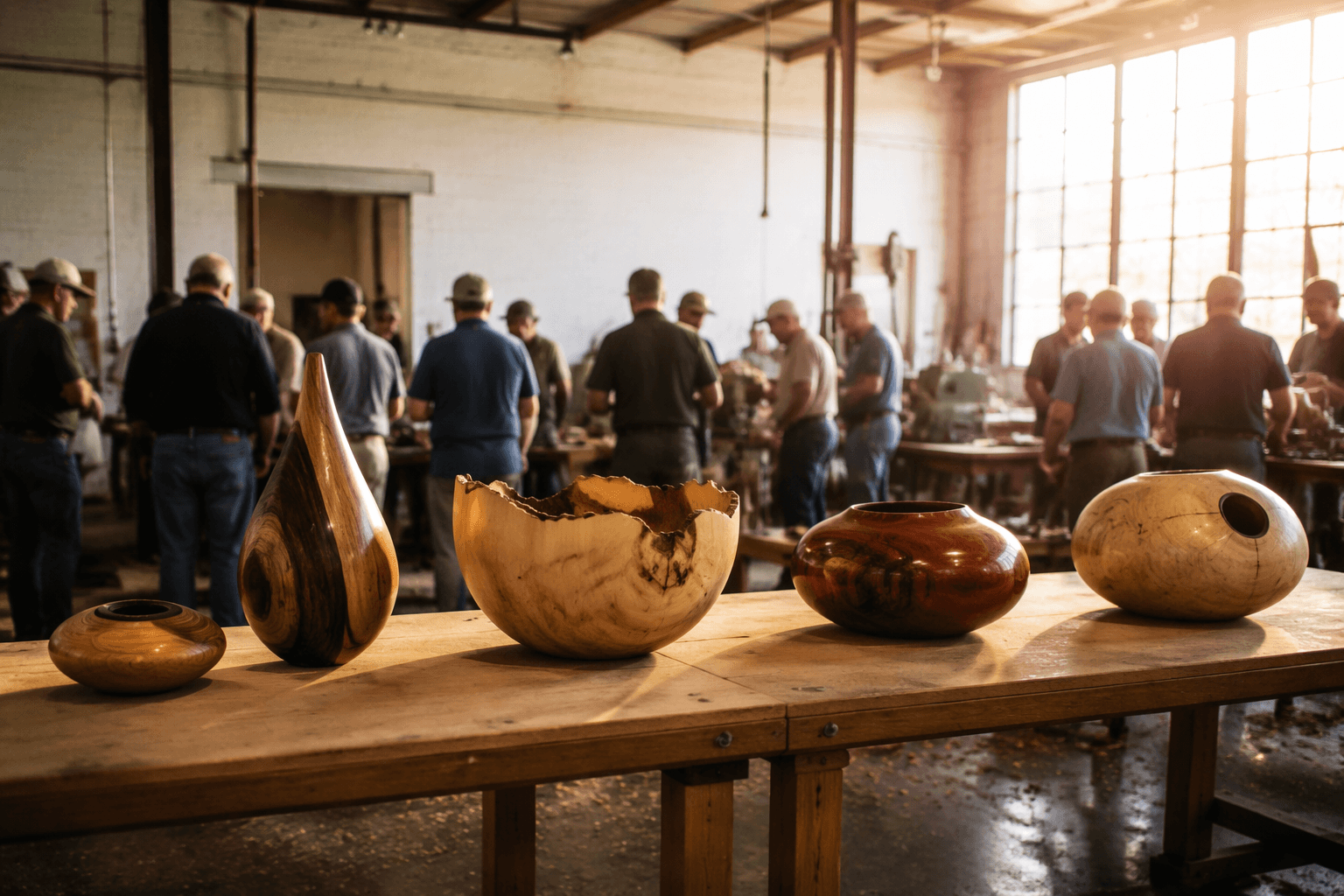
For turners today, Moulthrop still shows up wherever the form gets bigger and the problem-solving gets more serious. His work says a vessel can be monumental without abandoning the logic of the lathe, and that machine-building can be part of the artistic act. If you have ever looked at a huge bowl blank and thought more about balance, wall thickness, or finish than about decoration, you are already thinking in Moulthrop’s direction.
Melvin Lindquist: turning into sculpture
Melvin Lindquist widened the field by treating the lathe as a place for invention. The AAW says he was born July 5, 1911 and died November 24, 2000, began woodturning in high school in California in 1928, and came to the craft with the background of a master machinist, aeronautical engineer, army surveyor, and manager of quality control. That mix of precision trades and technical problem-solving is a big part of why his work still feels unusually contemporary.
The late-1950s discovery of spalted wood on his land in the Adirondacks pushed him into new territory, and the AAW says he invented new tools and groundbreaking techniques for hollowing vessels and working with spalted wood. That is the Lindquist fingerprint now visible in modern work that leans into voids, asymmetry, deep hollows, and surface complexity rather than stopping at a clean exterior.
The field had already started to recognize that importance by the time Lindquist appeared with Rudy Osolnik, James Prestini, and Bob Stocksdale on a panel at the second AAW conference in Philadelphia in 1988. That single gathering shows how quickly the studio movement had formed its own canon, and it explains why Lindquist remains a reference point whenever a turner wants the lathe to behave less like a duplicate machine and more like a sculptural tool.
Rudy Osolnik: form you can teach
Rudy Osolnik, listed as Rude Osolnik in several museum records, matters because woodturning spread through teaching as much as through objects. PBS LearningMedia says he accepted a teaching position at Berea College in 1937 and taught thousands of students over 40 years, while Brunk Auctions says he produced more than 100,000 pieces in more than sixty years in the field.
That combination of output and instruction is the reason his influence still feels practical. The Asheville Art Museum has featured a laminated plywood vase by Osolnik, a useful reminder that his design language was never limited to one material or one era, and PBS quotes him as saying that what makes a good craftsman is what makes a good artist: control of their material and techniques. That sentence still lands on the lathe because it describes exactly what turns a decent form into a convincing one.
Osolnik’s lesson is simple to read in modern work: a clear profile, repeatable proportions, and a willingness to teach the form well enough that others can carry it forward. When a turner builds a piece that feels clean, stable, and easy to understand from across the room, Osolnik’s hand is there in the background.
Taken together, these five names still read like a working vocabulary for the lathe. Prestini gives you control, Stocksdale gives you restraint, Moulthrop gives you scale, Lindquist gives you daring, and Osolnik gives you clarity that can be taught and repeated. That is why these giants still matter: the fingerprints they left on modern woodturning are the same ones you can still see in a bowl blank, a hollow form, or a polished rim today.
This article was produced by Prism’s automated news system from verified source data, official records, and press releases, then run through automated quality and moderation checks before publishing. The system is built and supervised by the people who set the standards it runs under. Read our full AI policy.
Did this article answer your question?