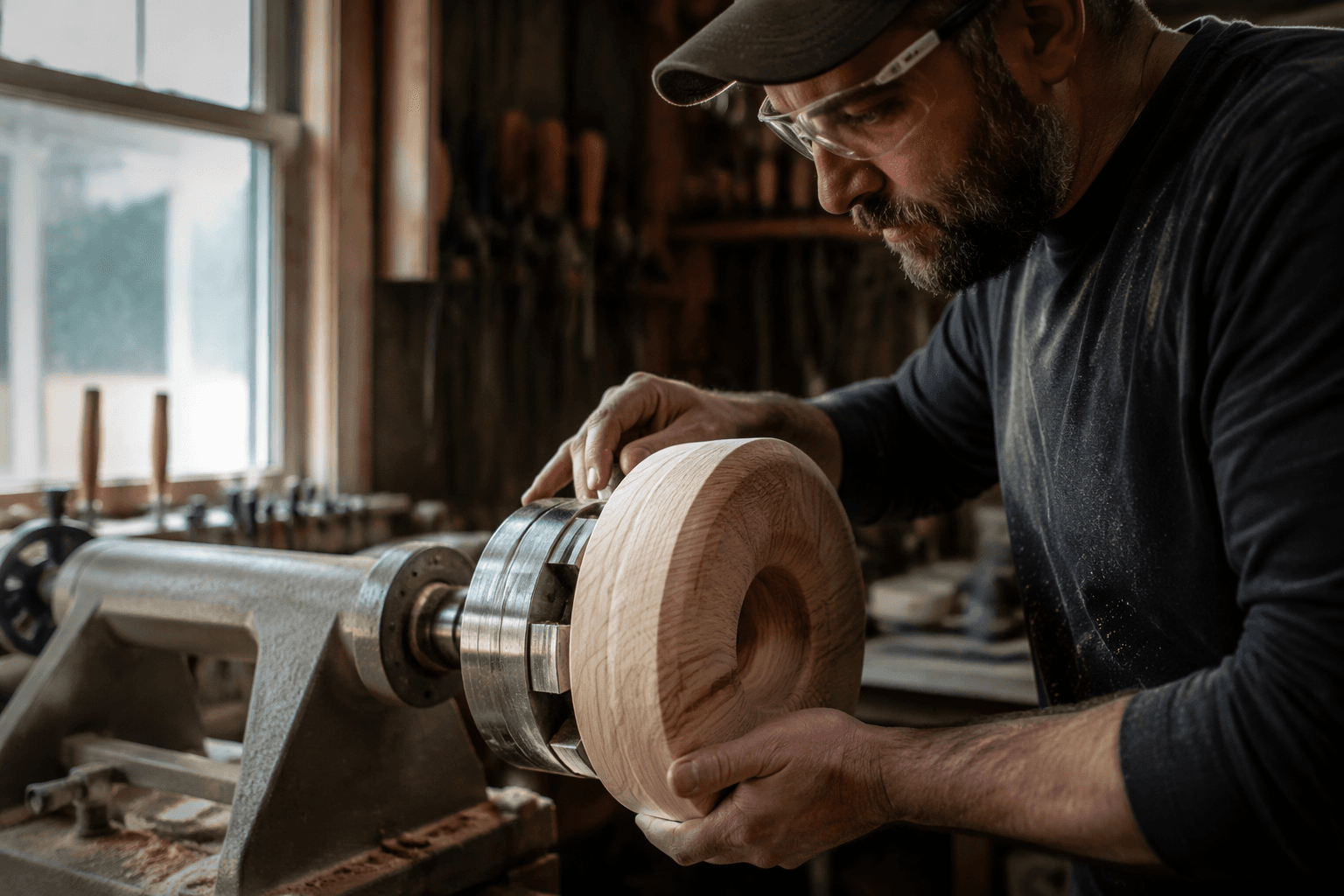
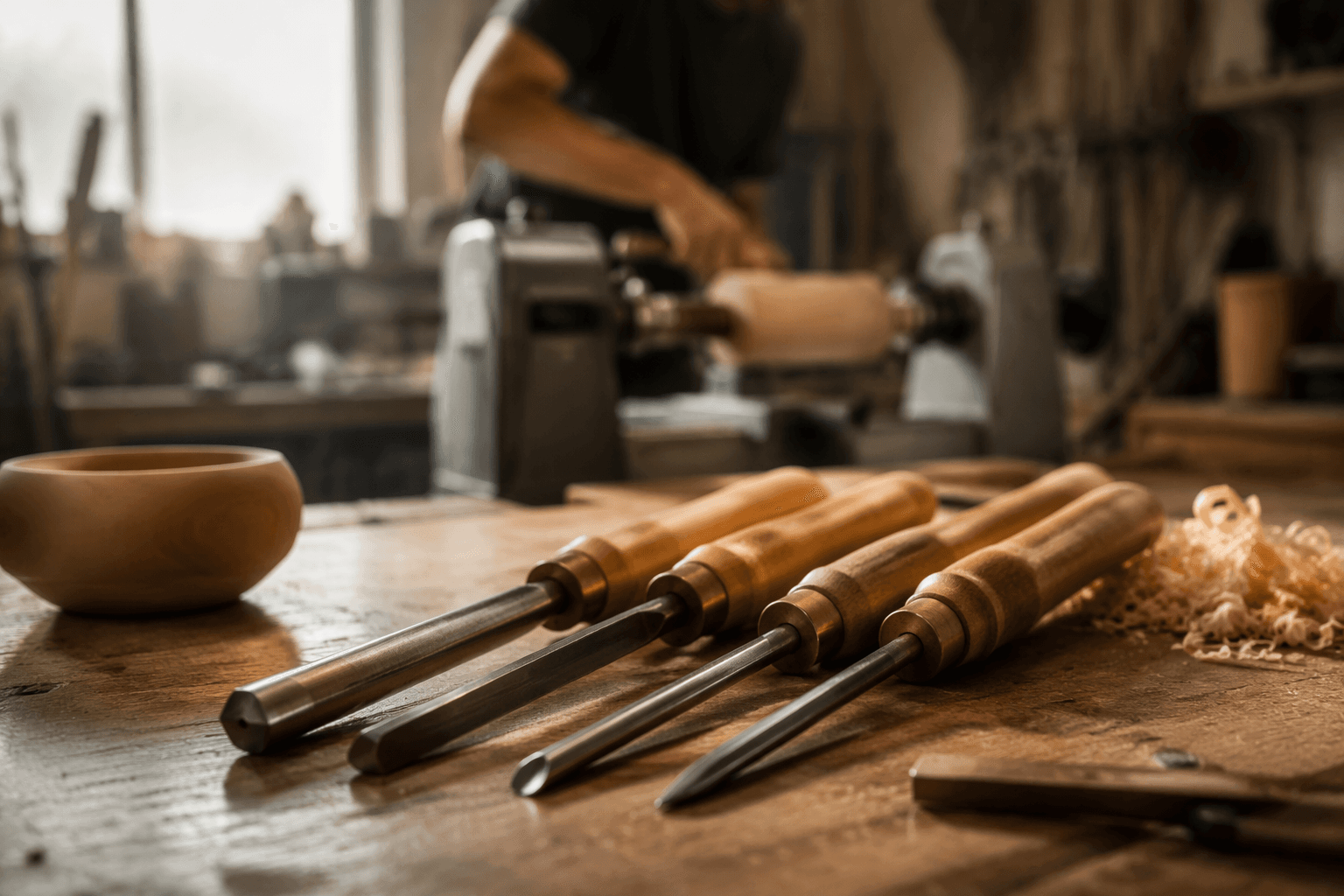
Richard Raffan’s handled bowls bridge bowl turning and spindle shaping
One blank can become two handled bowls, and the whole lesson lives in the details: grain, remounting, balance, and the handle transitions that keep the form elegant.
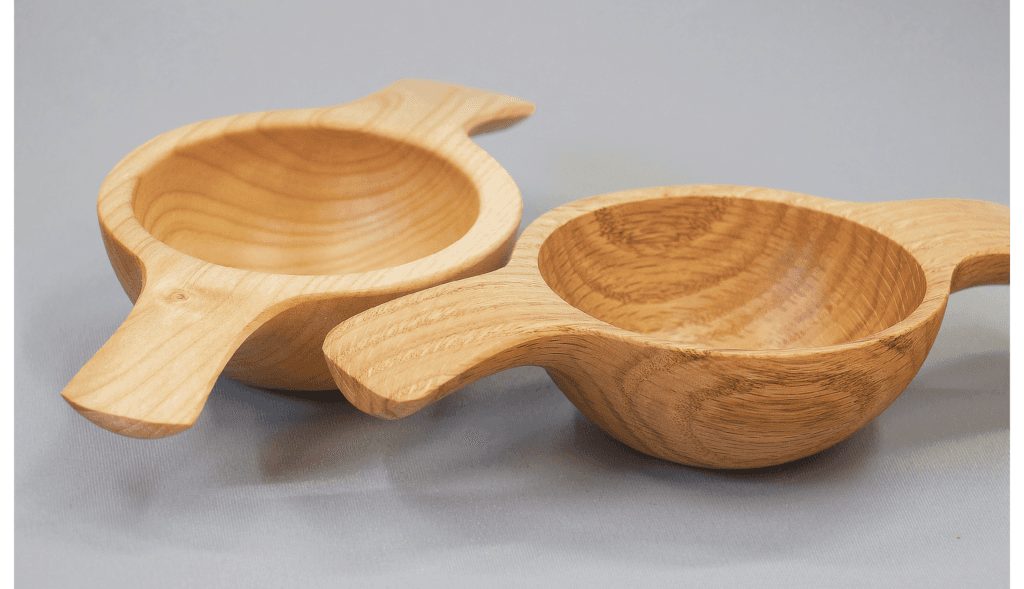
A handled bowl looks simple only after the geometry is right. Richard Raffan’s version starts with a blank a little over 4 in. square and 8 in. long, grain running lengthwise, and turns that stock into one elongated form that later splits into two bowls. The appeal is that you get a project that feels like bowl turning and spindle shaping at the same time, with the final character living or dying on the handle placement, the way the transition is shaped, and how evenly the two halves read beside each other.
From one blank, two bowls
Raffan’s project is built around a clear sequence. The blank is mounted between centers, with the drive and tail centers aligned to the glue line, then turned into a cylindrical or slightly spherical form before it is split lengthwise. That gives you two bowl bodies from one piece, and each half is remounted several times while the handles are refined. The process makes the form more than a novelty: it becomes a lesson in centering, repeatable layout, and the kind of controlled remounting that woodturning keeps asking for.
That repeated remounting matters because handled bowls sit in a narrow band between symmetry and expression. The two bowls can be a matching pair, or they can diverge, with different handle treatments changing the feel of the whole piece. The Woodworkers Institute example shows ash and pin oak handled bowls with a wingspan of about 8 in., while the largest version Raffan has made was 8 in. wide and a foot long. Those numbers matter because they show how the form scales: compact enough to stay manageable, long enough to let the handles breathe.
The layout that keeps the form honest
The project also teaches precision in the most practical way possible. A simple diameter gauge can be made from scrap plywood or MDF by cutting a circle with a 3/8-in. fingernail-ground gouge, then using burnish marks to spot the high areas as the sphere is refined. That is the kind of shop-made aid that turns a shaping problem into a readable process, and it is exactly why the form works so well as a skill-expansion project.
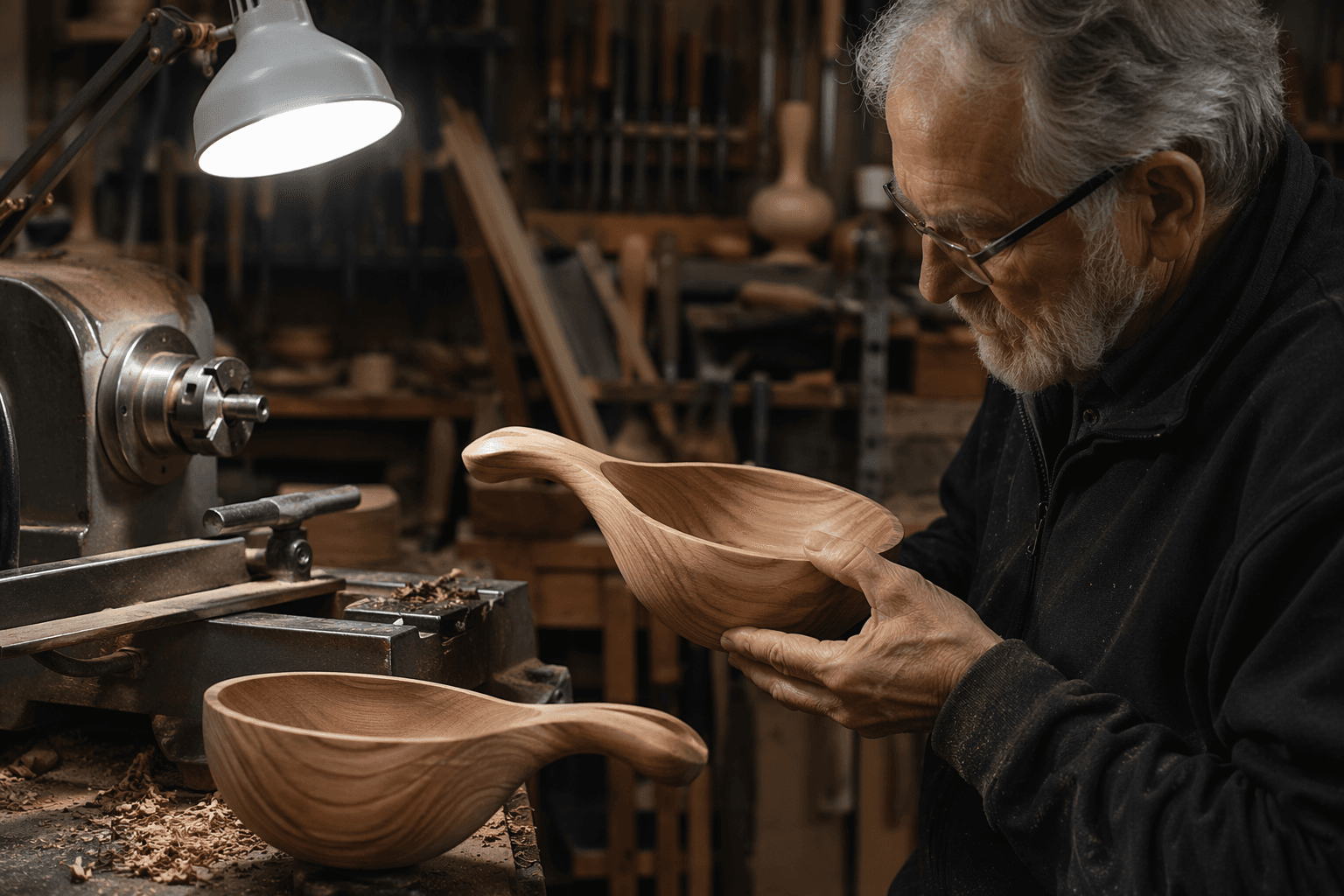
The early layout is just as important. Once the blank is between centers, the initial cylinder gets marked out before the ends are reduced and the central length that will become the two bowl bodies is established. That central section is the hinge between bowl and handle, and it is where awkward work shows immediately. If the transition is too abrupt, the piece looks forced. If it is too soft, the handles lose definition and the whole form goes dull.
Handled bowls reward a steady eye because the surfaces have to support both mass and lightness. The bowl portion needs enough substance to feel usable, but the handle has to taper cleanly enough that it reads as part of the design rather than an afterthought. That balance is what makes the project valuable for turners who already know how to hollow a bowl but want a form that asks for more than a simple rim and foot.
Why the wood choice changes the result
Mark Gardner’s handled-bowl approach adds another layer: material efficiency. He starts from the idea that handles can let you make a larger-feeling bowl from a smaller-diameter log, and his example begins with a cherry log about 10 in. in diameter. That matters in the shop because the form gives real visual scale without demanding oversized stock, which is part of why it feels like a smart next step after standard bowls.
Gardner also lays out the prep in a way that shapes the final movement of the piece. He cuts off cracked end grain, trims bark, splits at the pith, and orients the blank so the pith is near the bottom and sapwood is at the top. That orientation encourages a controlled oval warp as the bowl dries, which gives the finished form a quieter, more natural asymmetry than a perfectly static circle. In other words, the wood is not just being contained by the design. It is being guided into the design.
Gardner says he started making handled bowls in 1998 while assisting John Jordan at Arrowmont, and he describes the project as the first time he broke his rule that everything had to be completed on the lathe. That break opened up “countless possibilities,” and you can feel that in the form itself: the turning sets the structure, but the handled shape lives in the decisions that come after the basic turning is done.
A form with deep roots and a living audience
Handled bowls feel contemporary in the shop, but the broader craft history behind them is older than the form most turners first imagine. The American Association of Woodturners describes woodturning as an ancient craft known to many cultures worldwide, and notes that for many hundreds of years before the Industrial Revolution, the foot-powered lathe was the only woodworking machine in common use. It also describes the lathe as one of the oldest machines, originally driven by simple means such as twine.
That long history helps explain why handled vessels feel so familiar. Popular Woodworking notes that the lathe is a direct descendant of the potter’s wheel, which it places at more than 7,000 years old, and compares handled wooden vessels to Viking-era ale bowls and end-grain cups made more than 1,000 years ago. The form sits naturally between bowl, cup, and carrying vessel, so when you add handles you are not inventing a new language so much as tightening an old one.
The American Association of Woodturners gives the form even more current relevance. Its archive dates back to 1986, and it has more than 360 chapters worldwide, which tells you how wide the community is around this kind of work. The 2026 symposium schedule includes a handled-bowl session by Mark Gardner, a useful signal that this is still a live teaching topic, not just a museum piece.
Richard Raffan fits cleanly into that continuum. He has worked as a self-employed turner since 1970, has produced more how-to books on turning than anyone else, and was recognized by the American Association of Woodturners’ Professional Outreach Program in 2012. That is the right kind of anchor for handled bowls: a form that asks for classic bowl turning, spindle-like refinement, and enough judgment to decide where a handle begins to feel elegant instead of awkward. The best handled bowls leave you with that satisfying double image, one blank turned into two forms, each one carrying the exact point where the transition stopped being round and started becoming a handle.
This article was produced by Prism’s automated news system from verified source data, official records, and press releases, then run through automated quality and moderation checks before publishing. The system is built and supervised by the people who set the standards it runs under. Read our full AI policy.
Did this article answer your question?