Turn a lazy Susan on the lathe for a cleaner, faster build
Turn a lazy Susan on the lathe for cleaner curves, faster shaping, and a real lesson in faceplate turning. The project rewards careful mounting, balanced stock, and a finish that spins as well as it looks.
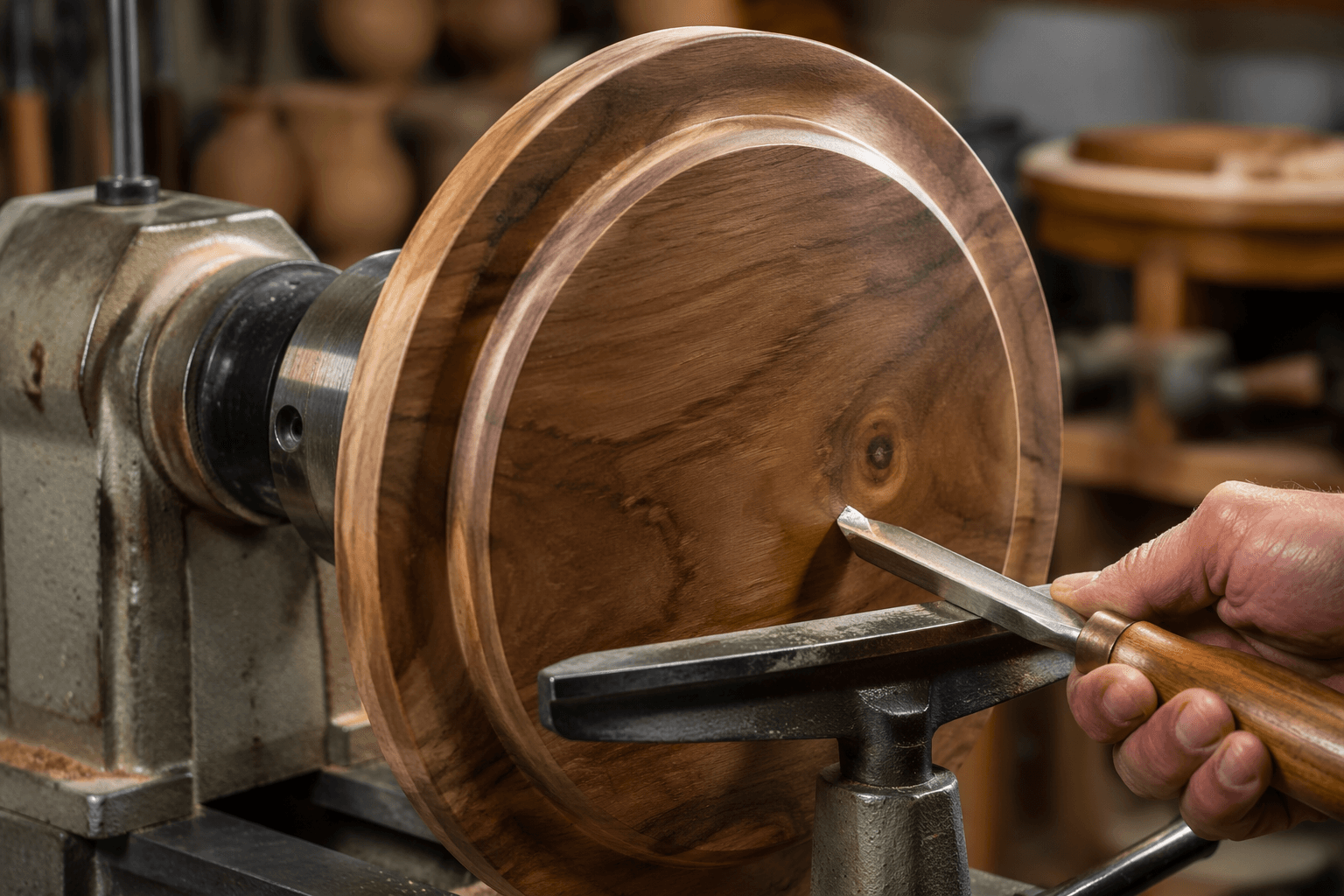
Turn a lazy Susan as a faceplate project and you get a clean concave dish, a coved rim, and a tool-cut surface that a bandsaw-and-router approach cannot match as quickly or as cleanly. When the blank is already prepared, the whole build can fit into one session, making it both a useful kitchen piece and a tight, practical turning lesson.
Why the lathe changes the project
Most online versions of a lazy Susan start like carpentry: cut the circle, route the edges, bolt on hardware. That works, but it treats the piece like a flat tray. On the lathe, the shape comes from turning, not tracing, so the top can be eased into a shallow dish and the edge can be shaped with the same tool control you would use on a bowl. The result feels more intentional in the hand, and it teaches the movement of the gouge instead of just the motion of the router.
It needs to look finished when it sits in the middle of a table, and it needs to spin smoothly once the bearing is installed. A turned version gets there by design: the face, underside, and hardware recess all follow a single workflow instead of a stack of separate shop operations.
Stock, blank size, and hardware
The blank needs to be thick enough to survive the shaping and still leave room for the bearing and mounting work. For a 12-inch platter, at least 1-1/2 inches of stock is the practical floor. Once you step up to 16 to 18 inches, 2-inch material makes more sense, because the wider the disk, the more mass and leverage you have to manage while cutting.
The setup also wants the right hardware from the start. A 3- or 4-inch faceplate gives you a solid mounting base, and the finished piece should be matched to a ball-bearing lazy Susan turntable sized for the final diameter. Commercial bearings are sold in standard round or square formats, and their load ratings matter. One 12-inch square lazy Susan turntable bearing carries a 453 kg load rating with a recommended turntable size of 20 inches and up.
In Popular Woodworking’s “Crazy Susan,” the mechanism is essentially a rotating centerpiece built around a corral of ball bearings sandwiched between two metal plates. That construction is simple and sturdy.
Turning the top and underside
Start with a flat, dry blank mounted securely on the faceplate. If the blank is not already balanced, bring up the tailstock for support during the roughing stage, especially if you are dealing with a broad, unbalanced disk. Woodcraft’s faceplate-turning guidance sets an initial roughing speed of about 500 rpm, which is a sensible floor when you are bringing a wide platter into round and still learning how the blank wants to behave.
Once the blank is running true enough to trust, shape the top with a bowl gouge ground around 40 to 45 degrees. That grind gives you enough control to form the shallow dish without digging in, and it is the part of the project that makes the piece feel turned instead of merely cut out. A round-nose scraper then helps on the underside, where you want a cleaner recess and a controlled surface that will accept the bearing and sit flat when the hardware is attached.
A simple sequence keeps the work clean: 1. Mount the blank on the faceplate and true the outer edge. 2. Shape the top dish and soften the rim with the bowl gouge. 3. Turn the underside while the blank is still mounted. 4. Cut or clean the recess for the bearing. 5. Remove the piece, install the turntable, and check the spin.
The key is to finish as much of the geometry as possible before you break the work loose from the faceplate. That keeps alignment honest and avoids chasing the same surface after the piece has already been turned once.
Safety is part of the technique
This is not bowl work in disguise. A wide, flat blank puts more torque on the headstock bearings than a bowl does, and the screw purchase is shorter, so the mounting deserves more caution, not less. The American Association of Woodturners advises using safety procedures and wearing a full face shield whenever the lathe is turned on.
Keep the tool rest adjusted closely, check the screws before you bring the machine up to speed, and make sure the blank is dry and stable before you start shaping. If the setup feels uncertain, stop and correct the mounting instead of trying to muscle through the cut.
Why the object feels familiar
The lazy Susan itself has a long life outside the shop. Some histories trace revolving serving tables back to 13th-century China, and the Smithsonian places the piece in Chinese restaurant dining in the United States in the 1950s, where it helped change how shared meals were presented. Even the name carries that long, fuzzy history, with the exact origin of the phrase still uncertain.
What this project teaches beyond the finished tray
A turned lazy Susan keeps the lesson focused. You get faceplate mounting, stock selection, balancing, bowl-gouge control, scraper work, and finish planning in one project that still feels approachable. The finished part has to look good, but it also has to spin cleanly.
This article was produced by Prism’s automated news system from verified source data, official records, and press releases, then run through automated quality and moderation checks before publishing. The system is built and supervised by the people who set the standards it runs under. Read our full AI policy.
Did this article answer your question?