Albuquerque's Yoga For First Responders Brings Mental Health Tools to Frontline Workers
Yoga For First Responders founder Olivia Mead is planting the organization's flag in Albuquerque, where its 38th Instructor School just certified a new cohort to take nervous-system training into fire stations and precincts.
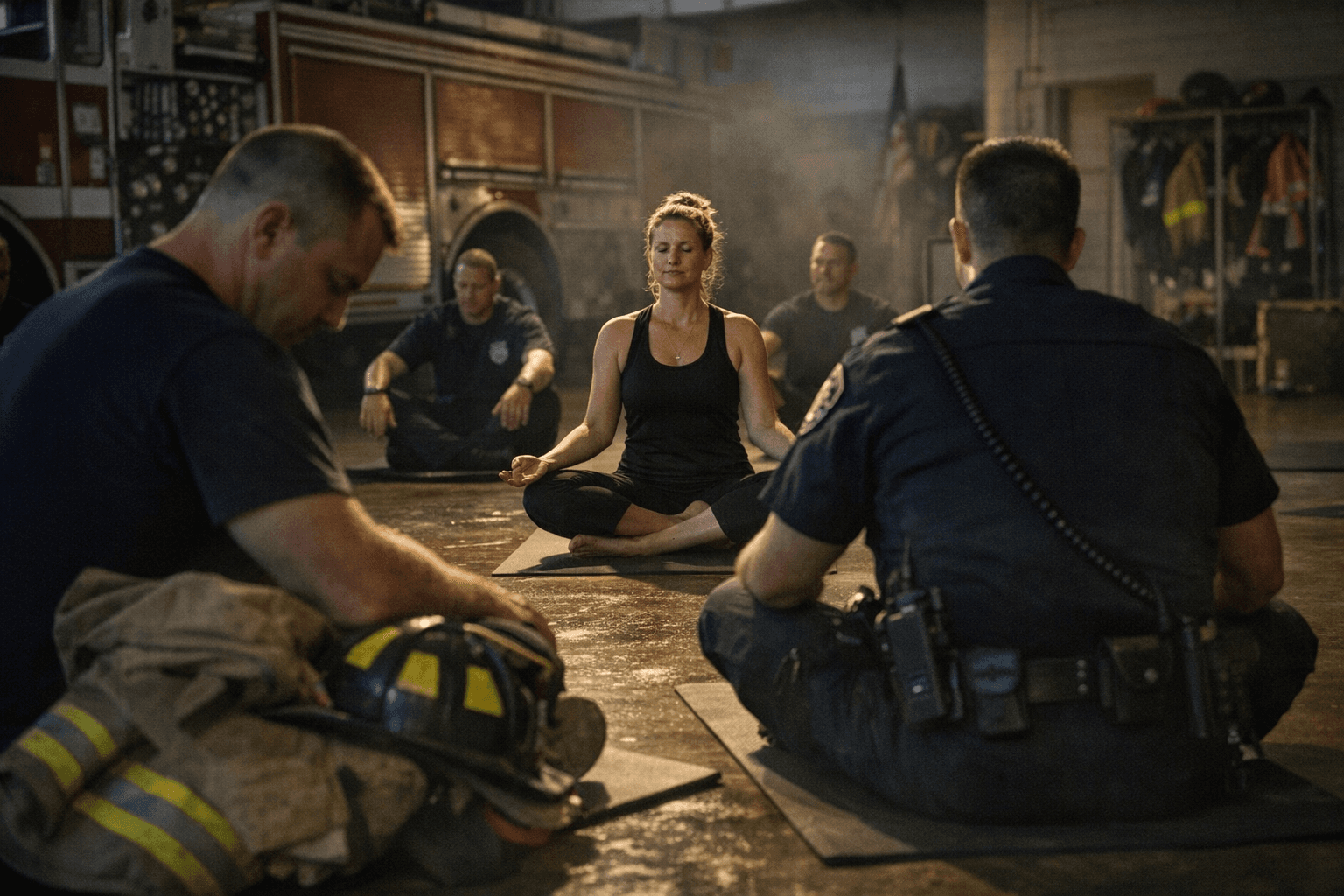
Yoga For First Responders, headquartered in Albuquerque, hosted its 38th Instructor School March 2 through 6 at the Bernalillo County Public Safety Training Academy, certifying and licensing instructors to bring a specific nervous-system-based protocol directly into fire departments, law enforcement agencies, EMS services and dispatch centers.
Founder and CEO Olivia Mead did not originally set out to create a national organization. Mead was a longtime yoga instructor teaching in studios across New York, Las Vegas and Los Angeles when she began questioning the direction mainstream yoga had taken. After more than a decade of building the program at departments across the country, she is now consolidating its training home. "Those 38 instructor schools have been all over the country, and we don't want to travel anymore, and so we're exclusively going to be doing open instructor schools only in Albuquerque," says Mead. "Albuquerque is now the home, the hub of the headquarters of yoga for first responders, and I am very proud of that."
The Instructor School in Albuquerque includes eight hours of online foundations training followed by five days and 50 hours of in-person intensive instruction, along with additional coursework and practice teaching. "Anyone can come to instructor school," says Mead. "We are not necessarily looking for yoga instructors specifically, because a lot of times you have to untrain things that aren't going to work for this population." Classes begin with breathwork, include a physical component and end with what Mead calls a neurological reset. "We tell them: You're here to learn how to process stress, build resilience and enhance performance," says Mead.
The research backing that claim grew from a study that started small. The program's research foundation grew organically when a research scientist approached Mead about conducting a doctoral study. The initial six-week online pilot showed "people's stress levels were going down and resilience was going up," Mead said. A follow-up in-person study demonstrated "a significant decrease in post-traumatic stress symptoms, a significant increase in resilience and cognitive reappraisal." The findings were sharpest among responders who had not yet crossed a clinical threshold: those showing early symptoms but not yet diagnosable with PTSD had "the most significant decrease," says Mead, "enough to say this could prevent post-traumatic stress in first responders."
To date, YFFR has trained over 300 instructors and introduced this new skill set to thousands of first responders and military personnel in the United States, Canada, Australia, and the Netherlands. In 2019 alone, YFFR reached over 150 departments in 35 states, and a total of 12,000 or more first responders and military personnel.
Instructor School tuition is $1,750, with a $300 annual licensing fee. Partial scholarships are available when funding allows. "It's very important for us that whoever needs it gets it," says Mead. The organization also operates on the principle that department budgets should not be a barrier; its programming is designed to fit any agency's schedule and environment, with costs varying by arrangement.
The organization offers free 45-minute classes twice a week that are open to the public and livestreamed. Beyond instructor training and department contracts, YFFR's platform includes YFFR On Demand and YFFR University for remote and self-paced access to its protocol.
More information on upcoming Instructor Schools, free community classes, and department partnership options is available at yogaforfirstresponders.org.
This article was produced by Prism’s automated news system from verified source data, official records, and press releases, then run through automated quality and moderation checks before publishing. The system is built and supervised by the people who set the standards it runs under. Read our full AI policy.
Did this article answer your question?