India positions yoga as preventive healthcare and cultural outreach
India is recasting yoga as daily prevention and soft power, pushing it into clinics, schools, offices, and screens. The shift stretches far beyond June 21.
Yoga as policy, not just practice
India is no longer talking about yoga only as a personal ritual on a mat. In a May 24, 2026 interview, Vaidya Rajesh Kotecha framed it as one of the country’s strongest tools of cultural outreach and a central pillar of preventive healthcare, a combination that gives the practice a new kind of political weight.
That matters because the ministry is describing yoga in the language of public systems, not lifestyle branding. Kotecha’s argument places yoga inside healthcare systems, schools, workplaces, and digital platforms, and presents its reach across more than 190 countries as proof that the practice now travels beyond geography, language, and culture. The point is not simply that yoga is popular. It is that India wants it understood as a scientifically supported public-health intervention.
There is a strong policy logic behind that pitch. The World Health Organization’s 2020 physical-activity guidelines emphasize that regular movement delivers significant health benefits and reduces health risks, while the National Center for Complementary and Integrative Health says yoga can support children and adolescents dealing with emotional, mental, physical, and behavioral health conditions. Put together, those frameworks help explain why yoga is being positioned not as an accessory to wellbeing, but as part of the prevention conversation itself.
From one observance to a year-round campaign
International Day of Yoga still sits at the center of the story, but it no longer functions like a one-day celebration in isolation. The United Nations General Assembly adopted the observance on December 11, 2014, through resolution 69/131 without a vote, giving June 21 a clear diplomatic origin and confirming that the campaign was always meant to be international.
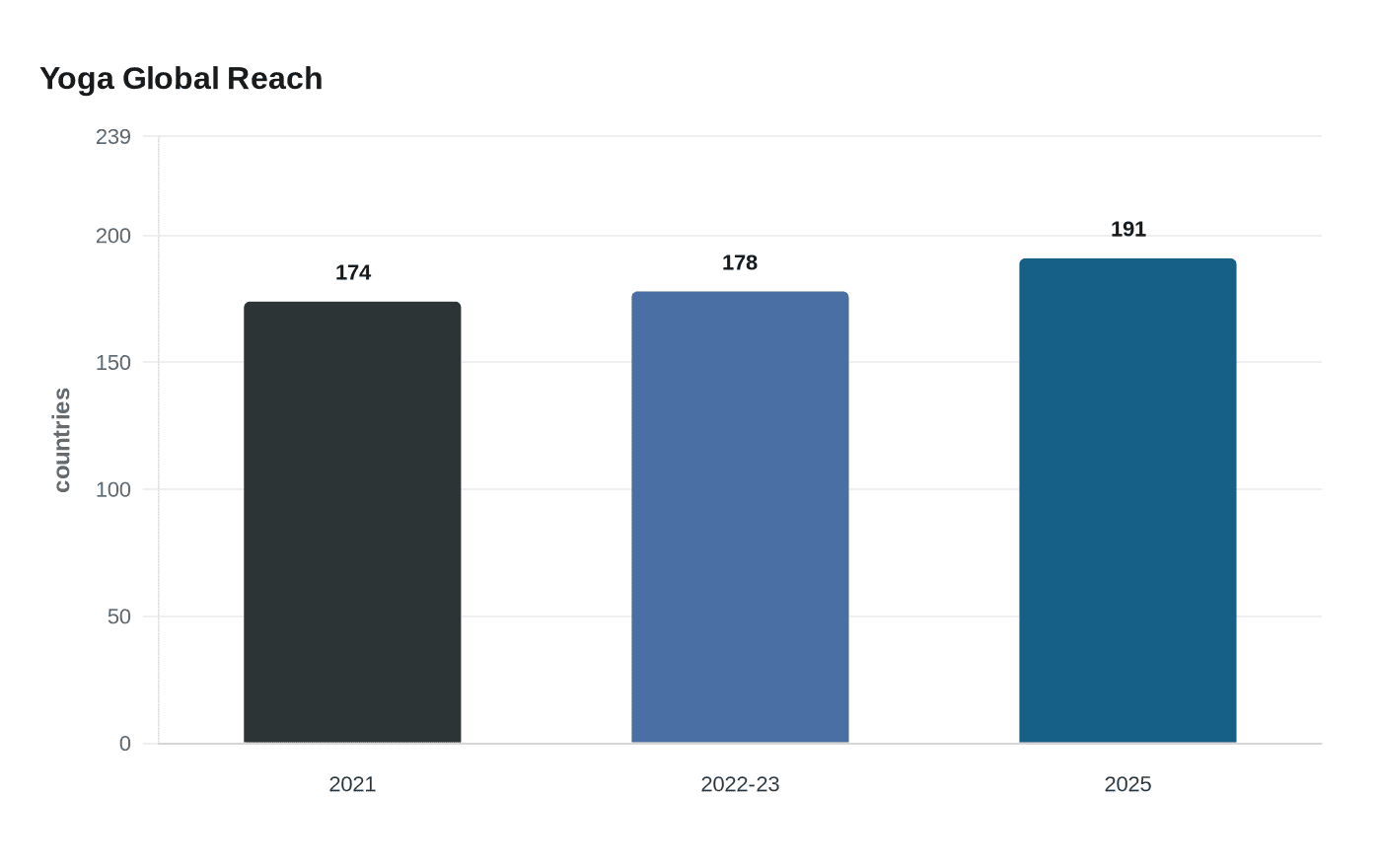
That global intent has widened over time. The Indian Council for Cultural Relations says it facilitated International Day of Yoga celebrations in 174 countries in 2021 and 178 countries in 2022-23. By 2025, the Press Information Bureau said the 11th International Day of Yoga featured more than 2,000 events across 191 countries, along with 1.3 million pre-registrations in India. The scale alone shows why the ministry sees yoga as more than a ceremonial export.
This year’s buildup is even more explicit. On March 13, 2026, Union Ayush minister Prataprao Jadhav launched Yoga Mahotsav-2026, marking the 100-day countdown to International Day of Yoga. The Ministry of Ayush followed with a high-level core committee meeting on April 28, 2026, to prepare for IDY 2026, and it paired the countdown with a new nationwide Yoga 365 campaign meant to make yoga a daily habit rather than a once-a-year event.
That shift changes the frame for everyone who practices or teaches. A day of mass participation still matters, but the real policy aim is no longer just a public demonstration in June. It is the slow normalization of yoga across the calendar, with government machinery, public institutions, and digital delivery all working toward the same habit-forming result.
What prevention looks like on the ground
The most concrete expression of the ministry’s new approach arrived in March 2026, when new yoga protocols for non-communicable diseases and target groups were launched. Reported targets include diabetes, hypertension, asthma, and mental health, with daily sessions of 30 to 60 minutes built around asanas, pranayama, meditation, and relaxation techniques.
That detail matters because it turns yoga from a broad wellness label into something much closer to a structured intervention. Once protocols are written around specific conditions and session lengths, the conversation shifts from “Do you do yoga?” to “How is it being deployed, for whom, and with what regularity?” That is a very different kind of public-health claim, and it invites a more standardized way of teaching.
The training ecosystem will feel that pressure. Teachers who work with government-aligned or health-facing programs are likely to encounter more protocol-driven expectations, where consistency, accessibility, and condition-specific framing matter alongside traditional sequencing and breath work. In practical terms, that means yoga education is being pulled closer to the vocabulary of prevention, rehabilitation, and population health.
Digital distribution is part of that same redesign. The Ministry of Ayush partnered with Habuild to provide free daily online yoga sessions, and in May 2026 it circulated a “100 Days Free Live Yoga Sessions” initiative to other government departments. Those moves signal that yoga is being treated as a repeatable service, one that can travel through screens, offices, and departmental networks instead of relying only on studio membership or elite wellness access.
For everyday practitioners, that creates a wider entry point and a broader public identity for the practice. Yoga is no longer being presented only as something you do for yourself in a class or at home. It is increasingly being offered as part of a civic routine, one that sits beside public-health messaging and workplace wellness in a way that feels distinctly contemporary.
Yoga’s global identity is becoming a state story
The diplomatic side of the project is impossible to miss. The same practice that appears in prevention protocols is also being used to strengthen people-to-people ties through diplomatic missions and international collaborations. That dual use is what makes the story larger than a typical wellness campaign, because yoga is functioning at once as health policy and soft power.
India’s pitch depends on that overlap. A practice embraced in more than 190 countries carries symbolic reach, but the ministry is trying to convert that symbolism into administrative rhythm, with digital classes, government department sessions, protocol-based use cases, and annual global observance all pointing in the same direction. In that sense, yoga’s identity is widening beyond studios and lifestyle content into something closer to national infrastructure.
The opening tension, between yoga as personal practice and yoga as state strategy, is now the defining feature of the moment. India is trying to keep both truths alive at once, and the clearest sign of where that leads is simple: the mat is still personal, but the policy is built for clinics, schools, workplaces, and screens, all year long.
This article was produced by Prism’s automated news system from verified source data, official records, and press releases, then run through automated quality and moderation checks before publishing. The system is built and supervised by the people who set the standards it runs under. Read our full AI policy.
Know something we missed? Have a correction or additional information?
Submit a Tip