Scholars Newcombe and Voix Preview Yoga Darśana Conference on Authenticity and Authority
The Open University's Suzanne Newcombe and Raphaël Voix of Université Paris Nanterre are previewing a Paris conference on yoga's legitimacy and knowledge transmission.
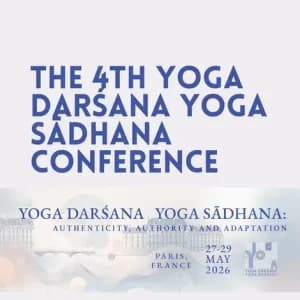
The New Books Network's "New Books in Indian Religions" podcast has just released an episode featuring Drs. Suzanne Newcombe from The Open University and Raphaël Voix from Université Paris Nanterre, offering an academic preview of one of the most intellectually ambitious yoga studies events of the year. The two scholars sat down with YogaResearch.org on March 17, 2026, in a conversation framed specifically around the 4th International Yoga Darśana Yoga Sādhana Conference, which convenes 27–29 May 2026 in Paris. For anyone who follows the serious scholarly conversation around yoga's histories, lineages, and contested claims to legitimacy, this is essential listening.
The Conference: What Is Yoga Darśana Yoga Sādhana?
The Yoga Darśana Yoga Sādhana conference series has built a reputation as a rigorous interdisciplinary meeting point for scholars approaching yoga through both textual and lived-practice lenses. The 4th iteration is organized by the Centre d'Etudes Sud-Asiatiques et Himalayennes (CESAH, CNRS-EHESS) in Paris and will take place at EHESS, the Ecole des Hautes Etudes en Sciences Sociales, one of France's leading institutions for the social sciences and humanities. CESAH's involvement signals a strong grounding in South Asian and Himalayan studies, positioning the conference squarely within the French academic tradition of rigorous area studies combined with comparative religious inquiry.
The conference's stated methodology is notable: it explicitly bridges philological and ethnographic approaches. That combination is still relatively uncommon in yoga scholarship, where text-focused classicists and fieldwork-driven ethnographers often operate in separate silos. Bringing both communities into the same room under a unified thematic framework is itself a scholarly statement.
The Theme: Authenticity, Authority and Adaptation
The conference theme, "Authenticity, Authority and Adaptation," is described by organizers as examining how yoga traditions establish legitimacy, transmit knowledge, and negotiate transformation across time and place. Each of those three terms carries enormous weight in contemporary yoga studies.
Questions of authenticity have become particularly charged in the last two decades as transnational yoga markets have expanded and practitioners, teachers, and lineage holders have disputed what counts as "real" yoga. Authority is equally contested: Who has the right to teach? Whose knowledge counts? How do guru-disciple relationships function when transplanted across cultural contexts? Adaptation, meanwhile, sits at the intersection of resilience and rupture, the process by which traditions survive, change, and sometimes fracture as they move through time and geography.
Framing all three concepts together, and situating that framework within both philological analysis of texts and ethnographic observation of living communities, suggests a conference that refuses easy answers. It is precisely the kind of conversation that serious practitioners and scholars have been circling around for years without a sufficiently structured forum.
The Scholars: Newcombe and Voix
Suzanne Newcombe is described by YogaResearch.org as a well-known scholar of contemporary yoga and religion, an accurate characterization for anyone who has followed the academic literature. Based at The Open University, Newcombe has produced work that takes seriously both the historical development of modern yoga and its reception in Western contexts, particularly in Britain. Her scholarship consistently asks how yoga becomes meaningful within specific cultural and institutional settings, which makes her an ideal interlocutor for a conference probing authenticity and authority.
Raphaël Voix, identified as a researcher and teacher affiliated with Université Paris Nanterre, brings a different but complementary angle. Paris Nanterre has a strong tradition in religious studies and the anthropology of South Asia, and Voix's dual identity as both researcher and teacher gestures toward the kind of embedded, practice-aware scholarship that the Yoga Darśana Yoga Sādhana series has consistently championed.
Together, the two represent a genuinely transatlantic pairing of institutional perspectives, which is worth noting given that much academic yoga discourse has historically been dominated by anglophone scholarship. A French academic co-hosting this conversation alongside a British one broadens that field of vision considerably.
Where to Find the Podcast Episode
The New Books Network episode featuring Newcombe and Voix is available now on all podcast platforms, according to the LinkedIn announcement shared by Dr. Raj Balkaran of The Indian Wisdom School. The New Books Network's "New Books in Indian Religions" series has become a valuable resource for tracking scholarly publishing in this space, with recent episodes covering Amy Landry's "The Ocean of Yoga" (published March 2, 2026), the Oxford Handbook of Tantric Studies with guests Richard K. Payne and Glen A. Hayes, and interfaith dialogue scholarship featuring Isaac Portilla. The Newcombe-Voix episode sits comfortably within that editorial line: serious, academically grounded, and accessible to engaged non-specialists.
The episode was also listed on the New Books in Indian Religions website with a date of March 9, 2026. The YogaResearch.org interview appeared on March 17, 2026. Whether these represent the same recording in different formats or two distinct conversations has not been confirmed, but between them they provide two access points into what Newcombe and Voix are thinking ahead of the May conference.
Why This Matters for the Yoga Studies Community
Yoga's credibility problems are not abstract. Lineage disputes, cultural appropriation debates, the commercialization of teacher training, and the fragmentation of traditional knowledge transmission are live and often heated conversations within studios, ashrams, and online communities every week. The Yoga Darśana Yoga Sādhana conference addresses these questions from a place of scholarly rigor rather than polemic, which is genuinely rare.
The fact that the organizing body is CESAH, a research center jointly associated with both the CNRS (France's national research center) and EHESS, adds institutional weight that the conference's themes demand. This is not a practitioner-facing wellness summit; it is an academic event that takes yoga seriously as a set of living traditions with complex, contested histories. Newcombe and Voix are exactly the right pair to preview it.
For those embedded in the yoga studies world, whether as practitioners curious about their tradition's intellectual heritage, teachers navigating questions of lineage and legitimacy, or researchers working at the intersection of South Asian studies and religious studies, the 4th International Yoga Darśana Yoga Sādhana Conference in Paris from 27–29 May 2026 represents one of the clearest opportunities this year to engage with these questions at the highest scholarly level.
This article was produced by Prism’s automated news system from verified source data, official records, and press releases, then run through automated quality and moderation checks before publishing. The system is built and supervised by the people who set the standards it runs under. Read our full AI policy.
Did this article answer your question?