גוגל מאתגרת את אנבידיה: מי ירוויח ממעבדי הבינה המלאכותית החדשים?
Google split its next AI chips into training and inference, and that narrows the gap between Nvidia headlines and the real winners in Israeli semis.
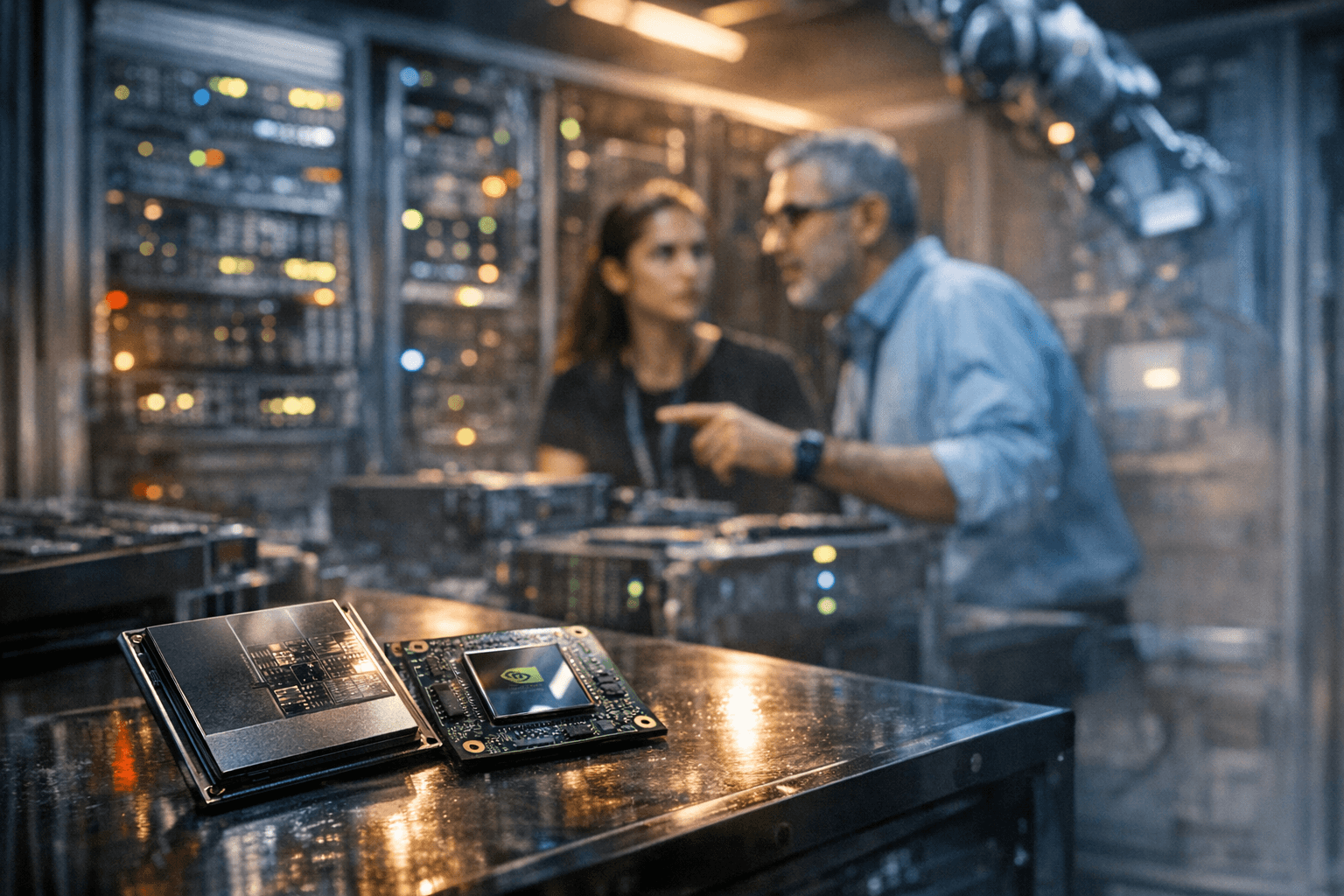
Google just redrew the AI-chip map. Its new TPU 8t and TPU 8i are not a cosmetic upgrade, they split training from inference and push more of the AI stack into Google’s own hands. For Israeli investors, that matters because Camtek, Nova and Tower do not sit in the same place in the chain, even if the market often trades them as one AI basket.
The broader message is simple: the AI buildout is moving beyond one merchant chip story. Google says the eighth-generation TPUs are built as two distinct systems for the full AI lifecycle, while Amazon, Microsoft and Meta have all been leaning harder into their own silicon and AI infrastructure. That shift does not kill demand for semiconductors; it changes where the money is made, from pure chip selling toward the equipment, metrology, packaging and process-control layers that keep the factories running and the yields high.
Why Google’s new chips matter
TPU 8t vs TPU 8i: training is not inference anymore
Google’s TPU 8t is built for massive model training, while TPU 8i is aimed at high-speed inference and the low-latency demands of AI agents. Google says the point is not just more FLOPS, but a better fit for workloads that now run from pre-training to post-training to real-time serving. That is a meaningful shift, because the economics of training a frontier model are not the same as the economics of serving millions of prompts or agent loops.
The technical split matters because it shows where hyperscalers think the bottlenecks really are. Google says the chips are part of its AI Hypercomputer, an integrated stack that combines hardware, software and networking, and it explicitly designed them to remove host-side data-prep bottlenecks. In plain English, Google is trying to own more of the bill, more of the architecture and more of the performance tuning.
The deeper message: control the stack, cut the bill
This is not just a Google move. Amazon says Trainium can lower training costs, Microsoft is pitching Maia 200 as an inference accelerator that changes the economics of token generation, and Meta says it is developing four new chip generations within two years to support ranking, recommendations and GenAI workloads. That is the real theme underneath the AI headlines: the largest customers do not want to rent the same silicon forever if they can design around it and improve their unit economics.
For chip investors, that is a double-edged sword. It keeps capital expenditure high, which is good for the picks-and-shovels layer, but it also means the market can stop treating every AI chip headline as a straight-line win for the same names. The right question is no longer “who sells the biggest GPU?”, but “who sells the tools, the controls and the capacity that make the whole stack work?”.
How the Israeli semiconductor names really map to AI
Camtek: the packaging and inspection layer
Camtek is not a chipmaker. It is a manufacturer of metrology and inspection equipment, with exposure to advanced packaging, memory, MEMS, CMOS image sensors, RF and related semiconductor segments. That sounds less glamorous than a GPU launch, but it is exactly where AI complexity starts to bite the factory floor, because advanced AI systems demand tighter process control, more layers and fewer defects.
If Google and the hyperscalers keep pushing custom silicon and higher-density systems, Camtek can benefit through the packaging and inspection budget, not because it sells the accelerator itself. The market often collapses that distinction, but it should not. Camtek gets paid when manufacturers need better inspection and metrology around increasingly complicated packages and wafers, not when a keynote mentions AI.
Nova: closer to the fab floor, closer to leading-edge complexity
Nova sits a step deeper in the manufacturing loop. The company describes itself as a leader in thin-film metrology and process control, with in-line materials metrology close to the fab’s process and integration needs. It also sells chemical metrology and software tied to advanced packaging and front-end dual-damascene steps, which is exactly the kind of precision work that becomes more valuable as chips get denser and margins get tighter.
That makes Nova the more direct bet on semiconductor complexity rather than on AI branding. If AI pushes more advanced nodes, more packaging layers and more yield-sensitive production, Nova has a cleaner link to that spending cycle than a stock that merely benefits from the word “AI” being attached to a press release. For an Israeli portfolio, that distinction is critical, because Nova’s upside is tied to process intensity, not to the number of times Nvidia gets mentioned on a trading screen.
Tower: useful, but not an AI pure play
Tower is a different animal. It is a foundry focused on high-value analog semiconductor solutions and says it serves more than 300 customers in mobile, infrastructure, automotive, medical, industrial, consumer and aerospace and defense. That business is relevant to the AI era, but indirectly, because AI infrastructure still needs power management, RF, imaging, connectivity and other analog building blocks.
Tower can win if AI infrastructure keeps driving demand for the supporting plumbing, including power-related silicon and networking components. But it is not the same trade as a pure AI accelerator supplier, and it should not be priced as if every TPU headline automatically translates into the same earnings leverage. Tower’s exposure is real, just more diffuse and much less explosive than the market sometimes assumes.
Where the market may be over-reading the AI narrative
Nvidia headlines can lift the whole sector, but revenue does not move in lockstep
This is where the rally gets messy. A Google TPU launch can support the AI capex story, but it also reminds investors that custom silicon can spread demand across more suppliers and more layers, instead of concentrating all the upside in one company. If a stock has already rerated on a broad AI narrative, the market starts paying for perfection long before the next purchase order shows up.
In practice, that means the Israeli chip names should not be treated as a single trade. Camtek and Nova are closer to the infrastructure of AI manufacturing, so they have a clearer link to rising complexity and tighter tolerances. Tower is more of an enabling foundry story, useful in the AI world but not a direct proxy for TPU demand. That difference is exactly where investors can separate a real AI beneficiary from a stock that is simply wearing the right narrative.
Why this matters in Tel Aviv
For Israeli investors, the trap is even more obvious because these names trade in a market that loves a clean story. A shekel-denominated portfolio can get pulled into the same AI headline cycle as Nasdaq traders, even though the underlying businesses are not interchangeable. The easy mistake is to buy the whole sector as if every company were a GPU supplier; the better approach is to ask which one actually gets paid when factories need better inspection, tighter process control or more analog capacity.
שאלות נפוצות
Does Google’s TPU launch replace Nvidia?
No. It challenges the idea that all AI compute must come from one supplier, but Google is still building for its own stack and its own workloads. The bigger shift is toward more custom silicon across the hyperscalers, which spreads demand across training, inference and the tooling around them.
Which Israeli stock has the cleanest AI exposure?
Nova is the closest to the fab-floor complexity that AI drives, while Camtek is strongly tied to advanced packaging and inspection. Tower is relevant, but mostly through the supporting analog and infrastructure layers rather than through direct AI accelerator exposure.
Does custom silicon help or hurt semiconductor suppliers?
Both. It can reduce dependence on merchant chips and pressure some parts of the market, but it also increases total infrastructure spending and raises demand for metrology, packaging, process control and specialty manufacturing. That is why the winners are usually the companies that sit closest to the bottlenecks, not the ones with the loudest AI slogan.
יודעים משהו שפספסנו? יש לכם תיקון או מידע נוסף?
שלחו טיפ