9 April Birthstone Jewelry Ideas for Every Style and Budget
Diamond's Mohs 10 hardness makes it April's most durable birthstone, but the right piece depends on budget, setting, and how often you plan to wear it.
Long before De Beers coined a slogan, the diamond earned its place as a symbol of permanence. The tradition of birthstones traces back to the breastplate of Aaron described in Exodus: twelve stones, one for each tribe of Israel. Scholars connect that ancient text to the modern standardized list formalized in 1912 by the American National Retail Jewelers Association, which assigned diamond to April. More than a century later, that assignment still holds, and the diamond remains the most coveted birthstone precisely because it is the hardest natural substance on earth, scoring a perfect 10 on the Mohs scale. That number matters more than most buyers realize: a crystal or rock quartz piece scores only 6 to 7 on the same scale, meaning daily wear will dull and abrade it in ways that diamond simply will not allow. Every recommendation below accounts for that distinction. Here is a fast reference before you read further:
- Budget pick: crystal-studded signet ring or CZ-set cufflinks, $50-$300
- Best for daily wear: bezel-set diamond pendant or lab-grown stud earrings
- Best for gifting: classic solitaire pendant or diamond stud earrings
Fast Chooser
Classic Four-Prong Diamond Solitaire Pendant
The four-prong solitaire pendant is the piece that defines April birthstone jewelry because no setting does more to let a diamond perform. Four slender prongs lift the stone away from the metal, maximizing the angles at which light can enter and exit, producing the white flash that distinguishes a diamond from every alternative. In 14k white gold with a round brilliant of 0.25ct to 0.50ct, expect to pay $500 to $2,500 for a natural stone; moving to 0.75ct to 1ct pushes the range to $3,000 and well beyond, depending on cut grade and color. The value justification here is durability: diamond's Mohs 10 hardness means the stone will outlast the chain, the clasp, and, in all likelihood, several wardrobe overhauls. For an April birthday gift that announces its intention clearly, nothing else comes close.
Bezel-Set Diamond Pendant
Where the prong solitaire maximizes brilliance, the bezel-set pendant maximizes practicality. A full bezel encircles the diamond with a continuous rim of metal, shielding the girdle from impact and eliminating the snagging risk that four exposed prongs carry. The result is a low-profile, architectural silhouette that sits flush against the collarbone. This is the setting of choice for active wearers: nurses, athletes, anyone whose hands and neck encounter frequent contact. In 14k yellow or rose gold with a 0.25ct natural diamond, prices start around $400; opt for a lab-grown stone of the same carat weight and the entry price drops toward $200 to $300, with identical Mohs 10 hardness. The bezel is also quietly gender-neutral: its clean geometry reads as refined on any neckline.
Diamond Stud Earrings
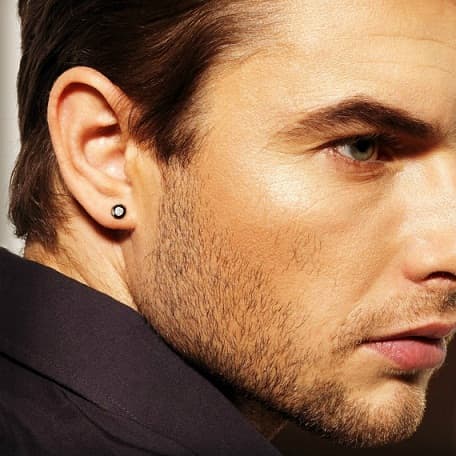
If the solitaire pendant is the gift that announces itself, the diamond stud earring is the one that quietly elevates everything else. A matched pair in four-prong basket settings in 14k white gold, totaling 0.50ct, sits comfortably in the $300 to $1,200 range for lab-grown stones; natural equivalents begin closer to $800. Push to 1.0ct total weight and natural stones move into $2,500 to $5,000 territory. The stud earring's case for daily wear rests not just on Mohs 10 hardness but on the low profile: there is nothing to catch on a scarf, tangle in hair, or announce itself when discretion is preferred. For April birthdays, a boxed pair of diamond studs remains among the most reliable gifts in jewelry because they are genuinely wearable by nearly anyone, regardless of personal style.
Diamond Tennis Bracelet
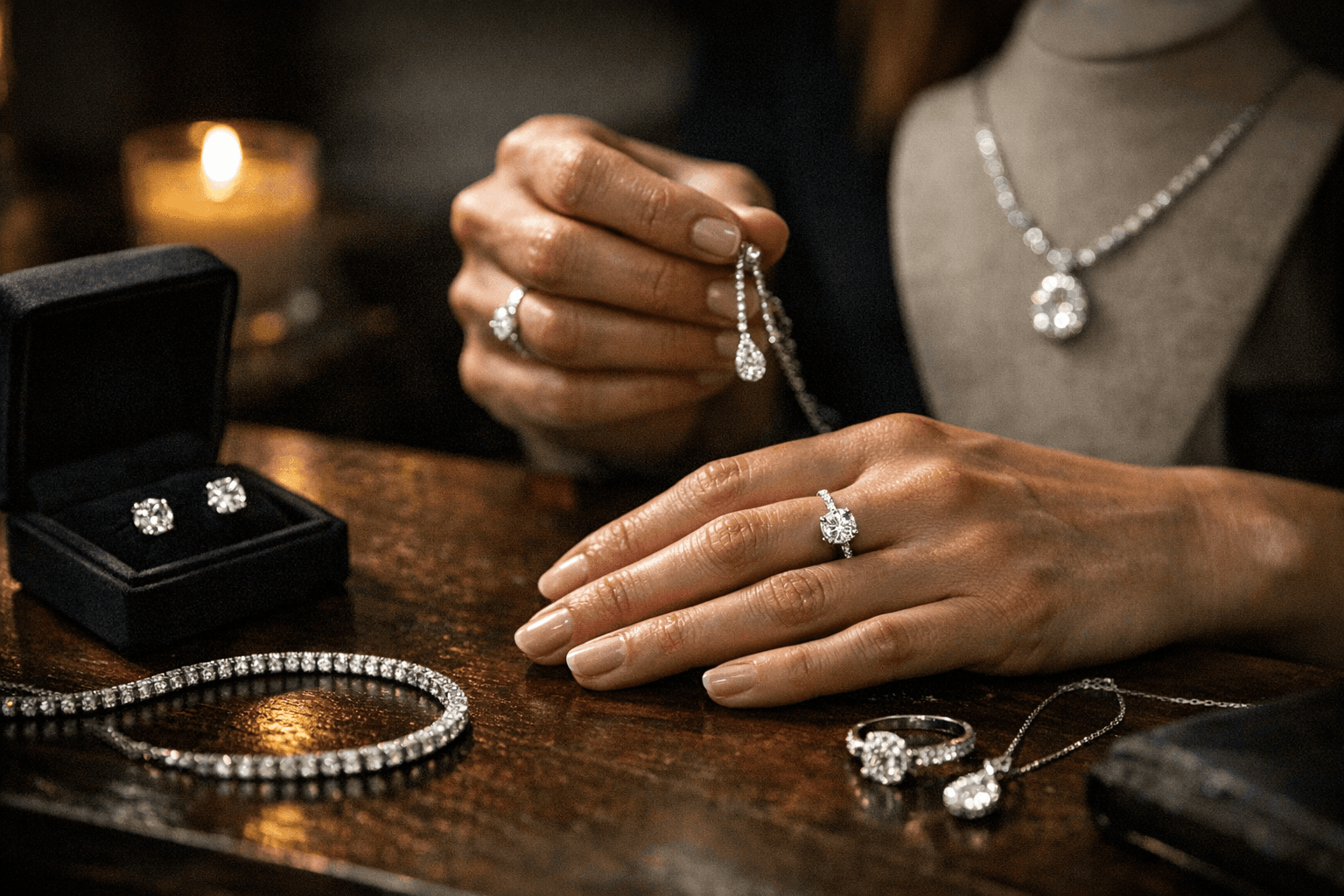
The diamond tennis bracelet carries its own lore. At the 1987 US Open, Chris Evert stopped a match to search for a diamond bracelet that had snapped off her wrist mid-game. The association of the piece with that moment is the origin of the name "tennis bracelet," and the design itself, a continuous line of individually set round brilliants, has remained one of the most recognizable configurations in fine jewelry. Channel settings, which house each stone in a grooved metal track, offer superior protection compared to prong settings for this style because no metal protrudes to snag fabric. A 14k white gold channel-set bracelet of 2ct total weight starts around $1,200 in lab-grown diamonds; natural stones in the same specification begin near $3,500. For April birthdays that call for a statement, this is the piece.
Pavé Diamond Band Ring
The pavé band ring is where diamond jewelry becomes genuinely democratic. Rather than a single focal stone requiring significant per-carat investment, the pavé configuration uses many small diamonds set tightly together with tiny bead prongs, producing a continuous surface of sparkle at a far lower cost per visible area of brilliance. A 14k gold band pavé-set with melee diamonds of 0.25ct to 0.50ct total weight runs $400 to $1,500, depending on metal and stone quality. The trade-off: small prongs require more careful handling than a bezel, and re-tipping can add maintenance cost over time. Still, for an April birthday ring that telegraphs diamond without the investment of a solitaire, the pavé band earns its place.
White Sapphire Alternative Ring
For buyers who want genuine gemstone quality without diamond pricing, white sapphire is the most defensible choice. Part of the corundum family, the same mineral that produces ruby and blue sapphire, white sapphire scores 9 on the Mohs scale. That single point below diamond is significant: measured by absolute abrasion resistance, the gap is far wider than the number implies, and white sapphire will show micro-scratching on its facet edges over years of daily wear in ways that diamond will not. But against glass crystal, CZ, and white topaz, white sapphire is substantially more durable and carries a genuine gemological pedigree. A 1ct white sapphire solitaire ring in 14k gold starts around $300 to $600, versus $3,000 or more for a comparable natural diamond. For the April birthday recipient who values the symbolism of a clear, brilliant stone without the investment, white sapphire is an honest, beautiful option.
Diamond Birthstone Cufflinks
The cufflink is the most underrated format in birthstone jewelry, which is precisely why it works. A pair of pavé-set round brilliant cufflinks in 14k yellow gold with natural diamond accents occupies a category most people do not shop for an April birthday, which guarantees the gift will be remembered. Natural diamond-set gold cufflinks start around $800 to $1,200; sterling silver with high-quality CZ stones, which score 8 to 8.5 on the Mohs scale, offer an entry point from $100 to $400. The bezel or closed-back setting used in most cufflink designs protects stones far better than open-prong rings, making even the CZ versions credible daily-wear pieces. These also work well beyond formal occasions: a simple, flat-face diamond cufflink reads as quietly distinguished with a relaxed French-cuff shirt.
Crystal-Studded Signet Ring
The signet ring has completed one of jewelry's most striking rehabilitations, moving from heraldic tradition to gender-neutral wardrobe staple. Crystal-studded versions, typically set with rock crystal or glass, hit a price point, $50 to $300, that makes the April birthstone accessible to buyers at any stage of their relationship with fine jewelry. The important caveat: rock crystal scores 6 to 7 on the Mohs scale, meaning a daily-wear signet ring will show surface wear faster than a diamond or white sapphire piece. A bezel or channel setting, rather than an open pavé, reduces the risk of stone loss. In sterling silver with an oval crystal face, the contemporary signet pairs well with minimalist fashion jewelry stacked on adjacent fingers. Think of this as the style entry point, the piece that makes the April birthstone wearable before a buyer is ready to invest in diamond.
Lab-Grown Diamond Layering Pendant Necklace
The clearest value story in April birthstone jewelry right now is the lab-grown diamond layering pendant. Lab-grown diamonds are chemically, physically, and optically identical to their mined counterparts: both score 10 on the Mohs scale, both are pure carbon in cubic crystal structure, and both carry GIA grading. The price difference is the entire argument: lab-grown stones typically sell for 50 to 75 percent less than natural equivalents of the same cut, color, and clarity grade, bringing a 0.50ct round brilliant pendant in 14k gold into the $300 to $700 range. In a layering context, that pricing allows for multiple pieces at different chain lengths, a 16-inch choker-adjacent length paired with an 18-inch drop, without requiring a significant individual investment in each. For the April birthday wearer who approaches jewelry as a wardrobe system rather than a single heirloom, the lab-grown layering pendant is where the conversation starts.
The most surprising number in this entire category has nothing to do with price: it is the hardness gap between the pieces at the top and bottom of this list. Diamond sits at Mohs 10; white sapphire at 9; rock crystal at 6 to 7. That span, from a crystal signet to a diamond solitaire, represents the full range of April birthstone jewelry, from fashion accessory to generational piece. Knowing where each stone falls on that scale is what separates a considered purchase from a disappointing one.
This article was produced by Prism’s automated news system from verified source data, official records, and press releases, then run through automated quality and moderation checks before publishing. The system is built and supervised by the people who set the standards it runs under. Read our full AI policy.
Did this article answer your question?