April Birthstones: Learn the Meaning, Color, History
A 1-carat lab-grown diamond retails for around $759; the natural equivalent averages $4,200. For April buyers, that gap changes everything about what "birthstone" means.
Somewhere around 1,200 B.C., a high priest named Aaron wore a ceremonial breastplate embedded with twelve gemstones, each stone representing one of the twelve tribes of Israel. Writing in the first century A.D., the historian Josephus drew a connection between those twelve stones and the twelve months of the calendar year, planting the seed of what would become one of jewelry's most enduring traditions. Today, if you were born in April, that tradition lands you the diamond: the hardest substance found in nature, a crystal that forms roughly 100 miles below the Earth's surface under extraordinary heat and pressure, and a gem whose significance stretches from Sanskrit texts before 400 B.C. (which associated crystals with deep value and mystery) to every fine jewelry counter in every city on Earth.
The National Association of Jewelers formally standardized the birthstone list in 1912, cementing diamond as April's modern stone. But the longer you sit with this particular birthstone, the more interesting the buying decision becomes. Especially now, when a 1-carat lab-grown diamond retails for roughly $759 while a comparable natural stone averages about $4,200. That gap does not just affect price. It reframes the entire question of what you are actually buying.
The Symbolism Behind the Stone
Diamond's cultural résumé is substantial. Across centuries and cultures, the stone has signified strength, clarity, innocence, and enduring love. The Latin word *adamas*, from which "diamond" derives, translates roughly as "unconquerable." In ancient Rome, diamonds were believed to carry protective spiritual energies. An 1870 poem described the stone as "an emblem of innocence," a phrase that captures the emotional register April babies have inherited.
Interestingly, sapphire once held the April spot in certain historical traditions; it was the modern 1912 standardization that locked diamond in as the month's definitive gem. Before that committee decision, birthstone assignments varied by country and era. Knowing that history doesn't diminish the diamond's resonance; it just makes the tradition honest about its origins.
Choosing Your April Stone: A Decision Tool
The most consequential choice for an April birthstone buyer isn't which setting to use. It's which stone. Here is a direct comparison across the factors that matter most.
Natural Diamond
- Symbolism: The only option carrying centuries of unbroken cultural standing as April's stone; associated with rarity, permanence, and enduring love
- Durability: Mohs 10, the hardest naturally occurring material on Earth; only another diamond can scratch it
- Typical per-carat pricing: $3,000 to $6,000-plus at retail for a 1-carat stone, averaging around $4,200 depending on cut, color, and clarity
- Trade-offs: Higher upfront investment; natural diamonds retain more resale potential than lab-grown stones, though that value fluctuates with the broader market. The scarcity argument is real: no two natural diamonds formed under identical conditions
- Best for: Buyers prioritizing geological rarity, long-term sentimental weight, and the fullest expression of fire and brilliance
Lab-Grown Diamond
- Symbolism: Chemically and physically identical to a natural diamond, the same carbon crystal structure, the same optical properties, the same Mohs 10 hardness. The distinction is origin, not material
- Durability: Identical to natural diamond, Mohs 10
- Typical per-carat pricing: Approximately $725 to $759 for a 1-carat round; around $800 to $827 for a 1-carat oval; roughly $1,700 for a 2-carat round
- Trade-offs: Lab-grown diamond prices have declined sharply in recent years, with wholesale rates dropping roughly 26% in 2025 before stabilizing in 2026. Industry observers now characterize lab-grown stones as consumer goods rather than investment assets. A stone bought today carries limited resale value
- Best for: Buyers who want diamond's optical performance and durability at a dramatically lower price, particularly for gifting or fashion-forward settings where resale is not a consideration
White Sapphire (and Other Clear-Stone Alternatives)
- Symbolism: No formal April birthstone designation, though white sapphire is a genuine precious gemstone associated with purity and wisdom, with no conflict-provenance concerns
- Durability: Mohs 9, extremely durable and appropriate for daily wear, though more susceptible to surface wear over years than a diamond
- Typical per-carat pricing: Considerably more affordable than either diamond option; price varies by quality and whether the stone is natural or lab-created
- Trade-offs: Noticeably less brilliance and fire. Where a diamond scatters white light into spectral flashes, a white sapphire produces a softer, more subdued glow. It is beautiful, but it reads differently. White topaz (Mohs 8) is the most accessible clear-stone option by price, well-suited for pendants and earrings but less ideal for rings worn every day
- Best for: Buyers seeking a natural precious gemstone with real durability at a fraction of the diamond cost, or those who prefer a quieter visual register
One critical note on marketing language: "diamond-like" is not a regulated term. Cubic zirconia and moissanite are frequently sold as diamond alternatives. Moissanite is a durable lab-created stone with legitimate optical merit, but neither CZ nor moissanite is a diamond of any kind, natural or lab-grown. A retailer selling a "diamond simulant" is selling something materially and legally different from a lab-grown diamond. That distinction should be explicit in any description and on any receipt.
What Certifications Actually Tell You
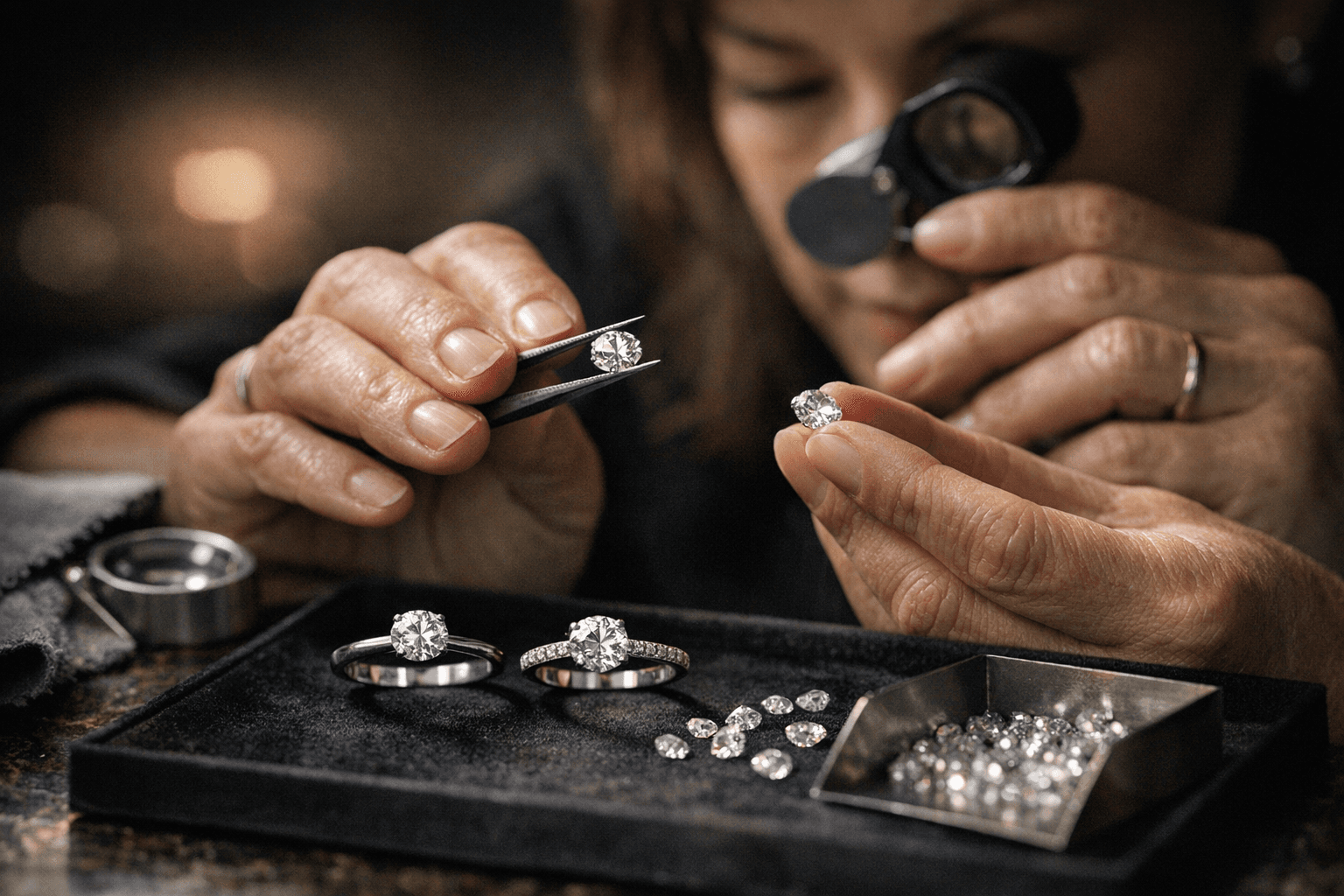
No conversation about buying a diamond is complete without the certification question. Two organizations define this space: the Gemological Institute of America (GIA) and the International Gemological Institute (IGI).
The GIA, founded in 1931, essentially built modern diamond grading. Its standards are widely considered the industry's most conservative and rigorous. A GIA VS1 grade means something precise and consistent, and the institute's grading reports command a price premium because buyers and resellers trust them. For natural diamonds, particularly stones above one carat, GIA certification offers the clearest accountability. The GIA updated its lab-grown grading program in 2020, but its dominant presence remains in the natural-diamond market.
IGI, founded in 1975 and headquartered in Antwerp, is the go-to certification body for lab-grown diamonds. Its grading is considered somewhat less strict than GIA's. Industry analysis suggests IGI has historically assigned higher grades than GIA would assign to comparable stones, which affects both the price and the perceived quality of IGI-certified stones. An IGI D/VVS2 and a GIA D/VVS2 may not describe identical stones. That said, IGI certification is widely accepted and provides a credible baseline, particularly in the lab-grown segment.
Practical guidance:
- For natural diamonds: prioritize GIA certification, especially above one carat
- For lab-grown diamonds: IGI certification is standard and serviceable; read grades with a degree of skepticism and compare to GIA-graded alternatives where possible
- For any stone: ask specifically whether the certificate covers origin (natural vs. lab-grown) and whether any treatments have been applied
The Four Cs, Prioritized
The 4 Cs framework, cut, color, clarity, and carat weight, was developed by the GIA and is now used universally. Of the four, cut has the greatest impact on how a diamond actually looks. A well-cut stone in the H color range will outperform a poorly cut D-color stone in most lighting conditions. Obsessing over color and clarity grades while ignoring the cut grade optimizes for the certificate rather than the stone itself. For April birthstone jewelry worn daily, cut deserves more weight than it typically gets.
How to Wear It
For everyday wear, a solitaire pendant on a fine chain or simple stud earrings remain the most enduring expressions of April's birthstone. Clean, versatile, and legible in any metal, they translate across wardrobes without demanding coordination. White gold and platinum complement a colorless diamond's cool optical properties naturally; yellow gold creates deliberate contrast that has moved from vintage territory into contemporary styling.
For more directional work, mixed-metal settings, yellow gold prongs holding a white-set brilliant, or rose gold bezels around a round solitaire, borrow from vintage jewelry vocabulary while reading entirely current. Fancy-colored diamonds, pale champagne, soft yellow, warm cognac tones, open different styling possibilities and push against the assumption that April's stone must always be colorless and austere.
The case for lab-grown diamonds in fashion-forward or high-carat settings is particularly compelling at current price points. A 2-carat oval lab-grown stone now costs roughly what a well-cut natural half-carat would, which materially expands what is achievable within a given budget.
The Purchase Path
The most useful way to approach an April birthstone purchase is to decide, upfront, whether you are buying a material or a story. A natural diamond carries geological provenance, scarcity, and a cultural lineage running from Aaron's breastplate through the 1912 standardized list to the present. A lab-grown diamond gives you the same crystal structure, the same hardness, the same brilliance, at a price that has fundamentally shifted what diamond jewelry can cost. A white sapphire offers genuine precious-stone quality without the diamond premium, at the trade-off of some fire.
None of these is a wrong answer. But each requires a different verification approach: GIA documentation for natural stones, IGI grading reports for lab-grown, and a retailer willing to state origin clearly for any alternative. The certificate is not the stone, but it is the first line of accountability between buyer and seller, and for a gem with as long a history as this one, knowing exactly what you hold matters.
This article was produced by Prism’s automated news system from verified source data, official records, and press releases, then run through automated quality and moderation checks before publishing. The system is built and supervised by the people who set the standards it runs under. Read our full AI policy.
Did this article answer your question?