Aquamarine, March's Birthstone, Captivates With Its Clear, Quiet Blue
Aquamarine's cool, clear blue makes it one of the most wearable birthstones — here's what to know before you buy.
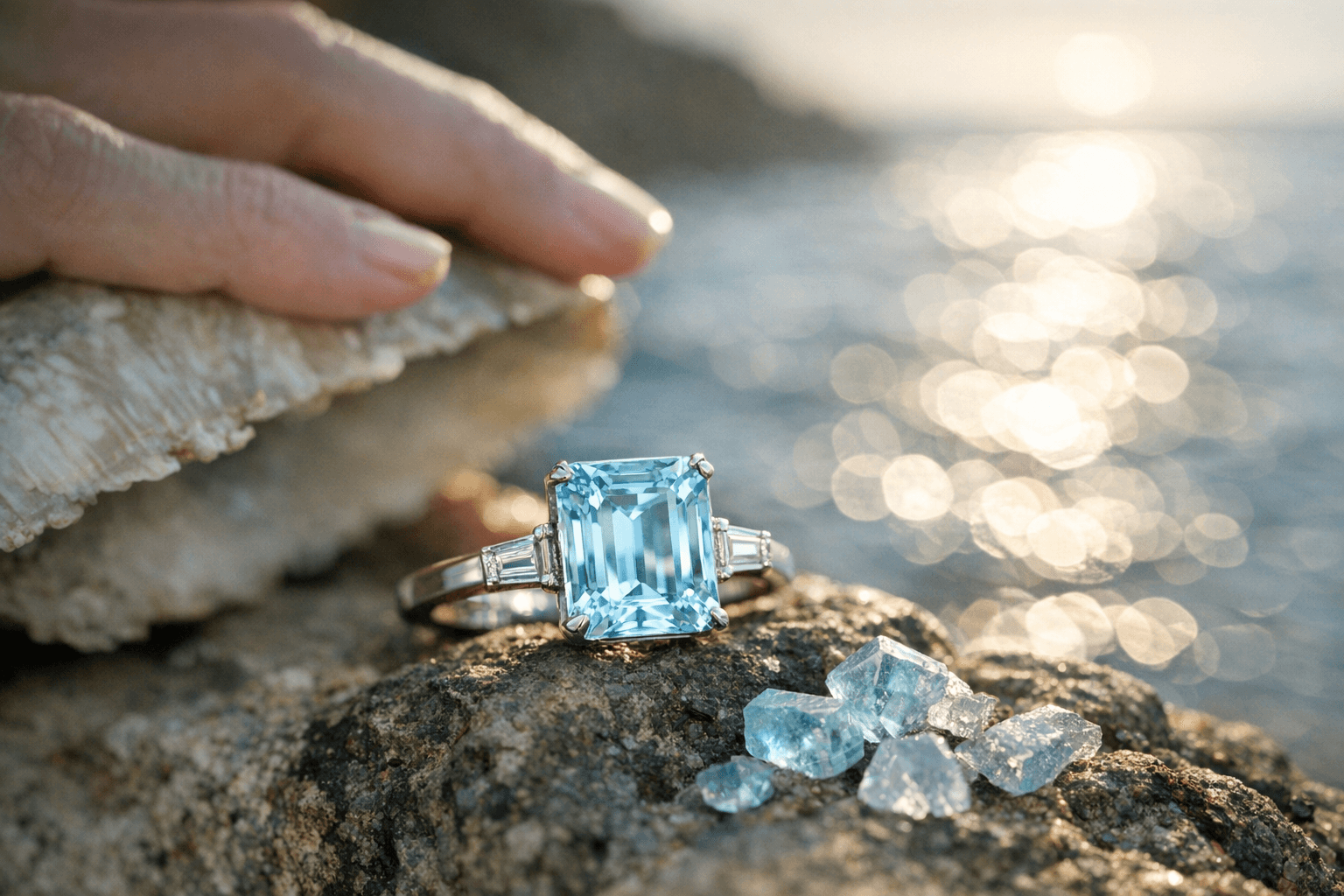
There is a particular quality to aquamarine's color that photographs cannot fully capture. In person, the stone reads like still water held up to morning light: not the saturated cobalt of sapphire, not the murky teal of some tourmalines, but a clear, quiet blue that seems to generate its own calm. For anyone born in March, or simply drawn to that cool transparency, aquamarine occupies a singular place in the gem world.
What makes aquamarine distinctive
Aquamarine belongs to the beryl family, the same mineral group that produces emerald and morganite. Its blue color comes from trace amounts of iron within the crystal structure, and the range runs from nearly colorless with a whisper of blue to a medium, saturated blue-green that gem traders sometimes call "Santa Maria" after the Brazilian mine where particularly vivid examples were historically sourced. The most commercially valued stones lean toward a pure, medium-toned blue rather than a greenish cast, though personal preference rightly overrides market convention when you are choosing a stone to wear every day.
Aquamarine's clarity is one of its defining characteristics. Unlike emerald, which almost always contains inclusions that gemologists politely call a "jardin," aquamarine typically grows with very few internal flaws. That natural transparency is part of what makes it so appealing in larger sizes: a clean, well-cut aquamarine of five or ten carats can be surprisingly affordable compared to sapphire of equivalent dimensions, and the stone carries the weight of size without looking muddied or dark.
Understanding the cut
Because aquamarine is pleochroic, meaning it shows different colors when viewed from different angles, a skilled cutter's job is to orient the stone so the most desirable blue faces up through the table. The classic choice for aquamarine is the emerald cut, a rectangular step cut with cropped corners that showcases the stone's transparency and lets light move through it in broad, glassy flashes. Oval and cushion cuts are also popular, softening the stone's geometry while retaining that sense of depth. Rounds and pear shapes work well in jewelry that needs the stone to play nicely with light from multiple directions.
What to avoid: shallow cuts that make the stone look washed out, or overly deep pavilions that darken the color and add weight you are paying for but not seeing. If you are buying online, ask for a side-profile image alongside the standard top-down shot.
Setting considerations
Aquamarine sits at 7.5 to 8 on the Mohs hardness scale, making it durable enough for rings with reasonable care, though it is more vulnerable to knocks than sapphire or diamond. For everyday rings, a bezel setting or one with protective prongs at the corners makes practical sense. In earrings and pendants, where the stone is less exposed to impact, you have more freedom: a simple four-prong solitaire pendant lets the stone's color speak without competition.
White metals, particularly platinum and white gold, are the traditional pairing for aquamarine because they reinforce the stone's cool tonality. Yellow gold creates an interesting contrast, warming the composition without muddying the stone's color. Rose gold has become increasingly popular in recent years, and while the combination is undeniably pretty, it can push the stone's blue toward a more muted, grayish read depending on lighting conditions. Worth seeing in person before committing.
Provenance and what to ask
Brazil has historically been the dominant source of fine aquamarine, with the state of Minas Gerais producing stones of exceptional size and clarity. Other significant sources include Nigeria, Madagascar, Pakistan's Karakoram region, and Mozambique. Unlike diamonds, aquamarine does not yet have an industry-wide provenance certification system equivalent to the Kimberley Process, which means the burden of asking falls on the buyer.
When purchasing, ask the jeweler directly: Where was this stone mined? Can they trace it to a specific country of origin, and ideally to a specific mine or supplier? Reputable dealers who work with small-scale or artisanal mining operations will often know this information and be proud to share it. Vague answers like "ethically sourced" or "conflict-free" without documentation are not sufficient. Those phrases cost nothing to print and prove nothing about labor conditions or environmental impact.
For a gemological certificate, the Gemological Institute of America (GIA) and the Swiss Gemmological Institute (SSEF) both issue reports for aquamarine that confirm species, origin, and whether any heat treatment has been applied. Heat treatment is standard and accepted practice in aquamarine, used to reduce greenish tones and produce a cleaner blue; a reputable seller will disclose this proactively. What you should be more cautious about is synthetic or simulant stones, particularly blue glass or synthetic spinel sold without disclosure.
Caring for aquamarine jewelry
Aquamarine is relatively low-maintenance as colored stones go.
- Clean with warm water, mild dish soap, and a soft brush. Avoid ultrasonic cleaners if the stone has significant inclusions or fractures.
- Store separately from harder stones like diamonds and sapphires, which can scratch the surface.
- Remove aquamarine rings before activities that involve hard impact: gardening, moving furniture, gym work.
- Prolonged exposure to intense direct sunlight can, over years, cause some fading in lighter stones. Occasional wear poses no risk; permanent display in a sunny window does.
The wider meaning of March's birthstone
Aquamarine has carried maritime associations for centuries. Sailors reputedly carried the stone as a talisman for safe passage, and its Latin root, "aqua marina," meaning sea water, reflects how naturally the color evokes open water. Whether or not you place weight in the symbolic dimension, there is something apt about a stone whose defining quality is clarity being associated with the month when winter begins to loosen its grip.
For March birthdays, aquamarine offers something relatively rare in the birthstone calendar: a gem that is both genuinely beautiful and accessible across a range of budgets. A small, well-cut aquamarine in a simple sterling silver setting can be found for under a hundred dollars. A fine, deeply colored stone of several carats in a platinum setting represents a serious jewelry investment. The range is part of its appeal, and the stone's quiet, clear blue holds up across all of them.
This article was produced by Prism’s automated news system from verified source data, official records, and press releases, then run through automated quality and moderation checks before publishing. The system is built and supervised by the people who set the standards it runs under. Read our full AI policy.
Did this article answer your question?