Aquamarine Rounds: Spring Equinox, Aries, and the Geometry of Wholeness
Buying a round aquamarine means losing up to 85% of the rough; here's what that sacrifice buys you in sparkle, durability, and price.
The ancient Romans called it *aqua marina*, water of the sea, and sailors carried it as a talisman against drowning. Scholars who have studied the twelve stones of Aaron's priestly breastplate in Exodus believe the eighth stone, tarshish, may refer to beryl, the mineral family that gives us aquamarine, making this pale blue gem one of the oldest consecrated materials in recorded history. Your March birthstone carries that weight. What it does not always carry is a transparent price tag or an honest disclosure about where it was born and what was done to it before it reached the jeweler's case.
This is the guide for buying round aquamarine with your eyes open.
Why Round? What the Geometry Actually Does
The round brilliant cut is the most light-efficient shape ever devised for a transparent gemstone. Its 58 facets (sometimes modified for colored stones) are mathematically arranged to bounce light back through the crown rather than leaking it out the pavilion. For aquamarine, whose color ranges from a whisper of glacier blue to the deep saturated hue called "Santa Maria," that engineering matters enormously. A well-cut round will show you the stone's true color from any angle: no "bow-tie" extinction, no dead zones.
Compare that with the two cuts aquamarine is most commonly sold in:
- Oval: Elongated brilliants look impressive on a finger because they read larger per carat than rounds, but they carry a significant risk of the bow-tie effect, a dark shadow across the center caused by light escaping through the sides. The effect varies by stone and cutting skill and is invisible in most gemological grading reports, which means you must evaluate it in person. Ovals also show body color unevenly, with color pooling at the tips.
- Emerald cut: A step cut, not a brilliant. Its long parallel facets create the "hall of mirrors" effect loved by Art Deco collectors, and aquamarine's natural clarity makes it a logical pairing. But step cuts do not return light the way brilliants do; they flash rather than sparkle, and they ruthlessly expose inclusions and color zoning. To do an emerald cut aquamarine justice, you typically need a higher clarity grade than you would demand of a round.
For durability, round wins unconditionally. It has no corners, no pointed tips, no thin edges. Ovals protect their ends reasonably well, but emerald cuts have vulnerable corners at all four points that can chip if struck in a setting with inadequate prong coverage. If you plan to wear your aquamarine daily: in a right-hand ring, a pendant, or a bezel-set stacking band. A round is the most resilient option.
Setting versatility is another round advantage. Because the girdle is perfectly circular, rounds drop cleanly into four-prong solitaires, six-prong halos, full bezels, and pavé-accented shoulders without requiring custom metalwork. Ovals and emerald cuts almost always need elongated settings designed specifically for their footprint, which limits your ability to reset a stone later.
Where Rounds Come From: The Hidden Cost of a Perfect Sphere
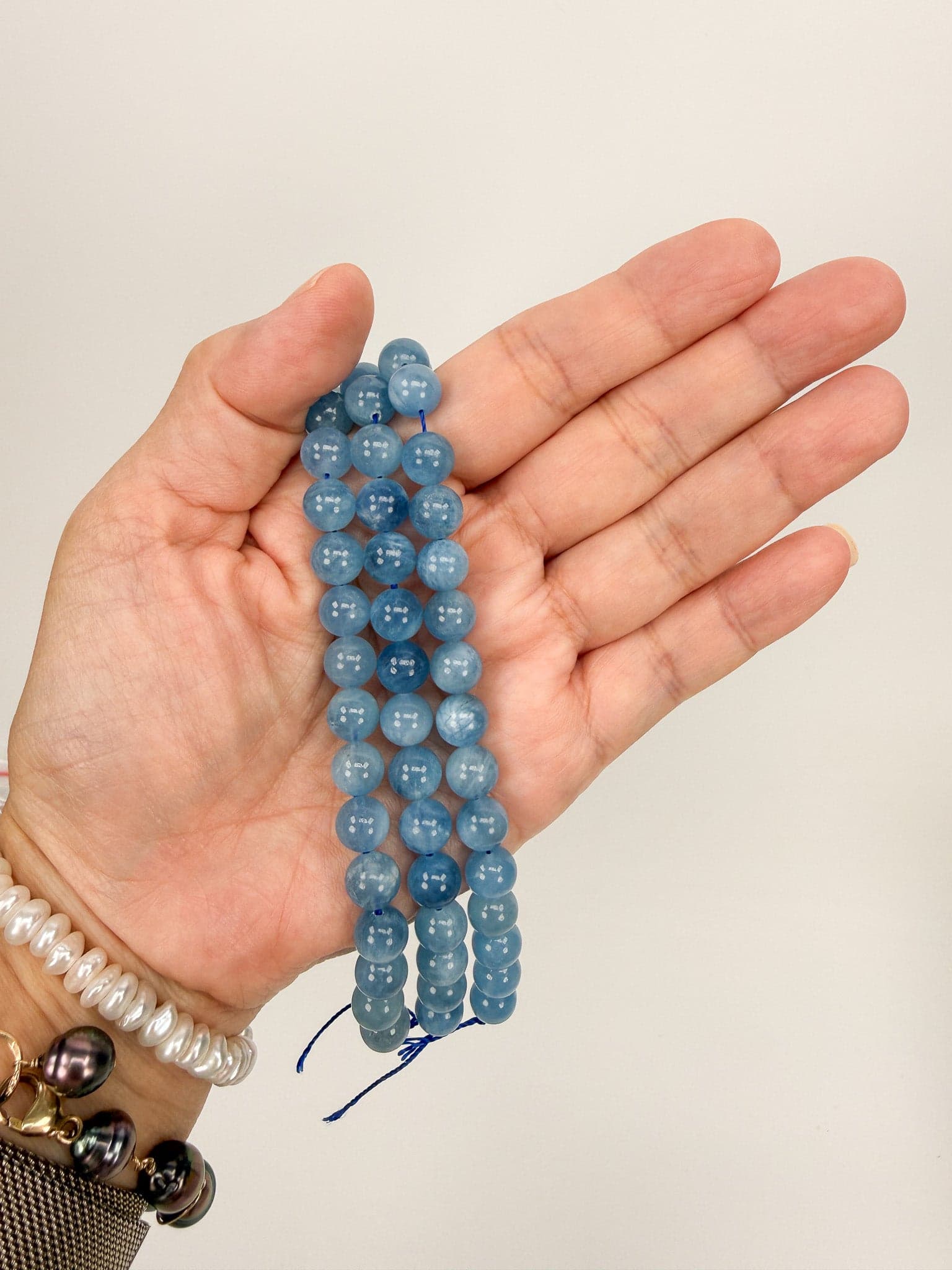
The raw material journey behind a finished round aquamarine bead or faceted stone is far more brutal than the polished display case suggests. Aquamarine originates primarily in Brazil, home to the legendary Santa Maria de Itabira mine that gave the world's most coveted aquamarine color its name, with secondary production in Pakistan, Russia, and parts of Africa. From Brazil, rough travels to cutting centers, with Jaipur, India, serving as the world's dominant processing hub for bead-grade and commercial-quality material. The GIA has documented the bead manufacturing operations in Jaipur on video, and the process is a revelation in material sacrifice.
To produce a strand of round beads, cutters work through a nine-stage chain: sorting by color and clarity, sawing into preforms, sphere-grinding on specialized machines, drilling, tumble-polishing, grading, and stringing for export. At every stage, material is lost. When it is all over, between 60 and 85 percent of the original rough has been ground away as dust and slurry. That is not a typo. For every kilogram of rough that enters the pipeline, as little as 150 grams emerge as finished, sellable beads. This loss rate is what drives the price floor for even bead-grade material, and it is why a strand of genuine aquamarine rounds, even in commercial quality, should never be priced like glass.
The same rough-to-finished math applies to faceted rounds, where the geometry of a sphere demands removing more material than an oval or emerald cut would require from the same piece of rough. When a dealer quotes you a "great deal" on a round aquamarine, ask yourself what the loss rate built into that price actually reflects.
Three Quality Tiers: What You Will Pay and Why
Aquamarine is graded on a non-standardized commercial scale that runs from GEM (sometimes called AAAA) at the top through AAA and AA. GEM-grade stones possess a pure blue or very slightly greenish blue hue with a light to medium light tone and strong to vivid saturation, while AAA-grade stones are very similar but with slightly weaker depth of color. Both top grades require eye-clean or loupe-clean clarity, and top-quality aquamarines in the GEM-to-AAA range represent roughly 10 percent of market supply. Here is what those tiers translate to at retail in 2026:
- Tier 1: Commercial (A to AA): Pale to medium blue with possible mild greenish cast, may have eye-visible inclusions, typically under 2 carats. Expect $50 to $150 per carat. This is the range for birthstone pendants, bead strands, and fashion jewelry lines where volume and accessibility are the design brief.
- Tier 2: Fine (AAA): Medium to medium-deep blue, eye-clean, 1 to 5 carats. Prices in this range run from $100 to $400 or more per carat for good color and clarity. Stones here are appropriate for engagement ring sidestones, stacking rings, and quality birthstone solitaires. The color is noticeably richer than Tier 1 and holds up under indoor lighting.
- Tier 3: Premium (GEM/AAAA, "Santa Maria" quality): Deep, vivid, pure blue with no detectable green secondary hue, eye-clean, typically 5 carats and above. Stones with excellent saturation can command prices upwards of $600 to $1,000 per carat. At this tier, named-origin documentation from Brazil (or the Mozambican equivalent, sometimes called "Santa Maria Africana") becomes both available and worth paying for.
Two thresholds cause meaningful price jumps. The first is the 5-carat mark: for an aquamarine to display an intense color it ideally needs to be over 5 carats, and stones that hold their deep blue past that weight are proportionally rarer. The second is the eye-clean boundary: even a single visible inclusion in a transparent blue stone drops its desirability and price sharply, because aquamarine buyers expect clarity as a baseline.
The Questions Every Buyer Should Ask
Before any money changes hands, get specific answers to these:
- Has this stone been heat-treated? Almost certainly yes: heat treatment is the industry standard for aquamarine, converting greenish-yellow iron compounds to a stable, permanent blue. It is not a red flag. What is a red flag is a seller who cannot tell you. The U.S. Federal Trade Commission requires disclosure of treatments that affect value.
- Has any other treatment been applied? Irradiation and fracture-filling are not standard for aquamarine but exist on the market. Fracture-filling, in particular, would significantly reduce durability and resale value.
- Where was this stone mined? "Brazil" is not specific enough for a premium purchase. Santa Maria de Itabira, the Marambaia Valley, and the Pedra Azul region in Minas Gerais all produce material of different character. For stones above $500 per carat, a laboratory origin report from GIA, AGL, or GRS is a reasonable request.
- Can you show me the cut proportions? For a faceted round, ask about table percentage, depth percentage, and girdle thickness. A well-cut round aquamarine should have a table between 55 and 65 percent and a total depth that prevents the stone from looking like a dark "window" face-up. These numbers rarely appear on colored-stone invoices, but a knowledgeable dealer will know them.
- Is this a natural stone? Synthetic aquamarines exist. They are optically identical to natural material and cost a fraction of the price. A lab report is the only reliable way to confirm natural origin.
Sustainability and the Bead Economy
There is a genuine trade-off embedded in how the round-bead market works. When cutters in Jaipur grind rough down into uniform spheres, they are processing material that would be unusable for single-stone faceted jewelry: off-color patches, heavily fractured material, undersized fragments. In that sense, bead manufacturing is an efficient use of material that would otherwise go to waste. It also creates the accessible price point that makes aquamarine birthstone necklaces achievable for buyers outside the fine-jewelry budget.
The problem arises when high-quality rough that could yield a fine faceted stone gets redirected into bead production for volume pricing. The beadmaking economy in Jaipur is largely driven by Brazilian rough, and as aquamarine rough prices rise, the pressure to maximize yield from every kilogram grows. That tension between accessibility and preservation of the finest material is not resolved; it is the defining sustainability question in the colored gemstone industry, and aquamarine is its clearest case study.
A round aquamarine is not simply a shape. It is a choice about what kind of stone you want, what you are willing to pay for it, and how much you care about its history before it arrived in the case. The answers to those questions exist. You just have to ask.
This article was produced by Prism’s automated news system from verified source data, official records, and press releases, then run through automated quality and moderation checks before publishing. The system is built and supervised by the people who set the standards it runs under. Read our full AI policy.
Did this article answer your question?