Birthstone Jewelry Blends Personal Meaning With Spring 2026 Style Trends
The birthstone list has only been official since 1912. This smart-buy guide ranks all 12 stones by durability, care and budget so you can choose for lifestyle, not just birth month.
Every gemstone has a story old enough to predate the jeweler's loupe. The idea of wearing a specific stone for each month is believed to have originated with the biblical Breastplate of Aaron, an ancient artifact adorned with twelve stones, each representing one of the twelve tribes of Israel. Over time, those stones became connected to the zodiac, and later to the calendar months we recognize today. The leap from sacred to sartorial was formalized surprisingly recently: in August 1912, the American National Association of Jewelers, now called Jewelers of America, met in Kansas City and officially adopted a standardized list. That list has been revised several times since. Jewelers of America updated it in 1952 to add alexandrite for June, citrine for November, tourmaline for October, and zircon for December, and again in 2002 when tanzanite became a birthstone for December. Most recently, spinel joined peridot in August, a change the American Gem Trade Association and Jewelers of America jointly announced. The reasoning behind that last addition, offered by AGTA president and CEO Doug Hucker, applies to the entire category: "As tastes change, fashion evolves, and as more consumers become interested in gemstones, it is important that our industry evolve to meet their needs."
That evolution lands squarely in spring 2026. Individuality, innovation, and intention are the pillars shaping this year's jewelry market, and birthstone pieces are positioned at the center of all three. The challenge for any buyer is translating symbolism into a purchase that actually performs in daily life. The chart below does that work for you.
The 2026 Smart-Buy Birthstone Matrix
The Mohs hardness scale ranks minerals from 1 to 10 based on scratch resistance, and for jewelry worn daily, a rating of at least 7 is the threshold for reliable durability. Use that number as your first filter; let budget and setting be the second and third.
- Best setting: Bezel or four-prong
- Budget: $50-$400 for quality set pieces
- Care tip: Warm soapy water only; avoid ultrasonic cleaners
- Who it suits: The bold minimalist who wears deep red year-round. Garnet sits just at the durability threshold, so a protective bezel is the smarter choice over open prongs for ring wear.
January: Garnet (Mohs 6.5-7.5)
- Best setting: Prong for earrings; bezel for daily-wear rings
- Budget: Under $200 for quality pieces
- Care tip: Avoid prolonged direct sunlight, which can fade color over time
- Who it suits: Color-committed buyers on a realistic budget. Amethyst ranks among the most affordable gemstones, often procured for less than $200 per carat, which makes it the most accessible colored stone on the entire list.
February: Amethyst (Mohs 7)
- Best setting: Four-prong or tension; aquamarine's clarity is its asset
- Budget: $100-$800 for quality stones
- Care tip: Mild soap and warm water; store separately from harder stones
- Who it suits: Those who want diamond-adjacent elegance in cool blue without diamond prices.
March: Aquamarine (Mohs 7.5-8)
- Best setting: Classic six-prong solitaire, pavé, or bezel
- Budget: $1,000+ for quality natural stones; lab-grown options significantly lower
- Care tip: Ultrasonic-safe; professional cleaning once a year
- Who it suits: The investment buyer. Diamond at 10 is the ultimate in durability for everyday wear, which means it's the one birthstone that never requires a lifestyle compromise.
April: Diamond (Mohs 10)
- Best setting: Bezel strongly recommended; open prongs risk chipping at inclusions
- Budget: $200-$5,000+ per carat; Colombian origin commands a significant premium
- Care tip: Never ultrasonic or steam; avoid heat; oiling inclusions is standard industry practice
- Who it suits: Occasion jewelry collectors. Despite a high Mohs number, natural emeralds are typically riddled with inclusions, called a "jardin," that reduce structural toughness. Treat them as statement, not workhorse.
May: Emerald (Mohs 7.5-8, but heavily included)
- Best setting: Pearl strands on silk; bezel for moonstone; any setting for alexandrite
- Budget: Cultured pearl strands from $50; alexandrite ranges from $2,000 to $12,000 per carat; moonstone sits affordably between the two
- Care tip: Pearls are organic: put them on last, take them off first, and keep them away from perfume and acid
- Who it suits: Three very different buyers. June's options span the widest price and durability gap on the list. Choose alexandrite if longevity and investment value are priorities; moonstone for ethereal aesthetics; pearl for classic formality.
June: Pearl / Alexandrite / Moonstone (Mohs 2.5-3 / 8.5 / 6-6.5)
- Best setting: Any; a four-prong lets saturated color sing
- Budget: $200 per carat for heat-treated stones to $15,000+ for fine Burmese untreated
- Care tip: Generally ultrasonic-safe if the stone is unfractured; check with your jeweler first
- Who it suits: The investment-minded and the red statement maker. Ruby at Mohs 9 is an excellent, durable choice for any piece of jewelry, which makes it the colored stone closest to diamond in practical terms.
July: Ruby (Mohs 9)
- Best setting: Bezel for peridot; any setting for spinel
- Budget: Peridot $50-$300; spinel $100-$600, representing extraordinary value for the hardness
- Care tip: Peridot is sensitive to acids and rapid temperature changes; spinel is low-maintenance
- Who it suits: Value hunters. Spinel, added to the official list relatively recently, remains one of the most underpriced stones relative to its durability and brilliance.
August: Peridot / Spinel (Mohs 6.5-7 / 8)
- Best setting: Four-prong or bezel for a modern, architectural look
- Budget: $500-$8,000 per carat in blue; padparadscha salmon-pink commands a significant premium
- Care tip: Ultrasonic-safe; have prongs inspected annually
- Who it suits: The smart long-term buyer. Sapphire holds value like few colored stones, and its Mohs 9 rating means it performs flawlessly in rings worn daily for decades.
September: Sapphire (Mohs 9)
- Best setting: Bezel is non-negotiable for opal; prong works well for tourmaline
- Budget: Opal $50-$3,000+ (black opal at the high end); tourmaline $50-$800
- Care tip: Opals contain up to 10% water; store away from heat sources and dry air
- Who it suits: October buyers should think of this as two stones for two lifestyles. Tourmaline every day; opal for evenings and occasions only.
October: Opal / Pink Tourmaline (Mohs 5.5-6.5 / 7-7.5)
- Best setting: Four-prong; bezel for daily topaz ring wear
- Budget: Citrine under $50 for most retail pieces; blue topaz $50-$300
- Care tip: Store topaz away from softer stones it could scratch; both can fade in prolonged direct sun
- Who it suits: Buyers who want maximum color saturation for minimum spend. These rank among the most affordable gemstones on the market, making November the best month for gifting without budget anxiety.
November: Blue Topaz / Citrine (Mohs 8 / 7)
- Best setting: Any setting for topaz; bezel essential for tanzanite and turquoise
- Budget: Turquoise from $20; tanzanite $100-$1,500 per carat; blue topaz very accessible
- Care tip: Tanzanite is sensitive to thermal shock; turquoise is porous and absorbs chemicals
- Who it suits: December offers the widest durability spread of any month. Blue topaz is the daily-wear choice with no caveats; tanzanite rewards careful ownership.
December: Blue Topaz / Tanzanite / Turquoise / Zircon (Mohs 8 / 6.5 / 5-6 / 6-7.5)
The Personalization Play: Building a Family Stack
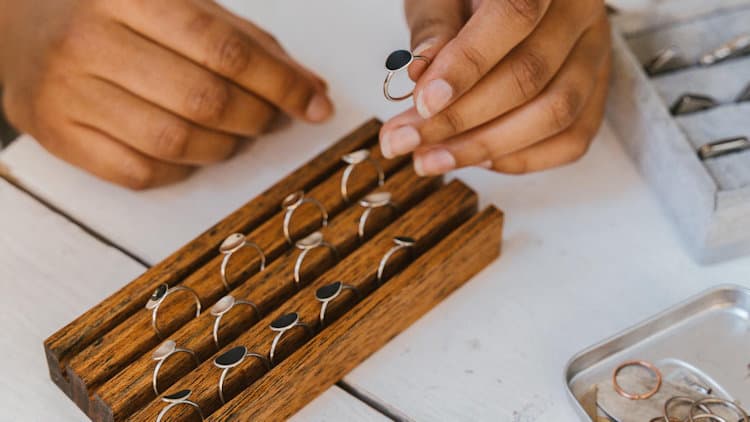
The most compelling thing birthstone jewelry does in 2026 isn't mark a birth month. It records a life. From monogrammed rings to pendants bearing initials, charm bracelets, birthstone jewelry, custom-cut stones, or even a special piece reset from an old heirloom, personalized jewelry is not just one-of-a-kind — it's uniquely yours. The specific approach making the most impact right now is the family stack: a set of thin bands, each set with a different stone, representing a partner, a child, or a parent. Stackable rings with birthstones allow wearers to create a personalized set that evolves over time, paired with diamond bands or mixed metals for a modern look that reflects family, life milestones, or personal journey.
Engravings take the concept further still. A bezel-set sapphire ring engraved inside with a child's birth date, or a garnet pendant paired with an initial charm on the same chain, transforms a stone into a document. Name necklaces are making a comeback in 2026 with a colorful twist: letters encrusted with birthstones or mixed gemstones create a playful, meaningful look that lets wearers mix style and sentiment.
Setting Strategy for 2026
The setting you choose determines both how a stone performs and how it reads aesthetically within a stack. Bezel settings read as minimalist jewelry, making them perfect grounding elements within a stack. A bezel-set band can break up pavé-heavy layers, while a single framed stone pendant brings clarity to layered chains. For softer stones (opals, moonstones, turquoise, pearls), a bezel isn't just a style choice — it's structural protection. For harder stones like diamonds, rubies, and sapphires, a prong setting elevates light return and showcases the stone's full optical character.
Rings, bracelets, and necklaces that combine textures, finishes, and mixed metals allow for playful stacking and layering while remaining adaptable to any personal style. The most enduring birthstone pieces are the ones bought with that layering future in mind — a decision made not just for today's outfit, but for the stack you're still building five years from now.
This article was produced by Prism’s automated news system from verified source data, official records, and press releases, then run through automated quality and moderation checks before publishing. The system is built and supervised by the people who set the standards it runs under. Read our full AI policy.
Did this article answer your question?