Birthstone Jewelry Market Grows as Personalized Rings and Stacking Trends Surge
Birthstone rings and stacking styles are reshaping how people buy fine jewelry, turning personal meaning into the market's most powerful growth engine.

Personalization has quietly become the most disruptive force in fine jewelry, and nowhere is that clearer than in the birthstone category. What was once a niche of sentimental gifts and charm-bracelet add-ons has matured into one of the most dynamic segments of the jewelry market, driven by consumers who want pieces that carry genuine meaning alongside genuine craft.
The market in motion
The birthstone jewelry market is expanding, and the momentum is structural rather than cyclical. Synthesizing data from seven source reports and market datasets, the picture that emerges in 2026 is of a category that has outgrown its gift-shop associations and moved firmly into the fine jewelry conversation. Growth projections across the analyzed sources point consistently upward, reflecting a broader consumer shift: buyers are less interested in anonymous luxury and more interested in jewelry that tells a specific story, theirs.
That shift matters for how you shop. It means the market is responding with more material variety, more setting options, and more price points than the birthstone category has historically offered. It also means more noise, more greenwashing, and more vague "ethically sourced" language that deserves scrutiny before you hand over your money.
Why personalization is the engine
The two trends driving this growth most forcefully are birthstone rings and birthstone stacking, and they are worth understanding separately even though they often overlap.
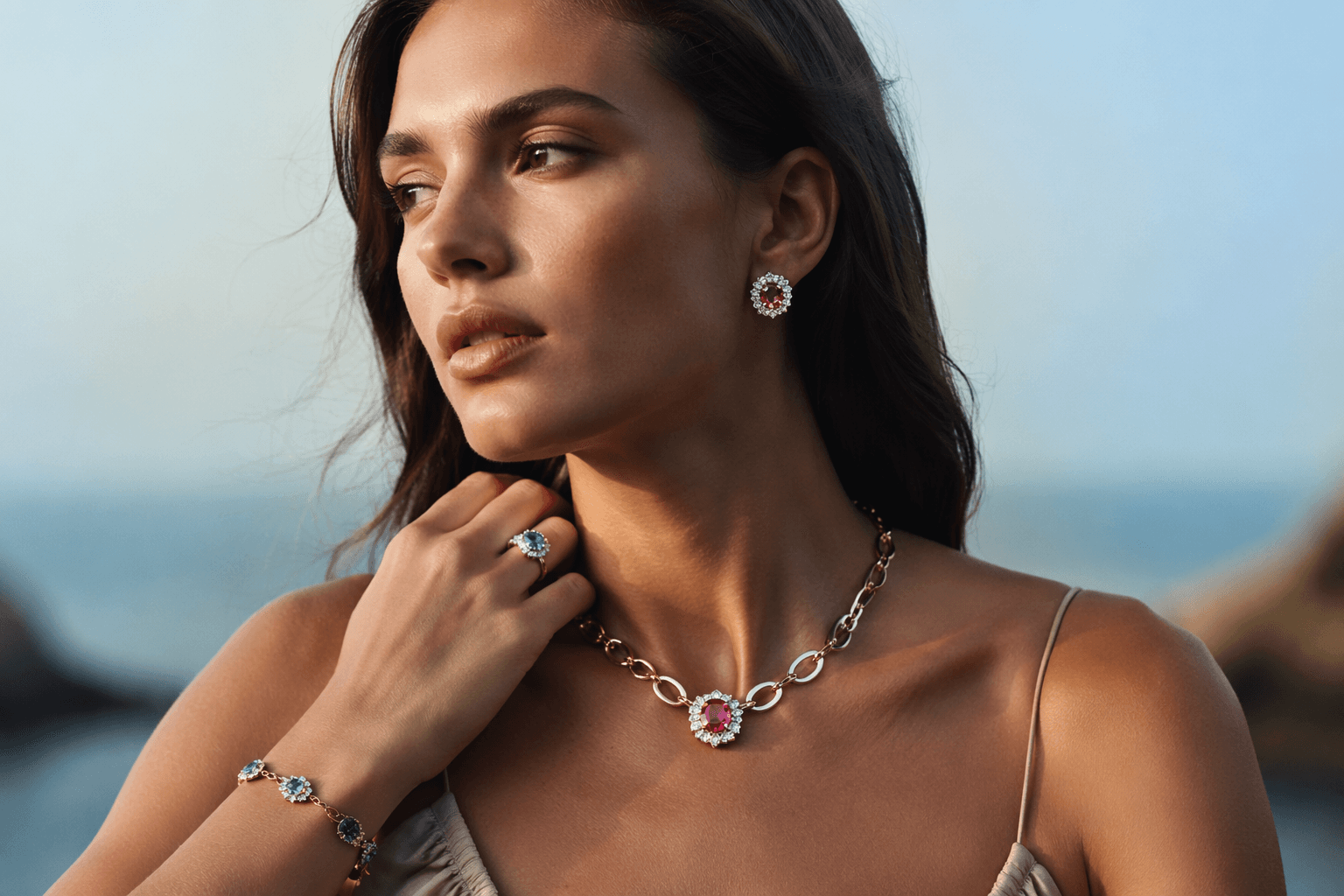
Birthstone rings have evolved well beyond the signet-style class ring or the cabochon-set solitaire of a generation ago. Today's versions range from delicate bezel-set stackers in recycled 14-karat gold to substantial cocktail rings featuring tension settings that expose the stone's full color saturation. The design vocabulary has expanded because the buyer has: younger consumers in particular are treating birthstone rings as a form of self-expression rather than a received tradition, choosing their own stones rather than waiting to receive them as gifts.
Stacking, meanwhile, has transformed the economics of the category. A single birthstone ring is a purchase; a curated stack is a collection, built incrementally over months or years. Brands have responded by designing rings explicitly for layering, with low-profile settings and consistent band widths that allow different stones and metals to sit flush against one another. For the buyer, this means thinking about a ring not as a standalone object but as one element in a longer visual conversation on the finger.
Reading the stones: what to know before you buy
Birthstone assignments vary slightly by tradition, but the modern standard, as recognized by the American Gem Society and the Gemological Institute of America, gives most months a primary stone and several alternates. January's garnet, February's amethyst, and September's sapphire are relatively stable. Other months are more contested: June claims pearl, alexandrite, and moonstone; December holds turquoise, zircon, and tanzanite.
This matters practically because the alternate stones often represent dramatically different price points and durability profiles. Alexandrite, the color-change chrysoberyl that is June's most coveted option, commands prices that rival fine sapphire. Moonstone, another June stone, is comparatively affordable but scores only 6 to 6.5 on the Mohs hardness scale, making it poorly suited to daily-wear ring settings where it will meet hard surfaces repeatedly. If you're building a stack you intend to wear every day, hardness is not a footnote; it's a primary selection criterion.
The same logic applies across the calendar. Emerald (May) is famously included and brittle relative to its hardness rating; opal (October) is beautiful but porous and sensitive to thermal shock. Sapphire, ruby, and spinel are workhorses that can handle daily wear. Knowing these distinctions separates a well-considered purchase from an expensive regret.
The provenance question
The growth of the birthstone market has attracted a corresponding growth in vague sustainability claims. "Responsibly sourced," "conflict-free," and "ethically mined" appear on countless product pages without the certifications to back them up. Before accepting these claims, ask for specifics.
For diamonds, the Kimberley Process is the floor, not the ceiling, and its limitations are well-documented. Look instead for brands using stones certified under the Responsible Jewellery Council's full chain-of-custody standard, or those working with specific mines that publish independent audits. For colored stones, the supply chain is considerably more fragmented. The most credible operators can name the mine, the country of origin, and the intermediary trading company, and many now work directly with cutters in source countries rather than routing everything through traditional wholesale hubs.
Recycled metals are more straightforward to verify. The Responsible Jewellery Council and the Fairmined standard both offer certified recycled gold designations. A brand claiming recycled gold without one of these certifications is asking you to take their word for it, which is a different thing entirely.
What the stacking trend means for craftsmanship
The popularity of stacking has created a tension worth naming: the commercial pressure to produce stackable rings quickly and affordably can compromise the craftsmanship that makes fine jewelry worth its price. Thin bands, minimal prong work, and stones set with speed rather than precision are the predictable results of scaling up a trend.
When evaluating a stackable birthstone ring, look at the prong tips under magnification if possible. They should be rounded and even, sitting flush against the girdle of the stone without gaps. Bezel settings, where metal wraps fully around the stone's edge, are inherently more protective and can be executed beautifully even at lower price points; a clean, level bezel is a reliable indicator of careful bench work. Check that the band's interior is properly finished and that the sizing marks are crisp rather than stamped carelessly.
The best stacking rings being made right now are not the cheapest ones. They are pieces where someone has thought carefully about how the ring will look and function alongside others, where the stone is selected for color consistency rather than just carat weight, and where the metal thickness is calibrated to survive daily contact without bending.
The investment dimension
As the birthstone category matures, some buyers are approaching it with the same deliberateness they bring to colored stone collecting more broadly. Fine ruby, sapphire, and emerald with strong provenance documentation and reputable laboratory certificates from GIA or Gübelin have historically held value; the personalization context does not diminish that, and in some cases the combination of quality and meaning makes a piece more significant to its eventual inheritor.
The stacking trend reinforces this: a set of well-made birthstone rings representing family members, built up over years with consistent quality, is a more coherent and potentially more valuable object than an assortment of fast-fashion stackers that will show wear within a season. The market's growth is creating more choice, which means the burden of discernment falls more heavily on the buyer.
In a category this personal, that discernment is exactly the point.
This article was produced by Prism’s automated news system from verified source data, official records, and press releases, then run through automated quality and moderation checks before publishing. The system is built and supervised by the people who set the standards it runs under. Read our full AI policy.
Did this article answer your question?