Birthstones by Month: Geology, Sources, and Lab-Grown Options Explained
Every birthstone tells a geological story — and knowing where your stone comes from changes how you wear it.
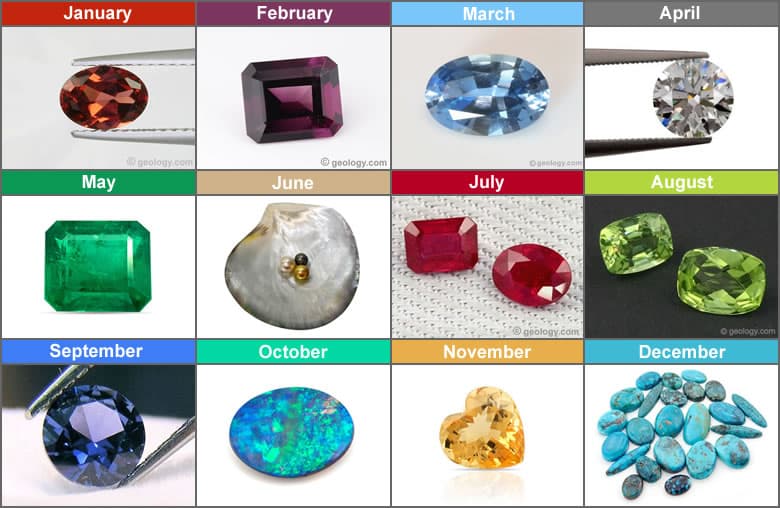
Birthstones are one of jewelry's oldest organizing principles, yet most people who wear them know surprisingly little about what they're actually wearing. The ruby on your finger isn't just a July symbol; it's a corundum crystal colored by chromium, most likely pulled from the mines of Mozambique or Myanmar. The aquamarine in your grandmother's brooch is a beryl, chemically related to emerald, softened by iron into that particular shade of sea. Understanding what your birthstone actually is, geologically speaking, transforms it from a sentimental convention into something genuinely fascinating.
Why Geology Matters for Jewelry Buyers
Before diving month by month, it's worth understanding why physical properties matter when you're choosing a piece to wear rather than display in a cabinet. The two most critical factors are hardness and cleavage. Hardness, measured on the Mohs scale, tells you how resistant a stone is to scratching. Diamond sits at 10; pearl sits around 2.5 to 4.5. A stone below 7 on the Mohs scale risks being scratched by everyday dust, which contains quartz particles rated at 7. Cleavage describes how a stone breaks along its crystal planes, which matters enormously for rings and bracelets that take daily impacts. A stone with perfect cleavage in multiple directions, like topaz, can split cleanly from a sharp blow even if it's hard enough to resist scratching. These aren't abstract mineralogy facts; they're the difference between a piece that survives decades and one that chips within a year.
January Through March: Garnet, Amethyst, Aquamarine
January's garnet is frequently misidentified as a single stone, but it's actually a mineral group with members ranging from deep red almandine (iron and aluminum) to vivid green tsavorite (a calcium-aluminum variety). The red almandine mined in India, Brazil, and parts of Africa is the classic January stone, hardness around 7 to 7.5, with no cleavage plane, making it genuinely durable for daily wear.
February's amethyst, a purple variety of quartz, rates 7 on the Mohs scale and was once priced alongside ruby and sapphire until large deposits were discovered in Brazil in the 19th century, which effectively collapsed its rarity value. Today, major sources include Minas Gerais in Brazil, Zambia's Kariba mine, and Uruguay. The Zambian material tends toward a deeper, more saturated violet with reddish secondary tones; the Brazilian stones run larger and lighter. This distinction matters when you're comparing pieces at similar price points.
Aquamarine, March's stone, is a beryl colored by ferrous iron, which gives it that distinctive blue-green clarity. The finest aquamarines historically come from Brazil's Minas Gerais state and from Pakistan's Karakorum range, where the stones tend toward a deeper, more saturated blue. With a hardness of 7.5 to 8 and no cleavage issues in the directions most relevant to setting, it's well-suited to rings.
April Through June: Diamond, Emerald, Pearl
April's diamond needs less introduction than any other stone on this list, but the sourcing question has never been more fraught or more important. The Kimberley Process Certification Scheme, established in 2003, was designed to exclude conflict diamonds from the market, but it has been widely criticized for its narrow definition of "conflict" and its exclusion of human rights abuses from its scope. For buyers who care about provenance, the more meaningful certifications are those that track chain of custody to specific mines, such as the Canadian Diamond Code of Conduct or stones certified through the Responsible Jewellery Council with mine-of-origin documentation.
May's emerald is a beryl colored by chromium and sometimes vanadium, and it is arguably the most inclusion-tolerant of all precious stones. The industry term "jardin" (French for garden) describes the internal fractures and inclusions that are considered natural and expected in emerald, unlike in diamond where inclusions are penalized. Colombian emeralds from the Muzo and Coscuez mines remain the global benchmark for color. Zambian emeralds are a strong and increasingly respected alternative, often more affordable with excellent saturation. Nearly all commercial emeralds are treated with cedar oil or resin to fill surface fractures, a practice that is accepted in the trade but should be disclosed.
June is one of only two months with three official birthstones: pearl, alexandrite, and moonstone. Pearl is the only birthstone that is a biological product rather than a mineral, formed when a mollusk coats an irritant in layers of nacre. Natural pearls are extraordinarily rare today; almost all pearls on the market are cultured, meaning a nucleus has been deliberately inserted. The most reputable cultured pearls come from Japan (Akoya, for classic white rounds), French Polynesia (Tahitian, for black and peacock tones), and Australia (South Sea, for large, creamy whites). Nacre thickness is the single most important quality indicator and is often not disclosed by retailers.
July Through September: Ruby, Peridot, Sapphire
Ruby and sapphire are the same mineral, corundum, differentiated only by color. The chromium that makes corundum red produces ruby; iron and titanium produce the blue of sapphire. The finest rubies historically come from Burma's Mogok Valley, a provenance that carries a premium but also significant ethical complexity given Myanmar's political situation. Mozambique has emerged as a major alternative source, producing rubies with strong fluorescence and vivid color.
August's peridot is one of the few gemstones that forms in the Earth's mantle rather than the crust, carried to the surface through volcanic activity. The San Carlos Apache Reservation in Arizona produces the majority of the world's peridot; the stones are primarily mined by tribal members under tribal authority, which gives this source a degree of economic accountability that's worth noting. Peridot's characteristic olive-to-bottle-green color comes from iron, and it cannot be treated to improve color, making what you see reliably what you get.
September's sapphire, like ruby, comes in almost every color except red (which is by definition ruby). Kashmir sapphires, the cornflower blue standard for the finest blue sapphires, are now essentially unavailable from new mining; stones with Kashmir origin certificates command significant premiums at auction. Sri Lanka (Ceylon) and Madagascar are the primary current sources of high-quality blue sapphires.
October Through December: Opal, Topaz, Turquoise, Tanzanite
October's opal is a hydrated amorphous silica, technically not a crystalline mineral at all, which is why it plays light so differently from other stones. Australian opals, primarily from Lightning Ridge (black opal) and Coober Pedy (white opal), account for roughly 95 percent of global production. Opal's water content, typically 3 to 21 percent by weight, makes it sensitive to extreme dryness or rapid temperature changes.
November offers topaz and citrine as alternatives. Blue topaz, the most commonly sold variety, is almost always colorless topaz that has been irradiated and heat-treated to produce blue tones. This treatment is stable and accepted in the trade, but it's worth knowing that the "natural" blue you're buying began as a colorless stone.
December has three options: turquoise, tanzanite, and blue zircon. Tanzanite deserves particular attention: it is found in commercial quantities in exactly one place on Earth, a small mining area near Arusha in Tanzania, which makes it geologically rarer than diamond by any measure of geographic concentration. The stone's blue-violet color, caused by vanadium, changes character under different light sources, shifting toward blue in daylight and violet under incandescent light.
Lab-Grown Stones: What the Science Actually Means
Lab-grown birthstones are chemically and physically identical to their mined counterparts; a lab-grown ruby and a natural ruby have the same crystal structure, the same hardness, the same refractive index. The differences are origin, traceability, and price. Lab-grown emeralds, rubies, and sapphires are widely available and significantly less expensive than mined equivalents of comparable quality. Lab-grown diamonds have driven dramatic price compression in the natural diamond market over the past five years.
The honest calculus for a buyer: if you care about having a stone whose journey you can partially trace, mined stones with credible provenance documentation (Fairmined gold, Responsible Jewellery Council certification, mine-of-origin documentation) offer something lab-grown stones cannot. If your priority is optical quality at a given price point, lab-grown stones frequently win. The question isn't which is "real." Both are real. The question is what you value in the story a piece carries.
A birthstone bought with knowledge of its geology, its source, and the honest terms of its trade is a more meaningful object than one chosen for calendar convention alone. That knowledge is available; it just requires asking the questions most retailers would rather you didn't.
This article was produced by Prism’s automated news system from verified source data, official records, and press releases, then run through automated quality and moderation checks before publishing. The system is built and supervised by the people who set the standards it runs under. Read our full AI policy.
Did this article answer your question?