Birthstones Reframed as Cultural Gems With Ancient Roots and Modern Legacy
The tradition of wearing a single birthstone is over 2,000 years in the making — from Aaron's priestly breastplate to a Kansas City trade meeting in 1912 that quietly shaped how the world buys colored gems today.
A Tradition Older Than Commerce
The earliest recorded connection between gemstones and calendar periods appears in Exodus 28:15–30, describing the high priest Aaron's ceremonial breastplate adorned with 12 distinct stones, each representing one of the 12 tribes of Israel. The breastplate wasn't decorative in any casual sense. Known as the "breastplate of judgment," it was a sacred garment worn by the High Priest of the Israelites, bearing the Urim and Thummim, elements said to carry the judgment of God concerning the Israelites at all times.
The first academic study of the breastplate was carried out by Roman scholar Titus Flavius Josephus (c. 37–100 AD), who examined the twelve gemstones and compiled the first list of birthstones based on his findings. Josephus believed there was a connection between the twelve stones in Aaron's breastplate, the twelve months of the year, and the twelve signs of the zodiac, though he himself gave two different lists for the twelve stones. The ambiguity matters: it is one reason the tradition kept shifting and splintering for nearly two millennia before anyone attempted to unify it.
Early Christian writers sought to connect these stones with the Apostles, further solidifying the association between gemstones and spiritual significance, though the direct link between the breastplate stones and the calendar months wasn't immediately established. By the 8th and 9th centuries, the trend evolved so that people would own a collection of all twelve jewels but wear only a single stone during a given month, where it was believed to have heightened powers.
The Path to Standardization
The custom of wearing a single birthstone is only a few centuries old, though modern authorities differ on dates. Gemologist George Frederick Kunz places the custom in 18th-century Poland, while the Gemological Institute of America traces it to Germany in the 1560s. The spiritual meaning of gemstones can also be traced to Hindu traditions: the Ratna Pariksha, a 5th-century Hindu text, discusses the relationship between gemstones and celestial bodies, days of the week, and deities. These were not isolated strands. They fed one another through trade routes, missionary activity, and the movement of Jewish merchants across early modern Europe.
Nobody could agree on what the twelve gems should be. Different lists were used, since there was no consensus on what the gems mentioned in scripture actually were, and different countries had different traditions. This was clearly confusing. So in 1912, the American National Jewelers' Association compiled a new birthstone list. In August 1912, to standardize birthstones, the National Association of Jewelers, now called Jewelers of America, met in Kansas City and officially adopted a list.
The National Association of Jewelers met in 1912 to officially standardize the list of American birthstones and each month they represented. The list combined various customs that had evolved over time while ensuring the stones chosen would be practical for American jewelers to sell and promote in large quantities. That last point deserves emphasis: this was a trade decision as much as a cultural one. The 1912 standardization was not a clean slate. It was a consolidation, and the seams still show.
Revisions and Expansions
The NAJ list has never been truly frozen. In 1952, the Jewelry Industry Council of America updated the list, adding alexandrite, citrine, pink tourmaline, and emphasizing aquamarine over bloodstone. The American Gem Trade Association added tanzanite as a December birthstone in 2002, and in 2016, the Association and Jewelers of America added spinel as an additional birthstone for August.
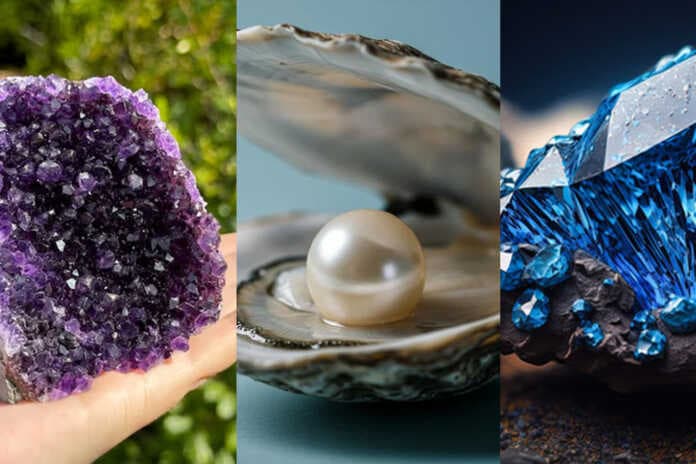
Two months now boast three primary gemstones: June, with pearl, moonstone, and alexandrite; and December, a range of blues encompassing turquoise, tanzanite, and zircon. Some months have long carried a single stone with near-universal agreement; others have accumulated alternatives over centuries of use and periodic industry revisions.
This layering of options was partly commercial and partly cultural, reflecting the reality that not every stone could be sourced or afforded by every buyer. Alexandrite, for instance, is considered among the rarest birthstones due to its unique color-change property and extremely limited geographic sources. It exhibits pleochroism, appearing green in daylight and red under incandescent light, and fine specimens showing a complete color change can exceed $12,000 per carat, with exceptional Russian alexandrites reaching $50,000 or more per carat.
What Gemology Actually Tells Us
Beneath the mythology, these are minerals with specific physical identities — and understanding them changes how you wear and care for birthstone jewelry. Contemporary gemologists classify birthstones with precise scientific criteria, including crystal structures: rubies and sapphires are both corundum (Al₂O₃), with their colors coming from trace elements such as chromium for red or iron for blue. June's pearl and August's peridot represent opposite ends of the spectrum, as one is formed by mollusks and the other by volcanic eruptions.
The Mohs scale measures scratch resistance, but gem durability is bigger than that. The GIA breaks durability into three factors: hardness (resistance to scratches), toughness (resistance to breaking and chipping), and stability (resistance to heat, light, chemicals, and humidity). In practical terms: diamonds score a perfect 10 on the Mohs scale, making them ideal for engagement rings and daily wear, while sapphires and rubies reach 9, offering excellent durability with vibrant color options. Conversely, amethyst has a Mohs hardness of 7, placing it at the minimum threshold for engagement rings but requiring careful wear to prevent surface abrasions over time.
Price ranges across the category are equally dramatic. A fine amethyst might cost $5 to $30 per carat, while an unheated Sri Lankan sapphire ranges from $300 to $3,000 per carat depending on color, and a pigeon blood Burmese ruby from $1,000 to $15,000 per carat. These are not decorative gems at a uniform price point. They are a spectrum that runs from accessible quartz to stones that rival any colored gemstone on the market.
Setting the Stone: A Craftsmanship Decision
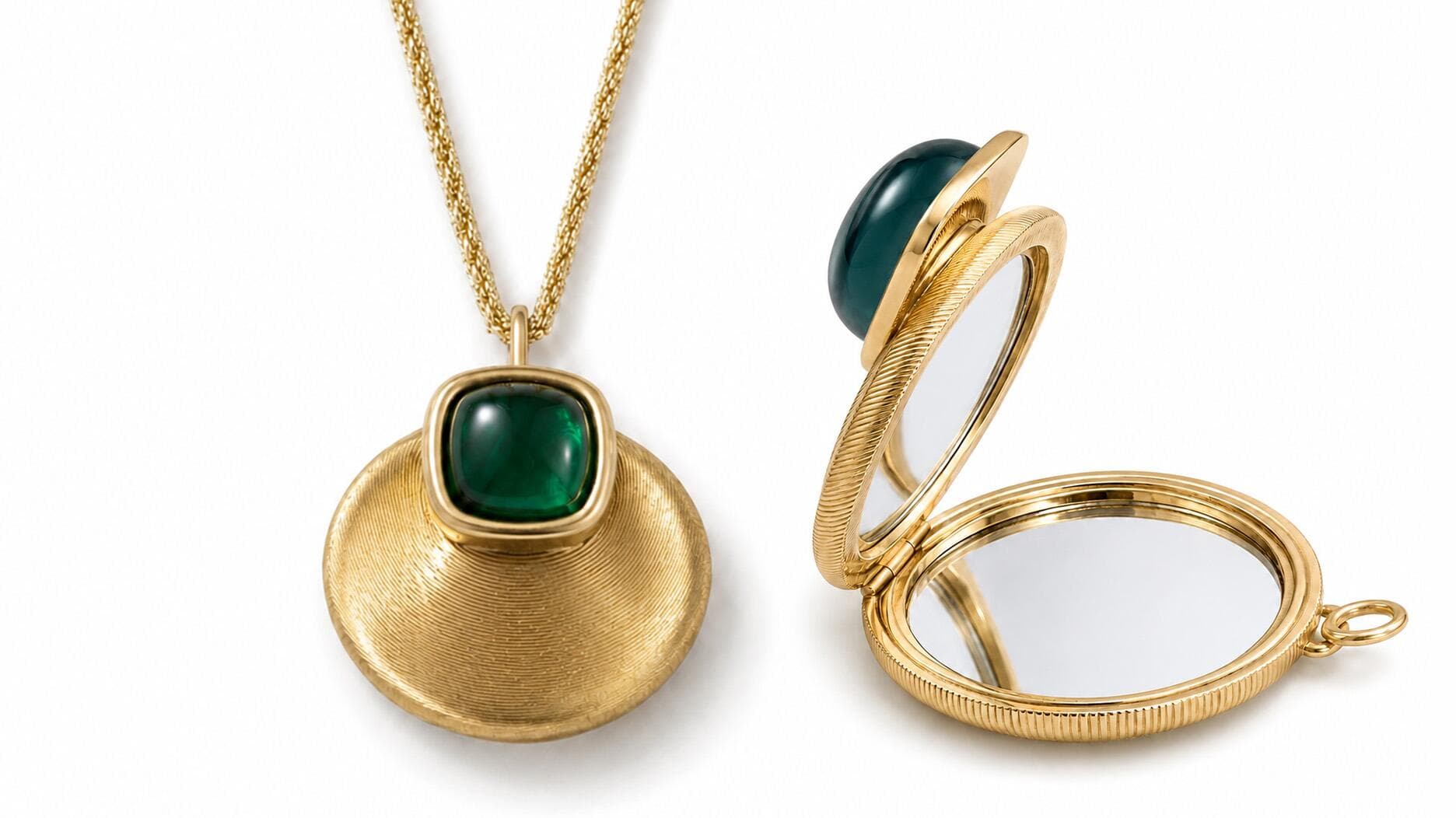
The setting you choose for a birthstone isn't purely aesthetic — it's a direct response to the stone's physical properties. From a gemological standpoint, channel settings protect smaller stones better than prong settings for everyday wear, while bezel settings offer the most security for softer stones like opal or moonstone. A bezel setting, in which a rim of metal fully encircles the girdle of the stone, is the most protective option in the jeweler's toolkit. A bezel setting guards the gem's edges and reduces the chance of damage; the metal rim shields the stone from impacts and scratches, and its clean profile allows the gem's color to read without distraction.
The halo, a ring of smaller stones surrounding a central gem, translates particularly well to birthstone jewelry. A halo of vivid blue sapphire rounds encircling a white diamond center, for example, creates a piece that reads as both classically structured and immediately personal. For eternity bands or stacking rings set with birthstones, the conversation between stone hardness and daily wear becomes even more consequential: softer gems set in low-profile bezels will outlast the same stone in a pronged half-bezel by years under conditions of regular contact.
The Living List and Its Cultural Legacy
The birthstone list is, at its core, a framework for meaning. It was codified by a trade association, but its roots reach back to scripture and astronomy. That combination of the ancient and the commercial is, in many ways, the story of the gem trade itself.
Cultural traditions continue influencing contemporary birthstone jewelry. Victorian-era styles featured ornate settings with symbolic engravings, while Art Deco designs emphasized geometric patterns and bold color contrasts. Today's pieces blend these historical influences with minimalist aesthetics, allowing wearers to express both heritage and modern sensibility through their birthstone choices.
The worldwide jewelry market is projected to grow from roughly $381 billion in 2025 to more than $578 billion by 2033, driven by evolving fashion trends and rising demand for personalized accessories. Within that growth, birthstones occupy a distinctive position: engravable pendants and birthstone pieces go beyond trends to become modern heirlooms, often commemorating relationships or milestones. Their value comes not just from fine materials and craftsmanship, but from the personal significance they hold.
Traditional birthstone jewelry continues to maintain a presence in the market, but it is not disappearing — it is evolving. Designers are increasingly reinterpreting classic materials through modern silhouettes, unconventional settings, and mixed-metal designs. Stackable bands set with a child's or partner's birthstone have become a fluent vocabulary for familial love. Multi-stone pendants layering three generations of birthstones into a single piece exist well outside trend cycles. They are, in the oldest sense of the word, talismans — made legible by a framework that a Kansas City trade meeting in August 1912 set, and that two thousand years of human belief in the power of stones had made possible.
This article was produced by Prism’s automated news system from verified source data, official records, and press releases, then run through automated quality and moderation checks before publishing. The system is built and supervised by the people who set the standards it runs under. Read our full AI policy.
Did this article answer your question?