GemSelect — 'Gemstone Price Per Carat' buyer guide
Your July ruby and September sapphire aren't priced alike out of sentiment; the gap runs from $20 to over $100,000 per carat, and knowing exactly why can save you thousands.
The high priest Aaron wore twelve stones on his breastplate, one for each tribe of Israel, as described in Exodus 28: sardius, topaz, carbuncle, emerald, sapphire, and seven more, arranged in four rows of three. That ancient inventory is among the earliest recorded attempts to assign specific stones to specific people, a lineage that would evolve over millennia into the modern birthstone tradition observed today. The present list was standardized in 1912 by the National Association of Jewelers, with subsequent updates adding alternatives like aquamarine for March. But the impulse behind Aaron's breastplate, the idea that a gemstone could belong to you by birthright, has never changed.
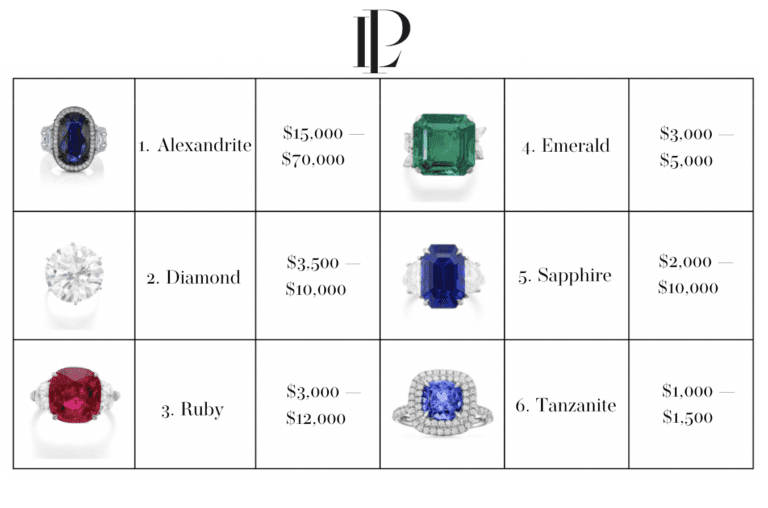
What has changed, and dramatically, is price transparency. A garnet and a ruby are both deep-red birthstones. One might run you $20 per carat; the other, well over $100,000. A fine-quality ruby has sold for over $1,000,000 per carat. The difference has nothing to do with sentiment. It has everything to do with ten variables: variety, color, clarity, cut, carat weight, origin, treatments, supply and rarity, market demand, and certification. For birthstone buyers, those ten factors resolve into a purchase decision you can approach with precision, if you know which two or three of them move the needle hardest for your specific stone.
The Month-by-Month Price Playbook
The table below translates that framework into birthstone-specific intelligence. Prices reflect the current retail market for fine-quality natural stones and, where relevant, lab-grown or treated alternatives. "Fine quality" means eye-clean clarity, well-saturated color, and competent cutting.
| Month | Stone | Natural (per carat) | Lab or treated alternative | Top pricing levers |
|---|---|---|---|---|
| January | Garnet | $20–$500/ct (almandine/pyrope); $500–$7,000+ (tsavorite) | Untreated natural; no significant lab market | Variety (tsavorite vs. red pyrope), color saturation, origin |
| February | Amethyst | $5–$50/ct fine quality | No significant lab market | Color depth (Siberian deep purple vs. pale lilac), size |
| March | Aquamarine | $50–$600; fine "Santa Maria" blue: $600–$2,000+ | Heated to reduce greenish tones (accepted, standard) | Color (pure blue vs. blue-green), clarity, size |
| April | Diamond | $2,000–$20,000+ | Lab: $400–$2,500 | Cut grade, color grade, clarity grade |
| May | Emerald | $1,000 to over $100,000/ct; most naturals oil-treated | Lab: $100–$500 | Oil treatment level, origin (Colombian), jardin inclusions |
| June | Alexandrite | $5,000–$70,000+ (natural) | Lab: $50–$500 | Color-change intensity (green-to-red), size, natural rarity |
| July | Ruby | $1,000 to over $100,000/ct; most naturals heat-treated | Lab: $10–$100 | Origin (Burmese Mogok), heat treatment status, pigeon's-blood color |
| August | Peridot | $5–$600/ct; good quality $50–$500 | No significant lab market; untreated standard | Color saturation (vivid lime-green), size (>5 ct rare), clarity |
| September | Sapphire | $200–$20,000+ (blue); unheated premium exponential | Lab: $50–$500; ~95% of natural sapphires have been treated | Origin (Kashmir/Ceylon), heat-treatment status, color (cornflower vs. ink-navy) |
| October | Tourmaline | $50–$5,000; Paraiba: $5,000–$50,000+ | Not commonly lab-grown | Color (Paraiba neon blue-green), origin, saturation |
| November | Citrine / Topaz | Citrine: $5–$50; imperial topaz: $300–$3,000+ | Irradiated blue topaz: $5–$50 | Imperial vs. blue topaz vs. citrine; natural color vs. irradiated |
| December | Tanzanite / Blue topaz | Tanzanite: $100–$1,200; blue topaz: $5–$50 | Blue topaz almost universally irradiated | Tanzanite color grade (AAA vs. A), size; blue topaz treatment disclosure |
Three Treatment Conversations You Need to Have
The treatment column above is not a scandal sheet. Heat treatment is fully accepted industry practice for sapphires, rubies, and aquamarines. What matters is disclosure, because treatment status carries a direct and documented effect on price.
For September sapphires: approximately 95 percent of natural sapphires on the market have been through some form of treatment. A heated sapphire is not inferior, but it is priced differently from an unheated equivalent. For stones under two carats, the price difference between heated and unheated sapphires is not as pronounced. For sapphires greater than five carats, that difference increases exponentially. An unheated five-carat Ceylon blue in fine color can command two to three times the price of a heated equivalent. Any sapphire above two carats without a laboratory report disclosing heat status is, at best, priced without evidence.
For May emeralds: virtually all natural emeralds are treated with cedar oil or resin to improve the appearance of their characteristic inclusions, known in the trade as the "jardin." Minor oiling is standard and acceptable; heavy oiling that masks significant structural fractures is not. The degree of clarity enhancement should appear on any reputable report from GIA, AGL, or Gübelin and directly informs price. An emerald with no indications of clarity enhancement on its certificate is rare enough to command a substantial premium over heavily oiled equivalents.
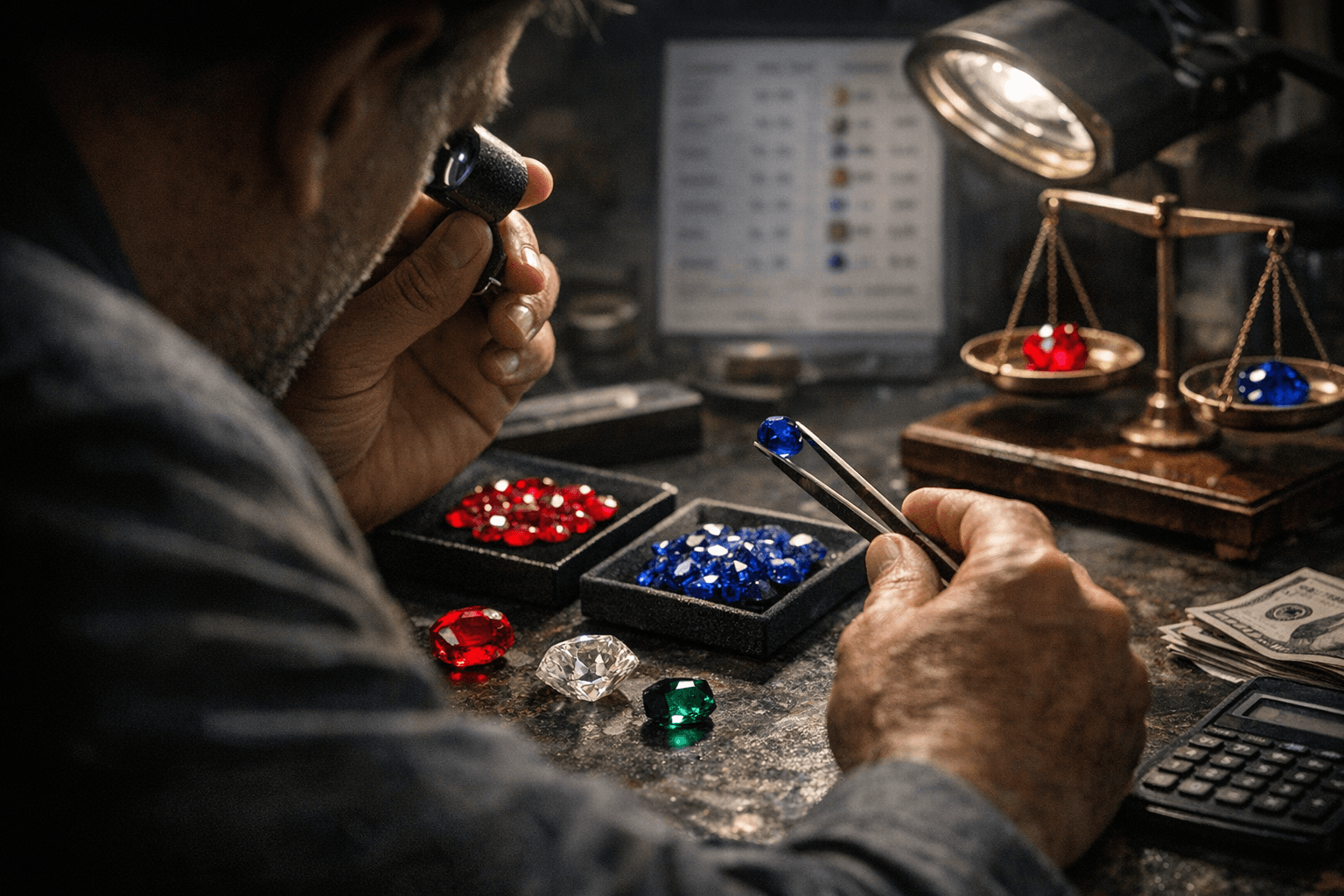
For July rubies: rubies and sapphires are both corundum. Heat treatment to improve color and reduce inclusions is near-universal in the market. Ruby was first discovered in Myanmar's Mogok region, and a stone confirmed by laboratory as originating there still carries a significant origin premium over Thai or Mozambican material of the same color grade.
Spot the Deal vs. the Rip-Off
A wide price range is not in itself a red flag. Per-carat pricing escalates steeply with size and color saturation, and that nonlinearity is normal. Here is what is not:
- A sapphire or ruby above two carats priced at the low end of the range with no laboratory certificate. Either the stone is heat-treated (fine, but disclose it) or there is a reason the seller is not confirming treatment.
- An emerald claimed to be untreated without a GIA or AGL report to confirm it. Unenhanced emeralds are rare enough to always come with paper.
- A "natural alexandrite" under $1,000 per carat. True natural alexandrite with strong color change is among the rarest gems on earth. Anything at that price is lab-grown, which is not fraudulent but must be labeled as such.
- Blue topaz listed as "natural untreated." Virtually all blue topaz is irradiated. Natural blue topaz is exceptionally rare and essentially never what you are buying at retail.
- Pressure to buy without a certificate from a named, independent laboratory. Reputable dealers welcome documentation.
Red flags:
Certificate expectations by tier:
For garnet, amethyst, peridot, citrine, and blue topaz under five carats, a dealer's written description and return policy is often sufficient. For aquamarine, tourmaline, and tanzanite above two carats, request at minimum a GIA or equivalent report confirming natural origin. For sapphire, ruby, emerald, and alexandrite of any meaningful size, insist on a report from GIA, AGL, Gübelin, or SSEF, specifically addressing origin and treatment status. The certificate cost, typically $100–$300, should be factored into any purchase where one is not already provided.
A short negotiation script:
You do not need to be aggressive. The most effective approach is specific: "Can you show me the laboratory report for treatment status on this stone? If there isn't one, I'd need the price to reflect that uncertainty." For stones in the mid-four to five figures, you can add: "I'm comparing this with a certified equivalent. What's your best price with a GIA report included?" Sellers who are confident in their merchandise will either produce documentation or adjust the price. Those who resist transparency are providing useful information of a different kind.
The priests who assembled Aaron's breastplate assigned stones by tribe, not by budget. But if they were sourcing a pigeon's-blood ruby in today's open market, they would want the Mogok origin certificate. Even sacred acquisitions deserve due diligence.
This article was produced by Prism’s automated news system from verified source data, official records, and press releases, then run through automated quality and moderation checks before publishing. The system is built and supervised by the people who set the standards it runs under. Read our full AI policy.
Did this article answer your question?