How to Care for April Birthstone Diamond Rings, and Keep Them Brilliant
April’s diamond is tough enough for daily wear, but lotions, chlorine and loose prongs can still steal its fire. The right routine keeps it bright for decades.
Why April’s diamond asks for care
Diamond is April’s birthstone, the gift of choice for the 60th and 75th wedding anniversaries, and a near-universal symbol of love and marriage. GIA says its durability comes from three properties, hardness, toughness, and stability, which is why diamond rings are often chosen for everyday wear. That strength can create a false sense of security, though, because even the hardest stone still depends on a clean surface, a sound setting, and a little restraint.
AGS says the first recorded use of a diamond in an engagement ring dates to the 15th century, and GIA notes that diamonds were once believed to protect against poison and the plague. The mythology is grand, but the maintenance is practical. A diamond ring is not just a symbol, it is a finely built object whose brilliance depends on how carefully it is worn.
The habits that matter most every day
Forbes Vetted’s ring-care guidance starts with a simple discipline: limit exposure to lotions and chemicals, remove rings during cleaning or workouts, store them in a soft-lined box, and have settings checked regularly. Those rules matter because an April diamond is often worn as a daily ring, the kind that moves with you through hand cream, dish soap, gym equipment, and the rest of ordinary life. The stone may be durable, but residue, friction, and tiny knocks can still make it look tired.
Jewelers of America adds an important reality check: engagement rings worn every day are more susceptible to damage or loss. That applies just as clearly to any April birthstone ring designed for constant wear. The more often a ring stays on, the more it needs deliberate habits, not just sentiment, to keep it secure and bright.
Water, chemicals, and workouts are the real danger zones
Fine jewelry should come off before swimming, going into hot tubs, or any exposure to chlorine or salt water, according to Jewelers of America. Water is not the only issue, because the combination of moisture, motion, and chemical exposure can be hard on both stone and setting. Even an unglamorous task can be risky, since Jewelers of America says washing dishes in a ceramic sink can chip a diamond.
That warning makes sense when you think about how diamond durability actually works. GIA describes it as a balance of hardness, toughness, and stability, which explains why diamond can survive so much daily life, but also why it still needs care around chemicals, heat, and wear. A workout, a scrub session, or a pool day may feel routine, yet each one is a small test of the ring’s security.
Why cleaning is part beauty routine, part health routine
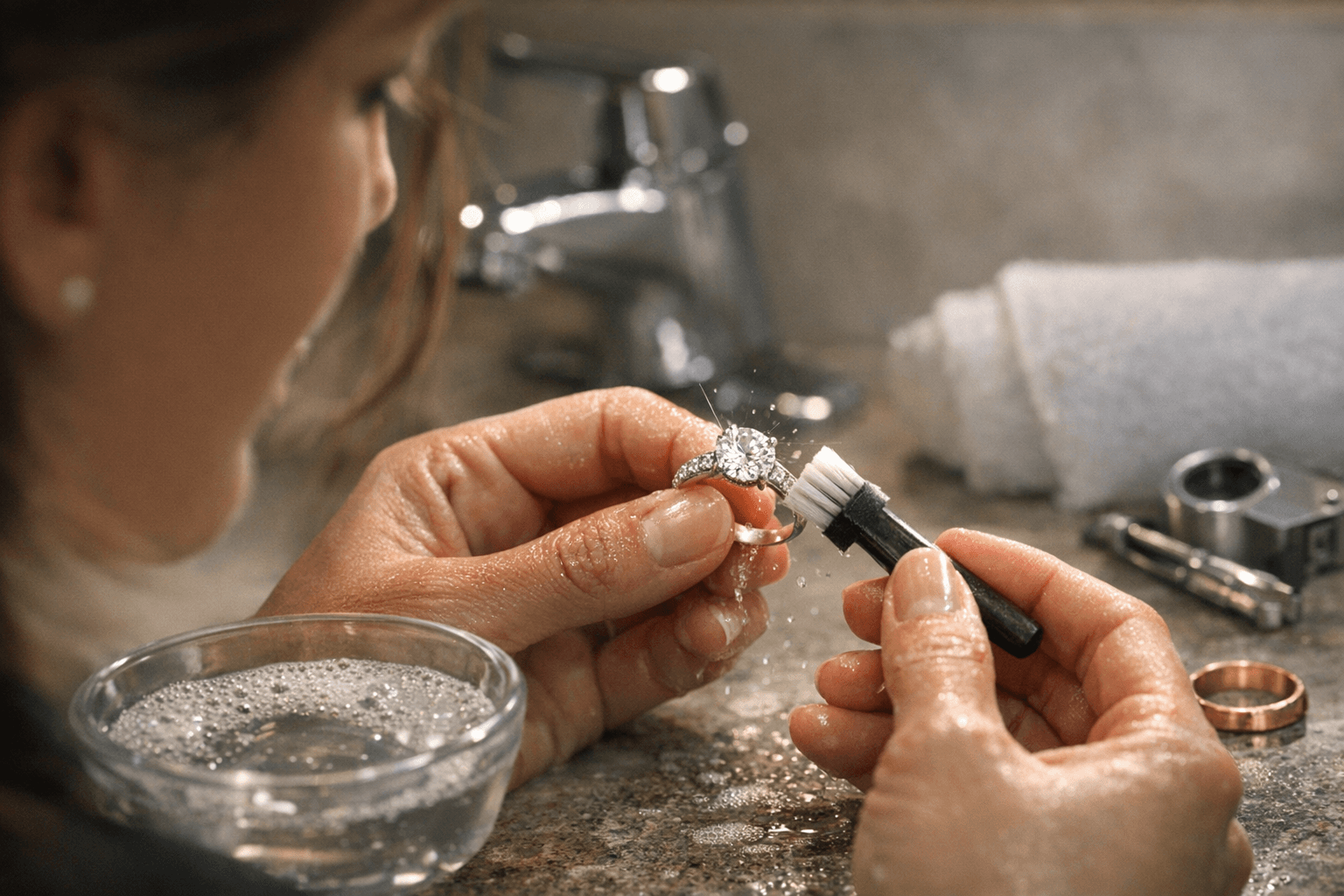
American Gem Society says dirt and grime can dull jewelry, contribute to scratches, discoloration, and metal degradation, and even cultivate bacteria that may irritate skin or worsen allergies. That makes cleaning more than a cosmetic fix. It is part preservation, part hygiene, especially when buildup gathers around the underside of the stone and along the metal that holds it.
The best strategy is to avoid letting the ring get heavily dirty in the first place. Still, even a carefully worn diamond ring benefits from a reset. Professional cleaning at least once a year, which Jewelers of America recommends, gives a jeweler the chance to restore brilliance and inspect the setting for loose stones, worn prongs, or a bezel that has begun to thin.
Storage is the unsung part of brilliance
A soft-lined box may seem like a small thing, but it is one of the easiest ways to protect a diamond ring when it is not on your hand. It keeps the piece from knocking against hard surfaces and gives the setting a resting place that is gentler than a counter, sink ledge, or jewelry dish. For a ring meant to carry memory and meaning, that kind of storage is not fussy, it is respectful.
This matters most for rings worn as everyday signatures. They move from sink to commute to office to evening, and each transition offers a chance for loss or damage. Putting the ring back in its lined box after wear is the simplest way to keep brilliance from becoming an accident.
The long view
The appeal of an April diamond is that it can live many lives at once. It is a birthstone, an anniversary gem, and for many wearers, a piece that is expected to endure the rhythm of ordinary days without losing its polish. That expectation is exactly why care matters.
Keep it away from lotions, cleaners, chlorine, salt water, hot tubs, and workouts. Store it in a soft-lined box, check the setting regularly, and schedule a professional cleaning at least once a year. Do that, and the stone once associated with protection from poison and plague will keep doing what diamonds do best now, holding light, memory, and wear with remarkable clarity.
This article was produced by Prism’s automated news system from verified source data, official records, and press releases, then run through automated quality and moderation checks before publishing. The system is built and supervised by the people who set the standards it runs under. Read our full AI policy.
Did this article answer your question?