March Birthstones Aquamarine and Bloodstone: Meanings, History, Buying and Styling Tips
Two very different stones share March: aquamarine’s clear sea-blue serenity and bloodstone’s dark-green, red‑spotted strength, choose by color, history, or the story you want to wear.

1. At a glance: March’s two birthstones
Aquamarine is the modern, official birthstone for March and bloodstone remains the traditional, alternative choice; together they offer a palette of sea-blue clarity and deep, earthy green with red flecks. The Old Farmer’s Almanac frames these stones as complementary, “aquamarine (modern) and bloodstone (traditional)”, and the month’s pairing captures both serenity and strength, language echoed in Azeera’s “Gems Of Serenity And Strength.”
2. Aquamarine, meanings and modern symbolism
Aquamarine is widely described as a stone of serenity, clarity, courage and honest communication: “Aquamarine symbolizes honesty, faithfulness and beauty,” a phrasing that appears in retailer copy and historical guides. Contemporary sources link it to inner peace, heightened awareness and improved communication skills, making it a natural choice for gifts that mark transitions, travel, or commitments among friends and loved ones.
3. Aquamarine, history and lore
Historically, aquamarine was a mariner’s talisman, “known as the Sailor’s Stone”, believed to calm rough seas and protect sailors from shipwreck, an attribution preserved in showroom copy and popular histories. Retail legend lives on: “Aquamarines are the treasure of mermaids,” a charming line from N. Fox Jewelers that captures the stone’s maritime associations and romantic provenance in popular lore.
4. Aquamarine, gemology and notable specimens
GIA describes aquamarine hues as ranging “from deep green‑blue to light, slightly greenish blue” and notes that faceted aquamarines are often free from inclusions and “as clear as water.” Retail and historical accounts amplify that clarity with spectacle: Joseph’s Jewelry cites particularly large examples, a “1,298‑carat stone gifted to First Lady Eleanor Roosevelt by Brazil” and a “240‑pound aquamarine discovered in Brazil”, claims that are striking but should be verified against museum or auction records before being treated as archival fact.
5. Aquamarine, styling and buying tips
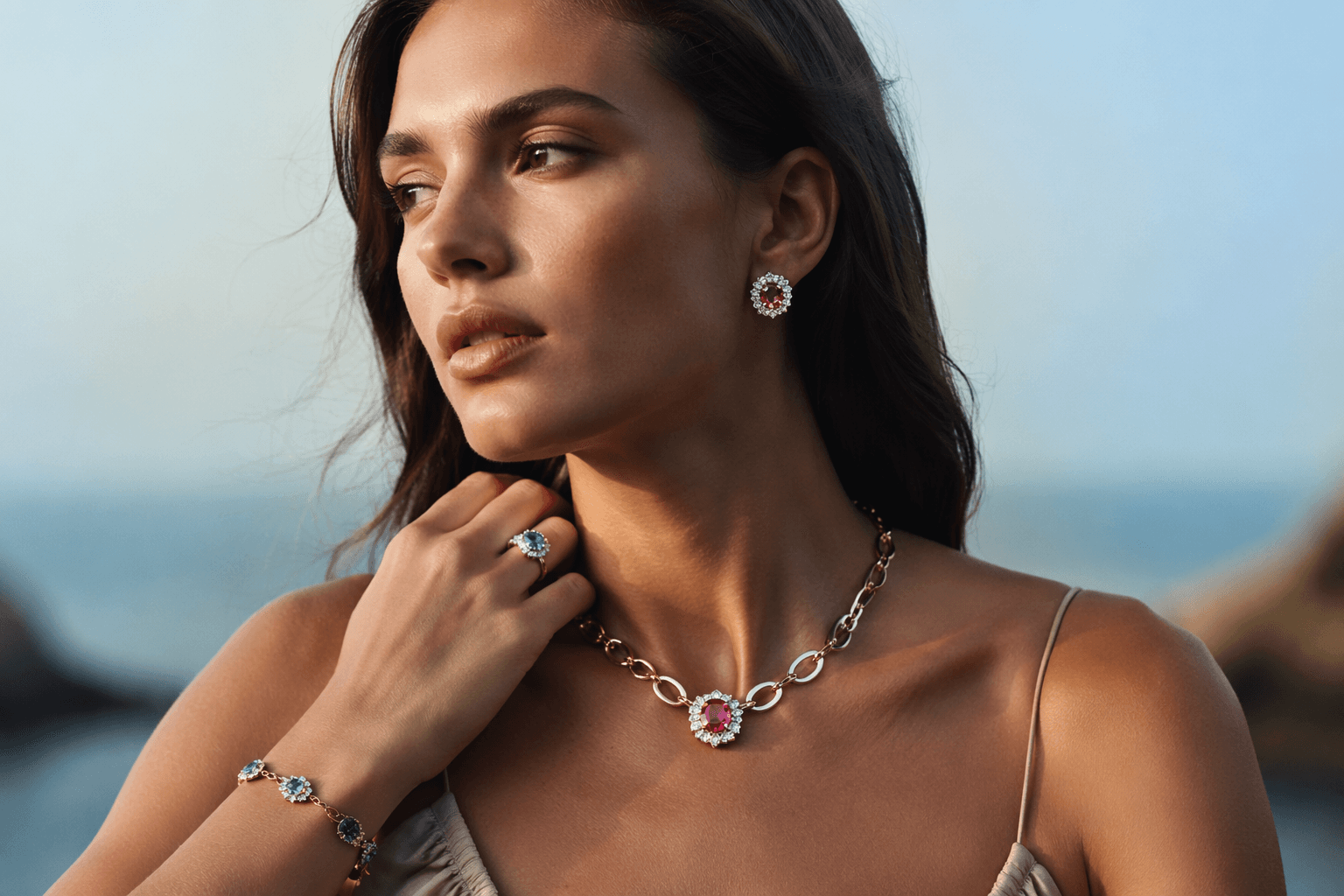
For styling, retailers recommend pairing aquamarine’s delicate blues with white metals: “Pair it with white gold or platinum for a fresh, airy look, or add some sparkle with diamond accents to elevate its elegance,” advice drawn directly from N. Fox Jewelers. For a sense of scale and design, GIA’s product‑style example, “a 10.06 carat pear shaped aquamarine surrounded by 72 round diamonds set in platinum”, illustrates how a single stone can be the formal focal point of a necklace; choose faceted stones for brilliance and consider diamond accents to lift a pastel blue into evening form.
6. Bloodstone, meanings and symbolism
Bloodstone (heliotrope) carries a very different set of associations: vitality, strength, courage, protection and historical healing powers. Sources tie it to sacrifice and redemption in biblical tradition and to protective amulets; Joseph’s Jewelry records its “biblical significance,” and GIA notes that both birthstones share a “reputation for protecting one’s well‑being.”
7. Bloodstone, history, lore and medieval use
Bloodstone has a long record of use in antiquity and the Middle Ages: Greeks and Romans wore it as amulets and signet rings believing it could staunch bleeding, while medieval carvers used it for religious scenes and crucifixion imagery. GIA preserves the etymology: “Bloodstone’s alternate name heliotrope comes from the ancient Greek word that means ‘to turn the sun,’” and both GIA and Shmuklerdesign repeat the ancient belief that heliotrope could “make the sun turn a reddish color if properly placed in water.” Such claims belong to folklore and devotional practice rather than to modern medicine.
8. Bloodstone, gemology and traditional cuts
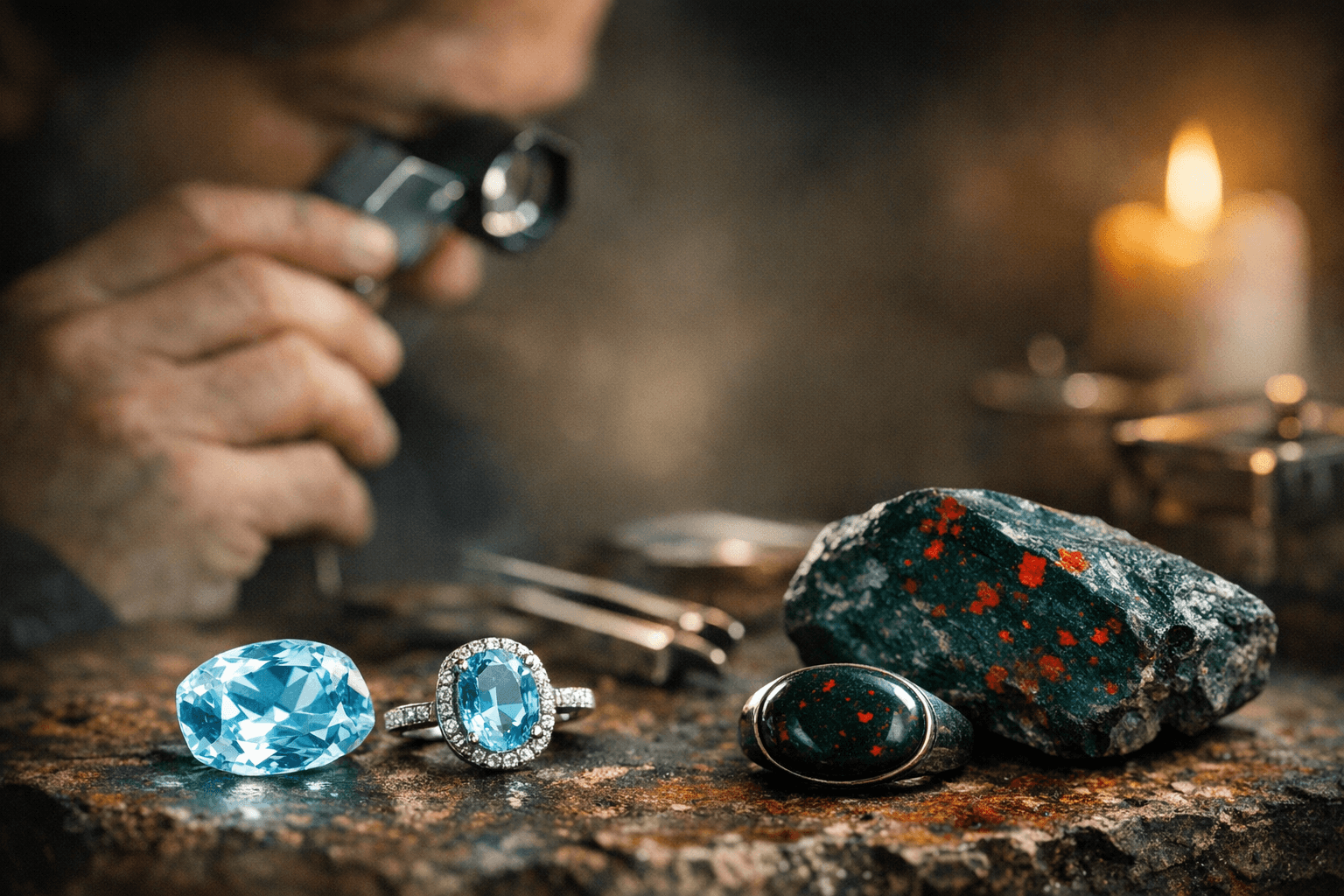
GIA classifies bloodstone as “a variety of chalcedony (cryptocrystalline quartz) that is traditionally semi‑translucent to opaque dark green jasper with red inclusions of iron oxides, especially hematite.” That appearance, deep green background punctuated by red spots, makes bloodstone best suited to cabochon form, signet rings and carved amulets rather than faceted fine jewelry. Shmuklerdesign and other retailers emphasize its Earthy, gothic palette and long history as a wearable emblem of protection.
9. Bloodstone, styling and buyer advice
Styling guidance for bloodstone centers on its bold, earthy personality: think statement rings, rustic settings and dark palettes that let the red hematite flecks read like punctuation against deep green. Many sources note metaphysical and historic uses, Shmuklerdesign lists claims ranging from invisibility to athletic luck and even the sale of crushed powder as an aphrodisiac in India, so present these as cultural lore rather than as objective benefits; choose bloodstone when you want jewelry that reads as historic, talismanic, and immediately tactile.
- Prioritize clarity and hue for aquamarine, lighter bluish‑greens read more summery, deeper green‑blues read more saturated and formal.
- For bloodstone, evaluate the quality of the green ground and the distribution and contrast of the red hematite spots; pattern and presence of red flecks materially affect the visual appeal.
- Remember that diamond accents and white metals elevate aquamarine’s formality, while warmer or darker metals complement bloodstone’s rustic energy.
10. How to choose between aquamarine and bloodstone
Decide by color story, cut and the narrative you want to carry: select faceted aquamarine when you want clarity, light and a spring/summer sensibility; select cabochon bloodstone when you want an earthy, statement piece rooted in antiquity. Practical tips:
11. Provenance, verification and where to look
When provenance or extraordinary claims are at play, check authoritative catalogs: Joseph’s Jewelry states that “Aquamarine became the official birthstone for March in 1952, replacing bloodstone,” a useful historical claim to note but one the trade typically verifies against industry lists; GIA remains the technical authority for mineral descriptions and should be consulted for precise gemological questions. For in‑person viewing and local expertise, N. Fox Jewelers lists a showroom at 404 Broadway, Saratoga Springs, NY 12866 and phone (518) 587‑7777; their site copy captures the retail tone, “So, which one will you wear? Or will you embrace both? Either way, you’ll be channeling centuries of history, symbolism, and style.”
12. Closing: choose by story as much as by stone
March’s two birthstones are not rivals but companions: aquamarine offers the serene clarity of sea water and a modern, faceted elegance; bloodstone brings deep, ancient earthiness and symbolic heft. As Azeera concludes, “March’s birthstones, Aquamarine and Bloodstone, offer a unique blend of serenity and strength. Whether you are drawn to the calming blue of aquamarine or the bold green and red of bloodstone, these gemstones provide a rich history, diverse meanings, and fascinating lore.” Choose the one that best expresses the life story you want to wear, whether that is quiet resilience, bold protection, or the layered history between them.
This article was produced by Prism’s automated news system from verified source data, official records, and press releases, then run through automated quality and moderation checks before publishing. The system is built and supervised by the people who set the standards it runs under. Read our full AI policy.
Did this article answer your question?