Modern and Traditional Birthstone Chart: Origins, Differences, Gem Profiles
A practical month-by-month map of modern and traditional birthstones, tracing their Polish origins, the contested 1912 standardization, and the gemological profiles that matter for jewelry.

1. January, Garnet
Garnet appears on both modern and traditional charts for January, a consistency reflected in multiple sources that list “January is garnet.” Historically, the broader traditional list that informs garnet’s placement originated in Poland between the 16th and 18th centuries, a point emphasized in the Gem Society’s account. As The1916company notes, garnets are most commonly red but “come in almost any color,” and were prized for protective symbolism by warriors and royalty, qualities that make faceted garnet and calibrated garnet beads equally viable choices for rings or signet-style settings.
2. February, Amethyst
Amethyst is likewise stable across modern and traditional charts as February’s stone; it is praised for its purple hues and approachable durability, with The1916company noting a hardness of 7 (on a 10 scale). The modern birthstone lists, standardized in various ways by trade groups, tended to prefer transparent gems, a practical choice for faceting and setting, because, as Gemsociety points out, “Imagine trying to create a ring with a pearl, a turquoise cabochon, and a diamond and emerald, both faceted).” For everyday wear, faceted amethyst in a prong or bezel setting balances sparkle with the stone’s resistance to abrasion.
3. March, Aquamarine and Bloodstone
March is routinely split between aquamarine (the modern choice) and bloodstone (the traditional choice): aquamarine’s name derives from Latin for “seawater,” and The1916company highlights its blue‑green range and its maritime protective lore. Bloodstone remains the older, darker guardian stone in traditional charts; collectors who favor historical authenticity often choose a cabochon or intaglio setting for bloodstone to preserve its mottled character. Aquamarine’s transparency and higher commercial availability make it a default option for modern settings, three‑ or four‑prong solitaires, halos, or channel set bands.
4. April, Diamond
April is unambiguous: diamond sits on both modern and traditional lists and is framed in trade charts as a symbol of “eternity and strength.” Diamonds’ exceptional hardness informs design choices, thin bezel rails for everyday wearable studs, four‑prong solitaires to maximize brilliance, or pavé shoulders for bridal silhouettes. The 20th‑century push to standardize birthstones elevated clear, facetable gems like diamond because they translate easily into consistent production for retail and commemorative pieces.
5. May, Emerald
Emerald is listed as May’s modern and traditional birthstone across the consolidated charts; Zearrow succinctly calls it “a symbol of rebirth and love.” Because emeralds are often included with natural fissures, settings that protect the girdle and minimize impact, low four‑prong or bezel treatments, are common practice. The stone’s chroma and potential treatments (oils to enhance clarity) make provenance and clarity grading relevant to value and to how a piece should be insured and cared for.
6. June, Pearl, Moonstone, Alexandrite (variants)
June demonstrates how modern charts can diverge: some retail lists present only alexandrite for June, while other modern charts and tables list pearl, moonstone, and alexandrite together as acceptable modern options. Zearrow’s modern column explicitly lists “Pearl, Alexandrite, Moonstone,” while Gemsociety’s one‑line list at times names alexandrite alone, an inconsistency buyers encounter. Practically, pearls and moonstones favor bezel or low‑profile settings to protect softer surfaces, whereas alexandrite, valued for color change, benefits from faceted cuts and secure prongs.
7. July, Ruby
Ruby is the clear choice for July on both modern and traditional charts; The1916company emphasizes its blood‑red mythology and notes that rubies, chemically corundum like sapphires, can show colors from pink to orangey red. Historically worn by warriors for strength, rubies today are prized for saturated pigeon‑blood to deep pinkish‑red tones; secure prong settings or bezel channels are favored for high‑carat stones to guard against chips. Market demand and the stone’s relative hardness make ruby an enduring investment pick for rings and statement pendants.
8. August, Peridot, Spinel, Sardonyx
August’s modern options commonly include peridot and spinel, while sardonyx appears in traditional columns, an arrangement visible in consolidated tables that show “Peridot Spinel” as modern and “Sardonyx” as traditional. Peridot’s bright yellow‑green glow, noted by The1916company as seeming to “glow at night,” wears well in faceted cuts and is often bezel‑set to protect its edges. Sardonyx’s banded character suits cameos and intaglios; spinel, increasingly included as a modern addition, offers the transparent brilliance retailers seek when updating charts to reflect market availability.
9. September, Sapphire
Sapphire occupies both modern and traditional slots for September and is classically associated with wisdom and faithfulness. The gem’s hardness and range of blue saturation allow for everything from delicate halo engagement rings to substantial collegiate‑style signet rings; heat‑treated sapphires dominate the commercial market and are typically faceted to maximize color. For collectors, Kashmir or Ceylon provenance and untreated stones command premiums, a distinction that should inform purchase and appraisal.
10. October, Tourmaline and Opal
October is traditionally associated with opal but has seen tourmaline added to modern lists because of its wide color range and market appeal, Zearrow explicitly notes tourmaline’s addition alongside opal. Opal, with its play‑of‑color, often requires protective bezel settings and careful handling due to relative softness and sensitivity to dehydration or shock; tourmaline, being transparent and available in vivid pinks and greens, lends itself to faceted, prong‑oriented designs. The modern practice of offering both stones reflects the trade’s effort to balance historical symbolism with consumer preference.
11. November, Topaz and Citrine
November’s chart typically pairs topaz (traditional) with golden topaz or citrine as modern options, Gemsociety’s table lists “Golden Topaz Citrine” in modern columns. Zearrow underscores the association of these stones with “joy and positivity,” an appealing retail narrative. Citrine and golden topaz are both transparent, heat‑treatable, and economical choices for warm‑toned necklaces and rings; both respond well to faceting and are commonly set in prong or halo styles that emphasize their sunny color.
12. December, Turquoise, Lapis, Blue Zircon, Blue Topaz, Tanzanite
December illustrates the broadest modern vs. traditional spread: traditional charts favor turquoise and lapis lazuli, while modern charts append blue zircon, blue topaz, and tanzanite as retail‑friendly options. The1916company warns that “Turquoise rarely emerges from the earth as a traditional vivid blue…they tend to be pale or colorless and are made vibrant by heat treatment,” while also noting “Blue zircon is a more recent addition to the birthstone chart, but its brilliance and affordability make it an increasingly popular choice.” Because December examples span porous, treated, and highly refractive stones, setting choice is crucial, lapis and turquoise are often cabochoned in bezels, blue zircon and tanzanite are faceted and usually prong‑set.
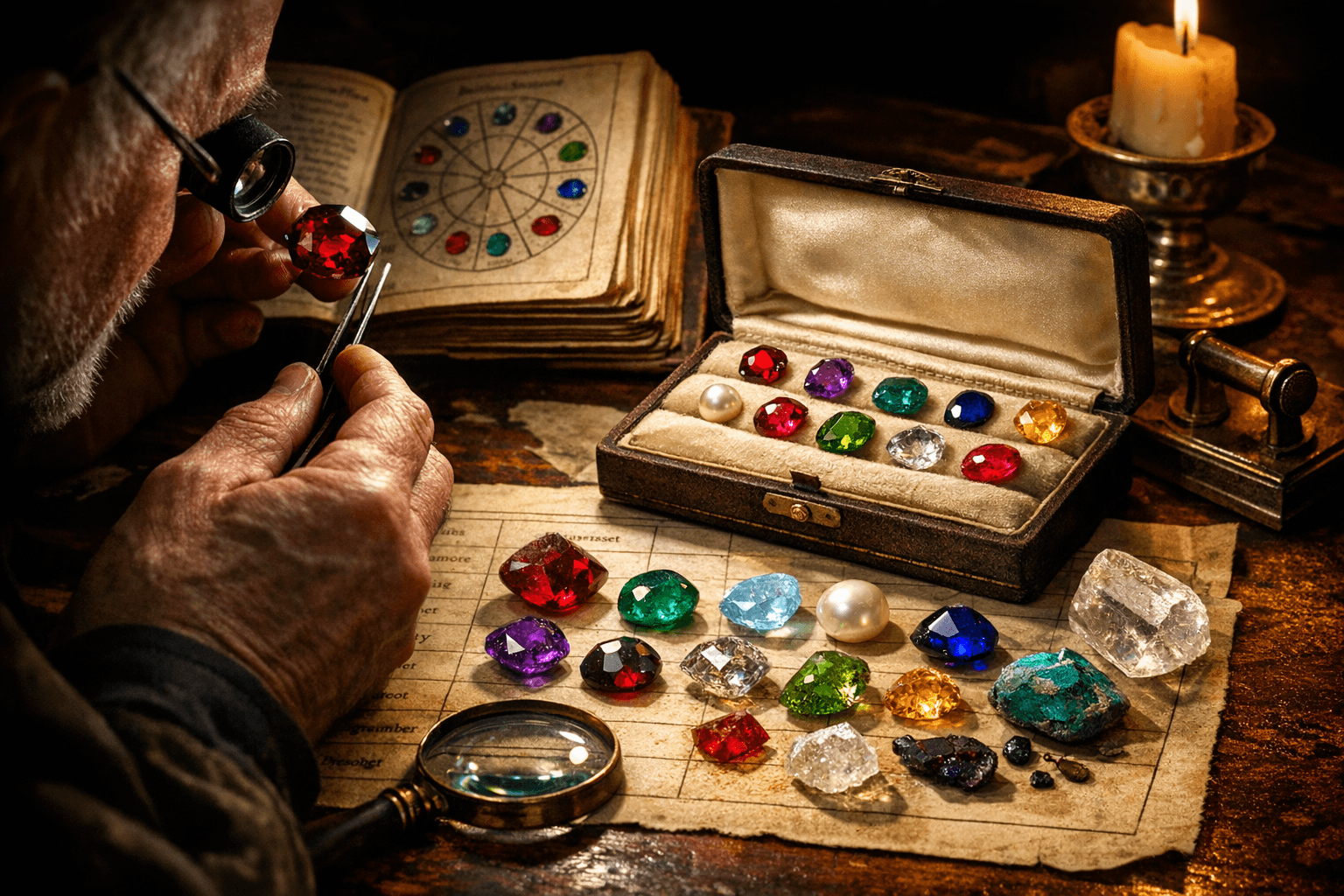
Final note (editorial synthesis) The birthstone lists you’ll encounter are a blend of centuries‑old tradition and 20th‑century retail standardization: the traditional set traces back to Poland between the 16th and 18th centuries, while modern charts were formalized by trade groups in the early 1900s, claims variously attributed to the National Association of Jewelers, the Jewelers of America, and other trade bodies in the sources, and have been revised as the market has evolved (spinel, citrine, tanzanite and blue zircon are recent additions noted by retail and trade sources). Retail language and disclosures appear alongside editorial content, IGS discloses “IGS may receive customer referral fees from the companies listed in this page,” and Gemsociety’s pages sometimes include promotions such as “FREE ENGRAVING + LIFETIME WARRANTY!”, reminders that many modern birthstone lists double as shopping guides. Choose stones with attention to hardness, typical treatments, and setting style: those are the practical details that turn a birthstone into a lasting piece of jewelry.
This article was produced by Prism’s automated news system from verified source data, official records, and press releases, then run through automated quality and moderation checks before publishing. The system is built and supervised by the people who set the standards it runs under. Read our full AI policy.
Did this article answer your question?