Ruby Prices in 2026 Range From $100 to $1 Million Per Carat
Ruby, July's birthstone, spans from $100 to over $1 million per carat in 2026; color alone drives up to 80% of the price, and knowing why changes everything.

The ruby appears in the breastplate of Aaron, described in Exodus and identified by the historian Josephus as the first stone set into that sacred vestment around 1200 B.C. For three millennia, no gem has matched its cultural authority. Sanskrit texts called it *ratnaraj*, the king of precious stones. Burmese warriors embedded rubies into their skin before battle, believing the stone conferred invincibility. If you were born in July, this is your birthstone, and in 2026, it carries a market range more dramatic than any other gem in the colored stone category: from roughly $100 per carat at the commodity end to well over $1,000,000 per carat for the finest unheated stones from Burma's Mogok Valley. Understanding where on that spectrum your ruby sits, and why, is the difference between a beautiful accessory and a genuine store of value.
Why Color Commands the Price
Every serious gemologist will tell you the same thing: with rubies, color is not one factor among many. It accounts for 60 to 80 percent of a stone's total value, a proportion unmatched in almost any other gem category. Color itself breaks into three components: hue (the actual red, which should be pure and not veering toward orange or purple), saturation (the intensity of that red, the more vivid the better), and tone (the depth, ideally neither too light nor so dark the stone reads as burgundy in low light).
The highest trade color grade is "pigeon blood," characterized by a vivid, saturated red with a slight blue undertone that creates an almost luminous, glowing appearance. The term was first used in 1829 to describe the finest rubies from the Mogok mines, where locals called the most vivid red stones "ko-twe," meaning pigeon blood. Today rubies from Mozambique and other regions have also achieved this designation, though it remains exceptionally rare. Pigeon blood rubies represent less than 1 percent of all rubies mined globally, which is why the color grade carries such a disproportionate weight in price negotiations.
The Five Budget Tiers: A Price-Per-Carat Framework
The ruby market in 2026 organizes itself into five distinct value tiers, each with its own buyer profile and non-negotiables.
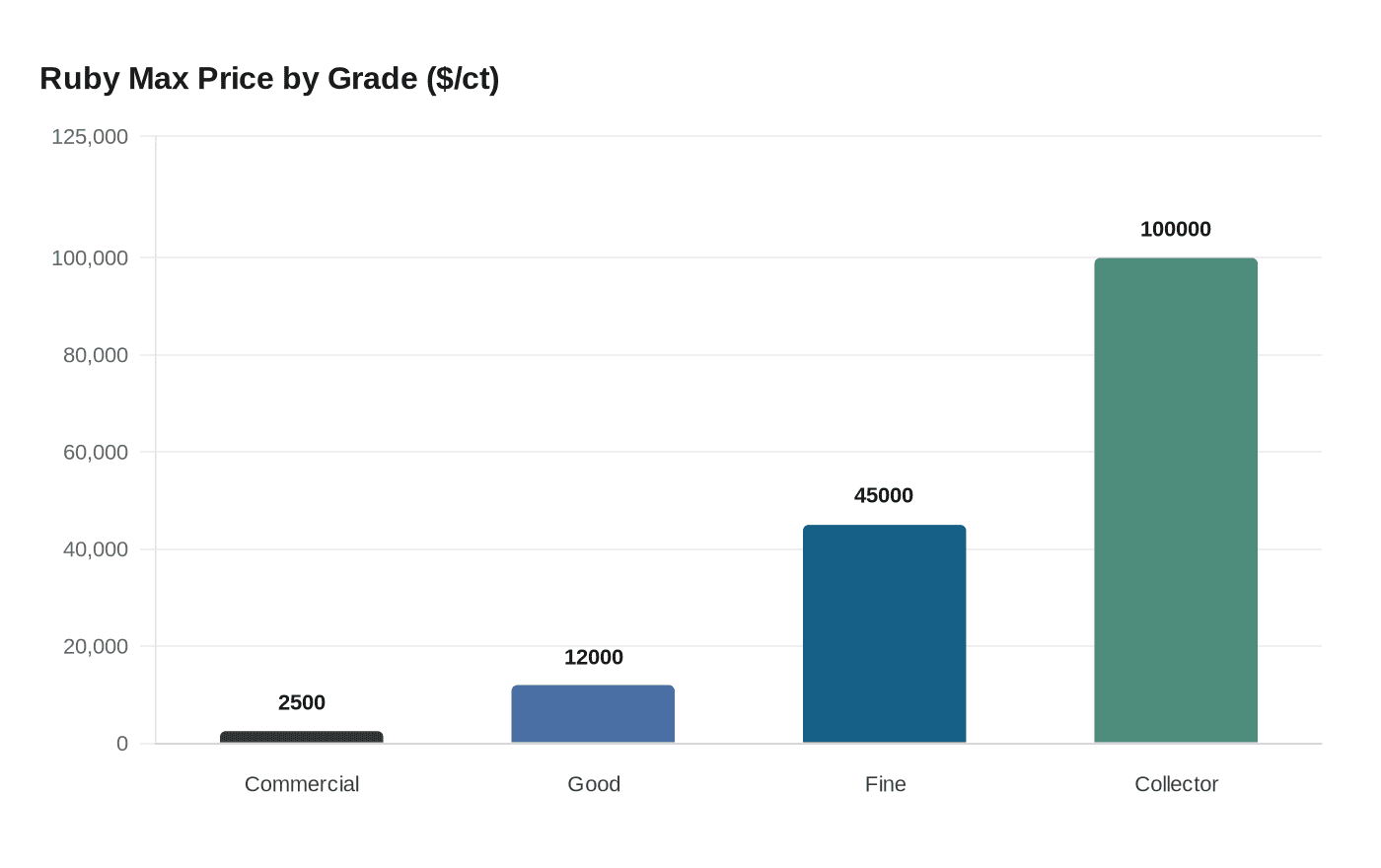
Commercial grade covers the broadest swath of the market, with prices running from approximately $100 to $2,500 per carat. These are typically heat-treated stones with moderate color, visible inclusions, and origins from lower-premium regions such as Thailand or Vietnam. They are perfectly appropriate for fashion jewelry, gift pieces, and birthstone jewelry where the emotional rather than investment value is primary. At this tier, a lab report is rarely worth the cost of the stone itself.
Good grade stones, with strong red color and minor inclusions, run from approximately $5,000 to $12,000 per carat for a one-carat stone. African rubies from Mozambique and Madagascar are second only to Burmese rubies in popularity, known for a characteristic dark-red color, and are generally more affordable than Burmese material. Mozambique stones at this tier represent some of the most compelling value in the 2026 market, delivering genuine quality at a meaningful discount to Burmese equivalents.
Fine grade rubies, with vivid to exceptional color saturation and eye-clean clarity, command $15,000 to $45,000 per carat. At this level, origin documentation matters and a lab report from GIA, GRS, or SSEF becomes a reasonable investment. Fine heated Mozambique stones typically price between $5,000 and $15,000 per carat, while fine heated Burmese stones push toward the upper end of the fine tier and beyond.
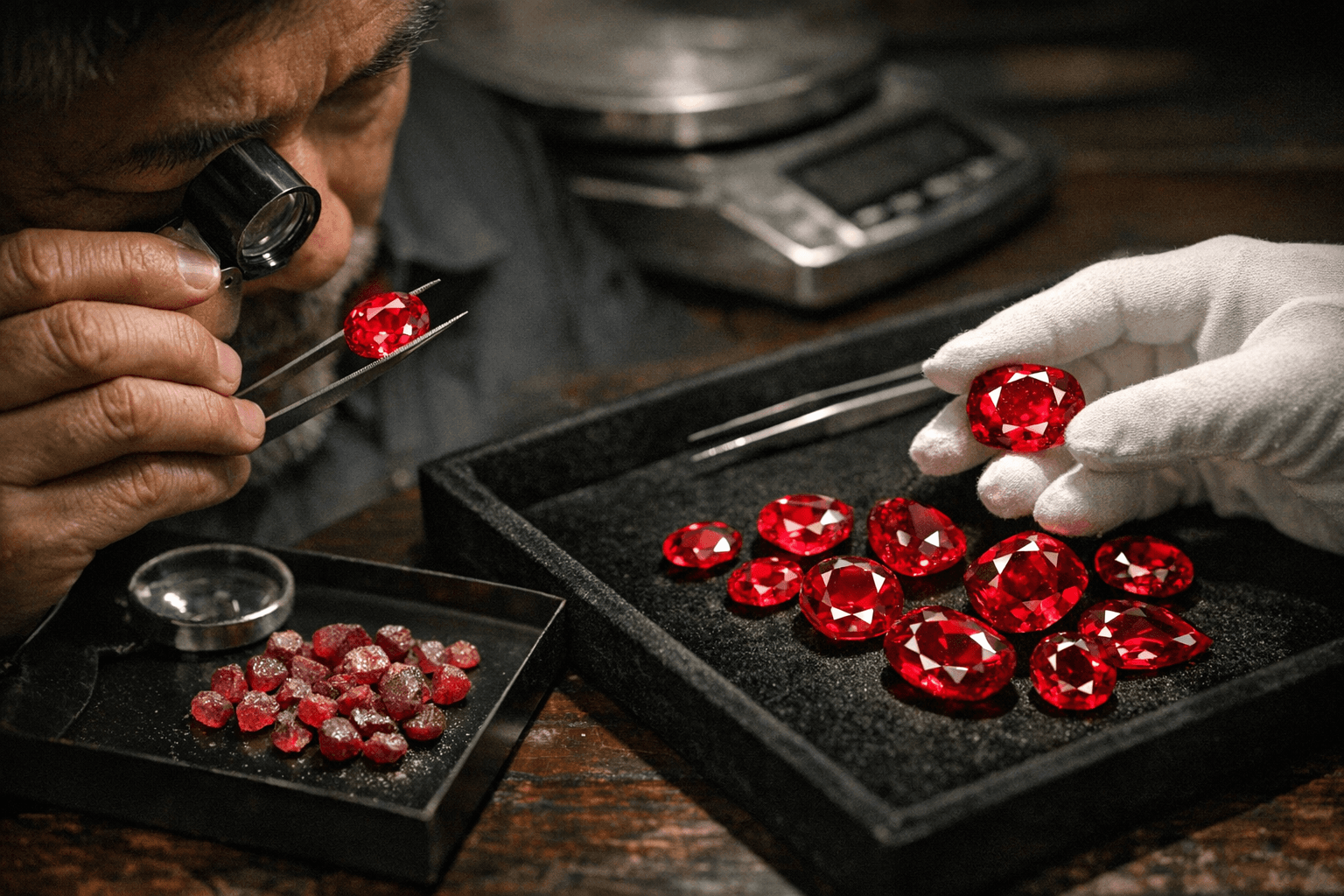
Exceptional and collector grades are where the arithmetic becomes extraordinary. Unheated rubies command a 100 to 300 percent price premium over heated stones of the same size and color, making them more resilient to market fluctuations. For the finest unheated pigeon blood rubies from Mogok, prices regularly exceed $100,000 per carat. A fine 3-carat-plus Burmese unheated pigeon blood ruby can exceed $100,000 per carat at auction. At the museum tier, the ceiling is theoretical: the Jubilee Ruby sold for $14 million at Christie's in 2016, the most expensive colored gemstone to sell at auction in the United States. A 10.33-carat unheated Burmese pigeon blood ruby sold at Sotheby's for $5.5 million.
The Treatment Question: Heat and What It Costs You
Heat treatment is a standard and accepted practice for approximately 95 percent of the world's rubies. That number deserves a moment to land: if you are buying a ruby without documentation confirming its treatment status, the near-universal assumption in the trade is that it has been heated. Heating dissolves inclusions, intensifies color, and improves clarity. It is not fraud. It is industry standard. But it is consequential for value.
Untreated stones sell for 5 to 10 times more than heated ones, with natural ruby value depending on three core factors: color, treatment status, and origin. A heated Burmese ruby of fine color might price at $20,000 per carat. The same stone confirmed unheated by a credible laboratory would cross $50,000 to $100,000 per carat without difficulty. Beyond simple heat treatment, glass-filling (a practice that fills fractures with lead glass to improve apparent clarity) represents a more serious treatment that dramatically reduces a stone's value and long-term durability. Any stone suspected of glass-filling should be avoided entirely for investment purposes.
Origin: The Geography of Premium
Mogok, Myanmar, remains the most prestigious origin, but continued political instability has made the supply of new Burmese rubies almost non-existent. This scarcity has created a legacy effect, where older Burmese stones circulating on the secondary market are fetching astronomical prices at auction. This is a critical market dynamic in 2026: you are not just paying for a stone from Mogok, you are paying for access to a supply that is effectively closed.
Rubies from Sri Lanka, Thailand, and Vietnam are not regarded or valued as highly as Burmese rubies. For buyers working in the mid-market, Mozambique remains the most intelligent origin to target: stones with genuine pigeon blood color characteristics at prices that, while significant, do not carry the Burmese provenance premium.
Clarity, Size, and Cut: The Supporting Factors
Rubies are a Type II gemstone, meaning inclusions are expected and their presence does not disqualify a stone the way it might in a diamond. What matters is whether inclusions are visible to the naked eye. Eye-clean rubies command a meaningful premium, but a stone with silk inclusions (fine rutile needles that create a soft glow) is often more desirable than one with fractures or carbon spots.
Size multiplies every quality factor exponentially. A one-carat ruby at fine quality prices around $15,000 to $45,000 per carat. But a three-carat stone of equivalent quality does not triple in price; it can increase four to six times per carat due to the extreme rarity of large, fine-quality rough. This size premium is one of the most important concepts for buyers to internalize before entering the market above the $50,000 total price point.
Cut is the most underappreciated value driver. In 2026, precision cutting, specifically cutting that maximizes color distribution across the face of the stone while preserving carat weight, is increasingly recognized as a value-add by sophisticated buyers. A poorly cut ruby that shows windowing (a washed-out, colorless zone in the center) loses value regardless of raw quality.
When a Lab Report Is Non-Negotiable
The decision tree here is straightforward. For any ruby priced above $3,000 per carat, request documentation. At that threshold, the cost of a GIA, GRS, or SSEF report ($100 to $500 depending on the stone and lab) is trivial relative to the purchase. For high-value transactions, the report must explicitly confirm geographic origin and the absence of heat treatment to protect the stone's resale value.
At the fine, exceptional, and collector tiers, a lab report is not optional. It is the purchase. Buyers, particularly Millennials and Gen Z investors, are now demanding precision documentation alongside the stone, and secondary market prices reflect that shift: an undocumented exceptional ruby will never achieve the same price as an identically graded stone with a GRS "Pigeon Blood" color call and a confirmed "No Heat" notation.
For commercial and good-grade purchases below $2,000 total, simpler transactions are entirely reasonable. A reputable dealer's word and basic gemological knowledge are sufficient. But the moment you cross into five figures per stone, the paperwork is the foundation of the investment, not an afterthought.
The Ruby Market in 2026 and Beyond
What makes the ruby genuinely unusual as a gemstone investment is the combination of supply contraction and rising demand from a generation that treats hard assets seriously. An investor-grade 2-carat unheated ruby is now considered by some in the trade a safer hard asset than almost any diamond, given the compression of Burmese supply and the global recognition of the pigeon blood standard. The ancient kings who built their treasuries around rubies were not wrong about the stone's permanence. The market in 2026 is simply giving that intuition a very precise price.
This article was produced by Prism’s automated news system from verified source data, official records, and press releases, then run through automated quality and moderation checks before publishing. The system is built and supervised by the people who set the standards it runs under. Read our full AI policy.
Know something we missed? Have a correction or additional information?
Submit a Tip