Swarovski Birthstone Earrings at Walmart Drop From $125 to $18
Crystal, not gemstone: Swarovski birthstone studs drop 86% to $18 at Walmart, and knowing the difference is everything.
The priestly breastplate described in Exodus set twelve stones — one for each tribe of Israel — into gold settings worn over the heart. Scholars trace that lapidary catalog, codified roughly four thousand years ago, as the origin of what we now call birthstones. Which is part of why a $18 pair of studs at Walmart can feel like far more than what the price tag suggests — and why, before you purchase, the material story deserves closer reading than the discount does.
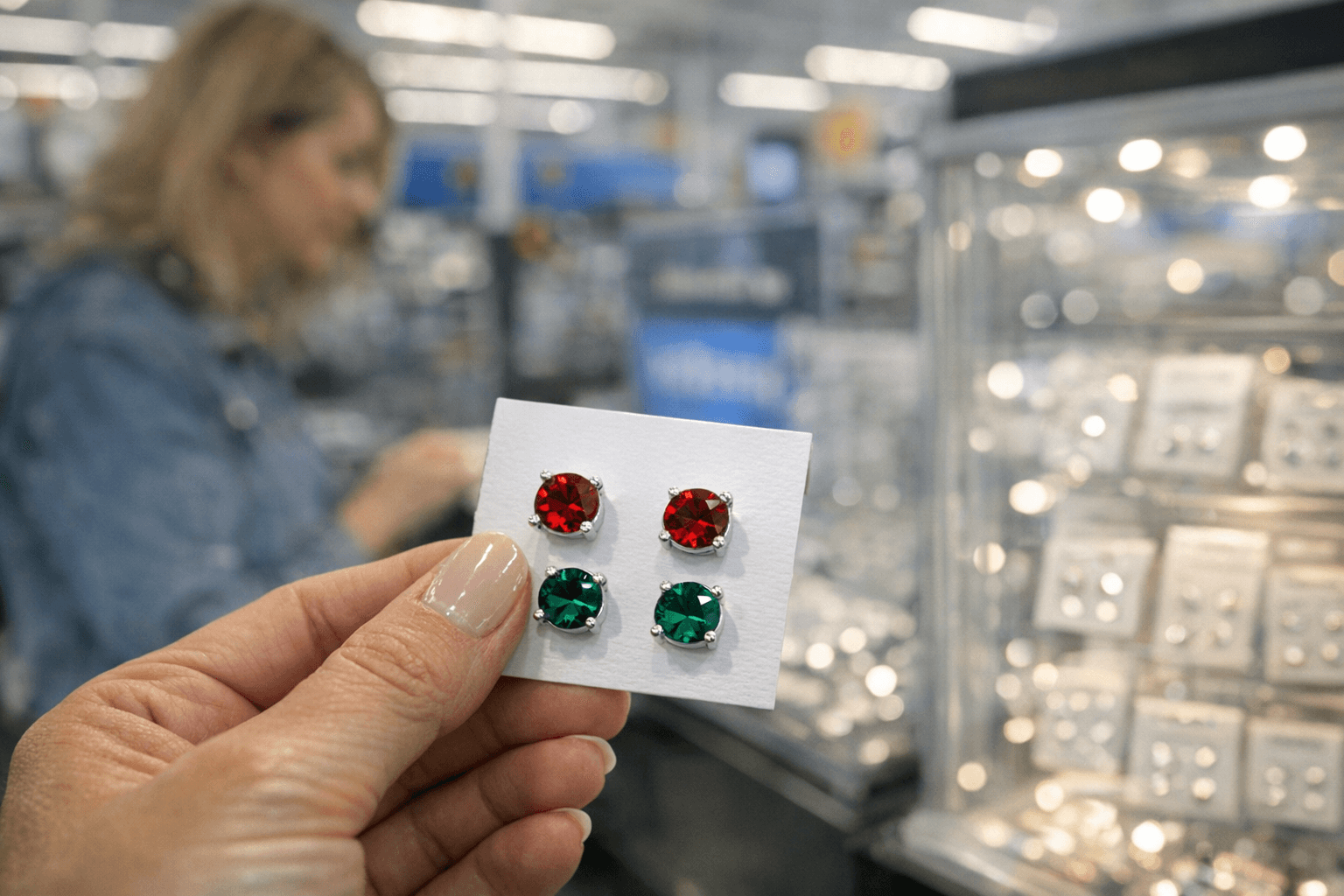
The earrings in question are Cate & Chloe's Swarovski Crystal Birthstone Studs, currently priced at approximately $18 at Walmart, marked down from the $125 list price, a reduction of roughly 86 percent. They come in twelve options, one for each month: red garnet for January, purple amethyst for February, blue aquamarine for March, white diamond crystal for April, green emerald for May, purple alexandrite for June, red ruby for July, peridot for August, blue sapphire for September, pink tourmaline for October, yellow citrine for November, and turquoise tanzanite for December.
The first thing to understand is what "Swarovski crystal" actually means, because "birthstone" in a mass-market context does not mean what it implies. Swarovski crystal is not a gemstone. It is a form of precision-cut glass, produced by melting silicon oxide at high temperature. The company, founded in Austria in 1895 by Daniel Swarovski, built its reputation over more than a century on the consistency of its cutting and polishing process, which gives its crystals exceptional light refraction and color saturation. The results are genuinely beautiful. But garnet is a mineral. Amethyst is quartz. Sapphire is corundum. Swarovski's versions are glass analogs carrying the name and color of the stones they reference, not the stones themselves.
That distinction reframes the $125 reference price. A genuine 1-carat garnet stud in sterling silver typically retails between $40 and $80; a natural amethyst stud in a comparable setting, somewhat less. Natural sapphire or emerald studs at meaningful carat weight begin well above $200. The $125 list price on a crystal alternative reflects Swarovski's licensing value and Cate & Chloe's positioning as a mid-market fashion jewelry brand, not the intrinsic worth of the stone. The markdown to $18 is real, but the benchmark was a premium-brand reference price, not a fine jewelry price.
Is $18 a true outlier for crystal birthstone studs? Partly. Generic birthstone crystal studs on Walmart's own marketplace, from brands like JeenMata and Bestyle, start around $15. Macy's currently lists cushion-cut birthstone studs in silver at around $30. What elevates the Cate & Chloe offering is the Swarovski certification: documented standards for clarity, cut consistency, and color that unbranded crystal cannot guarantee. At $18, that brand assurance is the actual value proposition.
A few practical checks before purchasing. The studs are set in 18k white gold plating, which photographs beautifully but requires scrutiny for anyone with metal sensitivity. Gold plating sits over a base metal, and that base may contain nickel. Confirm whether the base is nickel-free directly in the product specifications, not in the promotional description. Plated settings also degrade with daily wear, body chemistry, and moisture — pieces worn every day will eventually show the base metal faster than those reserved for occasional use.
On setting construction: confirm whether these studs use a bezel or prong configuration. A bezel, where a rim of metal encircles the crystal, provides better long-term security for the stone; a prong setting exposes more of the crystal's face but is more vulnerable to snagging. Promotional images do not always make this clear. Also confirm whether the specific listing is sold and fulfilled directly by Walmart or by a third-party marketplace seller, since return windows and counterfeit exposure differ significantly between the two. Walmart-fulfilled orders carry the standard 90-day return window; third-party sellers do not.
The cost-per-wear calculation makes the strongest case for the price point. Worn three times a week for a year, these earrings accumulate approximately 156 wearings, landing at a cost per wear of roughly twelve cents. That is less than the per-unit cost of a stick of gum, and cheaper per use than virtually any piece of jewelry bearing a recognizable brand name. For a birthday or Mother's Day gift with genuine personalization, selecting the recipient's specific stone rather than a generic stud, twelve cents a wearing is a difficult number to argue against. The real measure is not the percentage off a reference price. It is whether a piece of certified precision glass, worn with intention and personal meaning, earns a place in regular rotation.
This article was produced by Prism’s automated news system from verified source data, official records, and press releases, then run through automated quality and moderation checks before publishing. The system is built and supervised by the people who set the standards it runs under. Read our full AI policy.
Did this article answer your question?