Your Complete Guide to Birthstones by Month, Zodiac, and Anniversary
Ancient origins, a trade association meeting in 1912, and ongoing industry updates explain why birthstone lists rarely agree — here's the definitive crosswalk by month, zodiac, and anniversary.

Why Every Site Lists Different Birthstones (and Why That's Not an Accident)
Stand in front of a jewelry case and ask which stone belongs to June and you may hear three different answers: pearl, moonstone, or alexandrite. All three are correct. That confusion has a precise historical cause, and tracing it back explains not only the modern birthstone calendar but why it coexists with an older, entirely different system rooted in a 3,000-year-old sacred artifact.
The first-century historian Josephus was among the earliest to document a connection between the twelve stones adorning the biblical Breastplate of Aaron, circa 1200 B.C., and the twelve months of the year. That ceremonial breastplate, described in the Book of Exodus as bearing twelve gems representing the twelve tribes of Israel, became the conceptual seed for everything that followed. Over centuries, those stones migrated into zodiac associations, then into monthly assignments. The traditional list most Americans recognize today actually originated in Poland between the 16th and 18th centuries. Then, in August 1912, the American National Retail Jewelers Association, now known as Jewelers of America, formalized a new "modern" list designed to standardize what jewelers could offer customers. The modern list differed from its predecessor in one critical way: it included only transparent, facetable gems, making it far more practical for jewelers crafting multi-stone pieces like mother's rings, where a pearl, a turquoise cabochon, and a diamond would create an unwearable visual conflict. The list has been updated incrementally since: the Jewelry Industry Council of America added alexandrite for June, citrine for November, and pink tourmaline for October in 1952. Tanzanite joined December's options in 2002, and spinel was formally added as an August stone in 2016.
The Full Birthstone Calendar: Modern and Traditional
Below is the complete month-by-month crosswalk. For each month, the modern designation comes first, followed by the traditional alternative where it differs, along with Mohs hardness, the standard gemological measure of scratch resistance on a scale of 1 to 10.
| Month | Modern Stone(s) | Traditional Stone | Mohs Hardness |
|---|---|---|---|
| January | Garnet | Garnet | 6.5-7.5 |
| February | Amethyst | Amethyst | 7 |
| March | Aquamarine | Bloodstone | 7.5-8 (aquamarine) |
| April | Diamond | Diamond | 10 |
| May | Emerald | Emerald | 7.5-8 |
| June | Pearl, Moonstone, Alexandrite | Pearl | 2.5-4.5 (pearl), 6-6.5 (moonstone), 8.5 (alexandrite) |
| July | Ruby | Ruby | 9 |
| August | Peridot, Spinel | Sardonyx | 6.5-7 (peridot), 8 (spinel) |
| September | Sapphire | Lapis Lazuli | 9 (sapphire) |
| October | Opal, Tourmaline | Opal | 5.5-6.5 (opal), 7-7.5 (tourmaline) |
| November | Topaz, Citrine | Citrine | 8 (topaz), 7 (citrine) |
| December | Blue Topaz, Tanzanite, Turquoise, Zircon | Turquoise | 8 (topaz), 6-7 (tanzanite) |
A few months deserve special editorial attention. January's garnet, one of the few stones that appears identically on both lists, is commonly assumed to be red. It is not exclusively so. The garnet family encompasses multiple distinct species and can be found in every color except blue, with rare blue-to-green color-change garnets discovered only in the 1990s. The name derives from the Latin *granatus*, meaning seed-like, for the raw crystal's resemblance to pomegranate seeds. February's amethyst, once prized as highly as diamonds by European royalty, fell in value only after massive deposits were discovered in Brazil. For gem collectors, that history matters: fine deep-violet amethysts with minimal inclusions still command serious prices. December is the most complicated month, with four modern options. Tanzanite deserves special mention: found only within a few square kilometers of northern Tanzania, it is estimated to be approximately 1,000 times rarer than diamond, yet remains relatively accessible in price because the entire supply comes from a single active mining area that will eventually be exhausted.
Zodiac Stones: A Different Inheritance
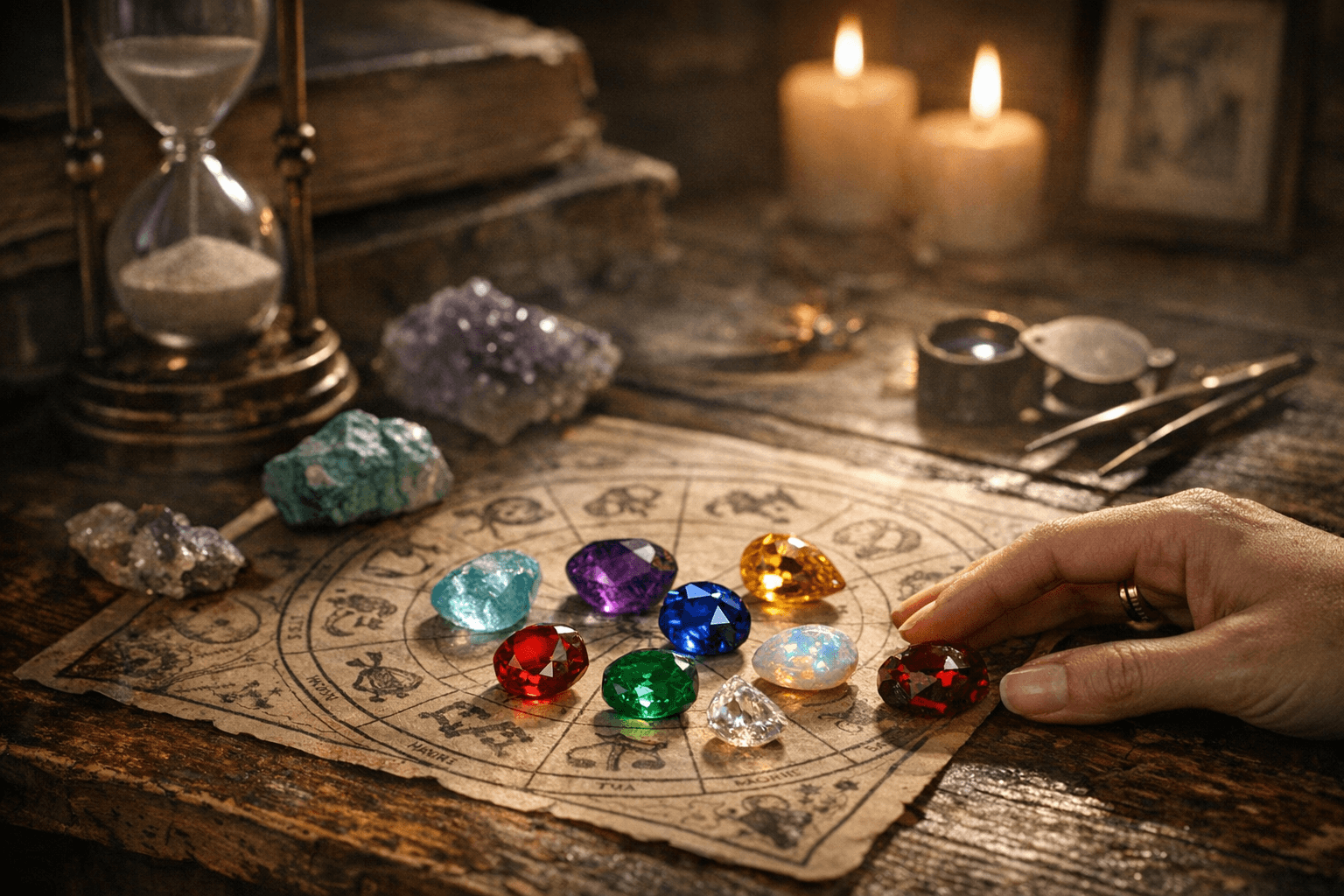
Zodiac birthstones follow an entirely separate lineage from the monthly calendar, and the two systems rarely align. Where monthly stones follow the Gregorian calendar, zodiac stones were chosen to complement the characteristics of each astrological sign. The two most widely cited systems diverge significantly:
| Zodiac Sign | Dates | Traditional Zodiac Stone | Modern Zodiac Stone |
|---|---|---|---|
| Capricorn | Dec 22-Jan 19 | Ruby | Garnet |
| Aquarius | Jan 20-Feb 18 | Garnet | Amethyst |
| Pisces | Feb 19-Mar 20 | Amethyst | Aquamarine |
| Aries | Mar 21-Apr 19 | Bloodstone | Diamond |
| Taurus | Apr 20-May 20 | Sapphire | Emerald |
| Gemini | May 21-Jun 20 | Agate | Pearl |
| Cancer | Jun 21-Jul 22 | Emerald | Ruby |
| Leo | Jul 23-Aug 22 | Onyx | Peridot |
| Virgo | Aug 23-Sep 22 | Carnelian | Sapphire |
| Libra | Sep 23-Oct 22 | Peridot | Opal |
| Scorpio | Oct 23-Nov 21 | Aquamarine | Topaz |
| Sagittarius | Nov 22-Dec 21 | Turquoise | Tanzanite |
The divergences are striking. An Aries born in late March has a bloodstone under the traditional zodiac system but a diamond under the modern alignment. A Gemini born in early June could legitimately claim agate, pearl, moonstone, or alexandrite depending on which system they follow. Rather than a problem, this flexibility is actually the point: birthstone traditions have never been fixed doctrine but a living conversation between historical symbolism, cultural preference, and the gem trade.
Anniversary Stones: The Third Calendar
A separate gemstone tradition maps to wedding anniversaries, formalized in 1937 by the American National Retail Jewelers Association and later expanded by Jewelers of America and the GIA into a more granular year-by-year guide. Key milestones:
- 1st: Gold jewelry
- 2nd: Garnet
- 3rd: Pearl
- 5th: Sapphire
- 10th: Diamond
- 15th: Ruby
- 20th: Emerald
- 24th: Tanzanite
- 25th: Silver (Silver Jubilee)
- 30th: Pearl (Pearl Jubilee)
- 45th: Sapphire
- 50th: Gold (Golden Jubilee)
- 60th: Diamond
The repetition of gold at years one and fifty, and diamond at years ten and sixty, is intentional: the same materials read differently across decades of accumulated meaning. A gold band at a first anniversary is an aspiration; a gold cuff at a fiftieth is an archive.
How to Shop: Hardness, Settings, and When to Break the Rules
Hardness is the single most practical variable when buying birthstone jewelry. A stone rated below 7 on the Mohs scale will show wear in a ring worn daily. This creates a genuine tension for June babies: pearl, at 2.5-4.5, is extraordinarily fragile in an exposed ring setting. The practical answer is to move pearl to a pendant or earrings, where impact risk is minimal, and choose alexandrite (8.5) or moonstone (6-6.5) if a ring is the goal.
Settings compound or mitigate this risk. A prong setting lifts the stone high off the band for maximum light exposure and visual impact, but leaves it vulnerable to impact and snagging. A bezel setting encircles the stone completely in metal, offering the best protection for softer gems like opal, moonstone, or turquoise. Channel settings, where stones sit flush between two parallel metal walls, offer strong protection and a clean modern line suitable for smaller accent stones in multi-birthstone family pieces.
Three situations justify choosing a stone outside your birth month:
- Hardness mismatch: If your birthstone is below 7 on the Mohs scale and you want daily-wear jewelry, choosing a harder alternative from your month's traditional list is a gemologically sound decision.
- Color preference: The modern and traditional lists together offer significant chromatic range. If you were born in September but love warm tones, the traditional lapis lazuli is a legitimate, historically grounded choice over the modern sapphire.
- Sensitivity or allergy concerns: Some metal alloys used with particular stone types in commercial settings can cause skin reactions. Choosing a stone that pairs cleanly with high-karat gold or platinum, regardless of birth month, is always defensible.
Treatment transparency is equally important when buying. Heat treatment in sapphires and rubies is industry-standard and accepted practice; an untreated sapphire of fine color will carry a significant premium. Opals are frequently oiled or filled to enhance stability. Ask any reputable seller for treatment disclosure before purchase, and for stones above a certain price threshold, request a certificate from the GIA or an equivalent independent laboratory.
Multi-Stone Pieces and Family Birthstone Jewelry
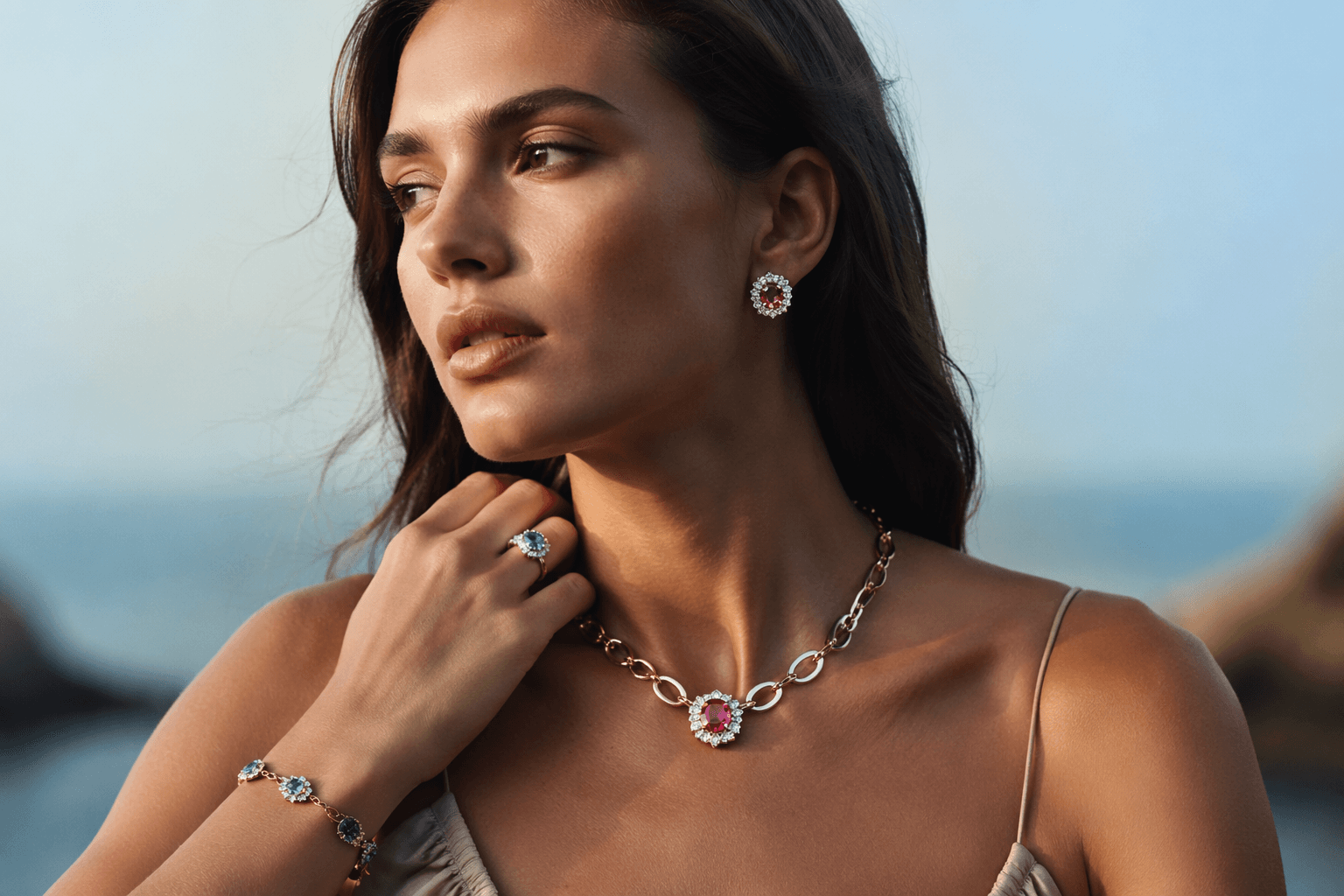
The 1912 modern list's insistence on transparent stones was largely practical: mixing opaque and transparent gems in a single ring produces incoherent results visually and creates inconsistent surface finishes. When designing multi-stone family pieces, whether a mother's ring featuring children's birthstones or a stack representing multiple family members, prioritize stones with compatible hardness ratings within two points of each other, and consider color temperature. Warm-toned stones (garnet, citrine, ruby, peridot) harmonize naturally; mixing warm and cool stones requires a deliberate design hand. White or yellow gold provides the most neutral backdrop for a diverse stone palette, while rose gold tends to flatter warmer hues and can visually overpower cool blues or greens.
The birthstone calendar, in all three of its forms, is ultimately less a rulebook than a starting vocabulary. The interesting jewelry, and the meaningful jewelry, begins where the list ends and personal judgment takes over.
This article was produced by Prism’s automated news system from verified source data, official records, and press releases, then run through automated quality and moderation checks before publishing. The system is built and supervised by the people who set the standards it runs under. Read our full AI policy.
Did this article answer your question?