2026 Jewelry Industry Statistics: 50+ Market Trends
The global jewelry market hits $397 billion in 2026, and the numbers reshape how birthstone buyers should think about lab-grown stones, pricing, and long-term value.
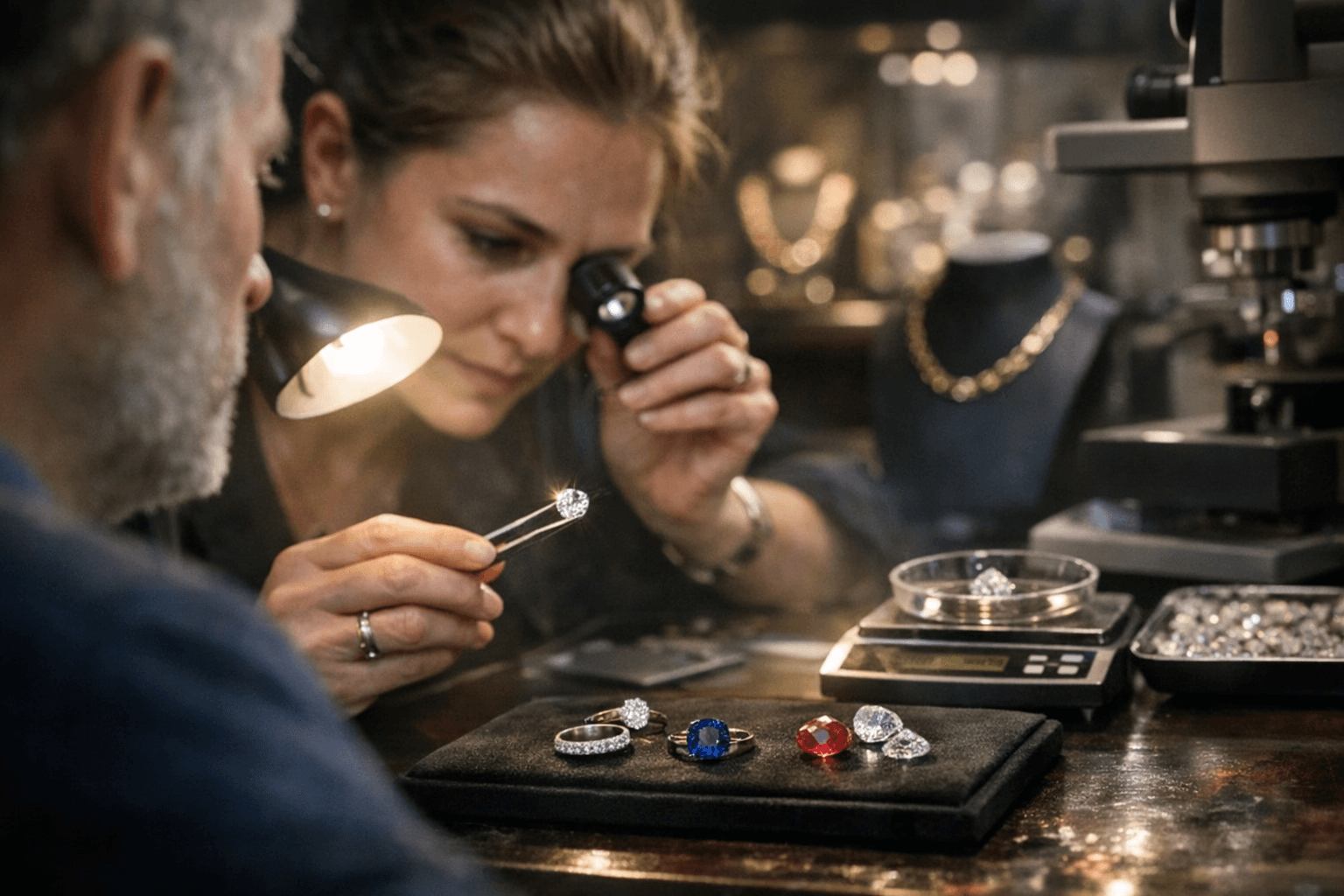
The breastplate of Aaron, described in Exodus and annotated by the historian Josephus nearly two thousand years ago, carried twelve stones, one for each tribe of Israel, and Josephus mapped those stones to the twelve months of the calendar. That taxonomy, refined across two millennia of trade, mythology, and gemological science, still governs what garnet goes into a January pendant today. What Josephus could not have anticipated was a $397 billion global market built, in part, on the logic he helped establish — and a structural revolution in how those stones are sourced, priced, and resold.
The 50 statistics below are not abstract market noise. Each one has a direct line to the choices birthstone buyers make at the counter, or increasingly, on a screen.
Global Market Scale
1. The global jewelry market is estimated at $397.72 billion in 2026.
That institutional weight sits behind every stone pricing decision from Jaipur to Antwerp to New York's Diamond District.
2. The market is projected to reach $578.45 billion by 2033, compounding at a CAGR of 5.5%.
A rising-tide market lifts well-chosen stones, though not all birthstones will benefit equally from that growth.
3. Diamond jewelry alone represents an estimated $408.2 billion in 2026, projected to grow to $652.4 billion by 2036 at a 4.8% CAGR.
April's birthstone commands more market real estate than any other stone category.
4. The natural diamond market was valued at $42.74 billion in 2025, projected to reach $53.16 billion by 2033 at a CAGR of 2.7%.
That relatively modest growth rate, compared to double-digit lab-grown expansion, tells the story of a category under structural pressure.
5. Asia Pacific holds 60.4% of the global jewelry market.
The scale of Asian demand, particularly for gold, exerts upward pressure on metal prices globally and, by extension, on the metal component of every fine birthstone piece.
The Lab-Grown Diamond Revolution
6. The lab-grown diamond market is valued at $33.54 billion in 2026, projected to reach $91.85 billion by 2034 at a CAGR of 13.42%.
This is the fastest structural transformation in jewelry since platinum displaced gold as the metal of choice for fine rings in the early 20th century.
7. Lab-grown diamonds now account for roughly 17 to 25% of all diamond jewelry demand globally.
In five years, a boutique novelty became a mainstream assortment anchor at every price point.
8. In the United States, lab-grown diamonds represent up to 50% of diamond sales by volume.
That penetration effectively splits the US market into two cohorts with incompatible resale expectations.
9. A 1-to-3 carat lab-grown diamond in 2026 costs 80 to 90% less than an equivalent natural stone.
For April birthstone buyers with a fixed budget, this differential is the most consequential data point in the entire market.
10. The U.S. lab-grown diamond market is valued at $24.23 billion in 2026, projected to reach $64.12 billion by 2035 at a CAGR of 11.37%.
American consumers have voted emphatically on the value proposition of synthesis over scarcity.
11. India's lab-grown diamond jewelry market stands at $453.7 million in 2026, set to expand to $1.798 billion by 2036 at a CAGR of 14.8%.
India's role as both major producer and growing domestic consumer gives it unusual leverage over where global prices settle through the decade.
12. Asia Pacific dominated the lab-grown diamond market with a 34.54% share in 2025.
The concentration of manufacturing and domestic demand in the same region keeps production costs structurally low and deflationary pressure ongoing.
13. Lab-grown diamond prices fell 20% in a single year as more producers entered the market.
Technology improvements and competitive supply are compounding that deflation with no visible floor in current pricing data.
14. The up-to-2-carat segment holds 70.49% of the lab-grown diamond market.
That dominance reflects where birthstone and engagement buyers are actually spending: wearable, gift-appropriate sizes rather than investment-grade rarities.
15. Lab-grown diamonds posted a 50% year-over-year online sales increase.
The channel where discovery and purchase converge most efficiently has become the lab-grown diamond's natural commercial habitat.
The Resale Divide
16. Lab-grown diamonds resell at 10 to 30% of their original retail price in 2026.
An underdeveloped secondary market and unlimited future supply mean those figures are unlikely to improve significantly in the near term.
17. Natural diamonds retain 25 to 50% of retail value at resale.
That gap between lab and natural is not merely numerical; it is the central argument for natural stone certification at every price point.
18. Natural diamond prices could rise up to 15% through 2026 as mining output tightens.
Pipe production from legacy mines in Botswana, Russia, and Canada is declining, with no major new discoveries in the recent pipeline.
19. Natural diamond categories declined approximately 2% in gross sales and 10% in units in 2025, despite a nearly 9% increase in average retail sale price.
Fewer customers are buying, but those who buy are spending significantly more per transaction.
20. Gold-heavy jewelry benefits from a price floor created by intrinsic metal value.
Over a five-to-ten year horizon, owners of gold-set birthstone pieces can frequently exit above their original purchase price when metal content is material to total cost.
21. Wealthy consumers shifted assets into tangible jewelry in early 2026 amid rising market uncertainty and equity volatility.
Fine jewelry's dual function as wearable asset is drawing buyers who have no prior gemological background.
22. Demand for colored gemstones, including rubies, sapphires, and emeralds, is rising as collectors seek alternatives to white diamonds.
This directly benefits buyers in March (aquamarine), May (emerald), July (ruby), and September (sapphire).
23. A Tiffany and Co. necklace featuring a Paraiba tourmaline sold at Christie's for a record price in December 2025.
October's birthstone sits at the intersection of wearability and collector-grade scarcity, and that auction signal will move retail pricing.
E-Commerce Performance
24. Online jewelry sales crossed $46.1 billion in 2026, compounding at 13.8% annually.
The channel is no longer supplementary; it is the primary growth engine across all jewelry categories.
25. The online jewelry market is projected to reach $148.3 billion by 2033.
Price transparency and search-driven discovery will only intensify, making comparative shopping a default consumer behavior rather than an enthusiast habit.
26. The average e-commerce conversion rate for jewelry is 1.19%.
That figure, the lowest of any significant retail category, reflects the emotional complexity of committing to a piece that is meant to last a lifetime without ever holding it.
27. Amazon captures approximately 67% of online jewelry sales in the United States.
For commodity-level pieces, price discovery now happens on Amazon, not in a jeweler's glass case.
28. Etsy captured 15% of the global online handmade jewelry market in 2023.
For birthstone buyers seeking artisan settings and non-standardized designs, that platform represents a genuinely distinct supply chain from mass retail.
29. Shopify powers 28% of independent online jewelry stores.
The fragmentation of independent retail across a single platform creates both opportunity and homogeneity risk for makers trying to differentiate.
30. Personalized jewelry accounts for 28% of online purchases.
Birthstones are the oldest form of jewelry personalization in the Western tradition, which means the data-driven channel is structurally aligned with the category's deepest cultural logic.
31. Layering sets have increased bundled sales by 40%.
Multi-stone birthstone stacking rings and layering necklaces are the commercial expression of this trend, and retailers are building assortments to match.
32. Pearl jewelry revived with 30% online sales growth.
June's birthstone, one of three alongside alexandrite and moonstone, is benefiting from a broader precious-metal-alternative aesthetic gaining traction with younger buyers.
33. Moissanite overtook cubic zirconia in online popularity as a diamond alternative.
For buyers prioritizing optical brilliance over prestige in birthstone settings, moissanite has become a credible focal stone for colorless April designs.
34. Men's jewelry online sales doubled since 2020.
The digital channel has functioned as the primary adoption ramp for male buyers who would not have considered a traditional jewelry store.
35. North America holds 35% of the global online jewelry market share.
That concentration gives US consumers unparalleled price-comparison access and, in turn, makes the American buyer the de facto global price-setter for premium stones traded online.

Men's Jewelry
36. The U.S. men's jewelry market was valued at $5.64 billion in 2024, growing at a CAGR of 8.4% from 2025 to 2034.
That growth rate is more than 50% faster than the overall jewelry market.
37. The U.S. men's jewelry market is projected to reach $10.75 billion by 2032.
Birthstone pieces for men, from bezel-set signet rings to pendant-suspended month stones, represent a meaningful share of this growth in personalized accessories.
38. The global men's jewelry market is projected to reach $12.76 billion by 2032 at a CAGR of 5.22%.
American men's jewelry growth is running nearly twice the global average rate.
39. 67% of online jewelry buyers are men in 2026, up from 20% in 2020.
The gender composition of the digital buyer pool has effectively inverted in six years.
Sustainability and Sourcing
40. 78% of American consumers consider ethical sourcing when buying jewelry, up from 52% in 2020.
That 26-point swing in five years represents a repositioning of what "value" means in the fine jewelry transaction.
41. Conflict-free certification, recycled metals, and traceable supply chains have moved from brand differentiators to baseline consumer expectations.
Asking for provenance documentation is no longer an enthusiast behavior; it is the expected inquiry.
42. Lab-grown diamonds are widely positioned as the ethical choice due to reduced environmental impact relative to traditional mining operations.
That framing accelerates adoption among buyers who weigh sustainability alongside budget.
43. GIA and AGS certification for natural stones remains the most defensible documentation for resale purposes.
The quality of paperwork is inseparable from the quality of the stone when a piece eventually changes hands.
Regional Breakdown
44. The UK jewelry market is valued at £6.41 billion, growing at a CAGR of 5.7%.
Strong performance across both fine and fashion segments reflects buyers who are simultaneously value-seeking and aspirational.
45. The European jewelry market is growing at a CAGR of 5.1%.
Continental Europe's gemological rigor and hallmarking traditions create favorable conditions for certified birthstone pieces to hold value over time.
46. North America accounts for 22.2% of the global jewelry market.
Combined with 35% online share, American buyers are the single most influential cohort in setting global pricing expectations for premium stones.
47. The 22K gold segment commands over 45% of jewelry revenue in Asian markets.
Asian gold demand functions as a structural price floor for the metal globally, benefiting every fine birthstone piece where metal value is material.
Personalization and the Road Ahead
48. 68% of couples now prefer some level of customization in their engagement rings.
Birthstone integration, whether as accent stones flanking a diamond or as alternative center stones, is a direct commercial beneficiary of the retreat from the standardized solitaire.
49. The children's jewelry market is projected to grow at a CAGR of 4.8% from 2026 to 2033, driven by personalized pieces with names, birthstones, and symbolic details.
The gifting segment around birthstone jewelry is more commercially durable than trend-driven categories because it is anchored in occasion rather than fashion cycle.
50. The ring segment is projected to be the leading jewelry category, accounting for 32.68% of the total market in 2026.
Birthstone rings, from a simple bezel-set garnet to an elaborate halo-set sapphire, sit at the center of this category's momentum, and the structural data suggests that positioning will only strengthen through the decade.
The 50 statistics above resolve into a clear buyer's roadmap. Where the data suggests room to negotiate: lab-grown diamond settings and any white stone alternative for April, where market oversupply has structurally compressed prices. Where certification is non-negotiable: natural diamonds and any colored stone above $1,000, where GIA and equivalent reports are the only protection against resale loss. And where demand pressure is most likely to build through 2026: September sapphires, July rubies, and May emeralds, colored gemstones with hard supply constraints and rising collector attention, on a trajectory that Josephus, cataloguing stones on a high priest's breastplate, would have recognized as the oldest and most durable of all value drivers: genuine rarity.
This article was produced by Prism’s automated news system from verified source data, official records, and press releases, then run through automated quality and moderation checks before publishing. The system is built and supervised by the people who set the standards it runs under. Read our full AI policy.
Did this article answer your question?