Mumbai Artisan Awards Spotlight Bold New Directions in Gem Design Innovation
Bvlgari's Lucia Silvestri handed top honors to Mumbai's boldest gem designers as 550 entries revealed 3 motifs now rewriting the rules for birthstone jewelry in 2026.

Somewhere around 1200 B.C., a high priest named Aaron walked into the Tabernacle wearing a breastplate set with twelve stones: sardius, topaz, carbuncle, emerald, sapphire, diamond, jacinth, agate, amethyst, beryl, onyx, and jasper. Each stone bore the name of one of the twelve tribes of Israel, inscribed like a ledger of identity pressed against the heart. The historian Josephus, writing in the first century, drew the line that gem scholars have followed ever since, connecting those twelve stones to the twelve months of the year and, by extension, to the twelve signs of the zodiac. In that single interpretive leap, the birthstone was born: a piece of colored earth given to a person as a birthright, a marker of when they arrived in the world.
Three thousand years later, in Mumbai on April 8, that inheritance landed in the hands of 27 finalists competing in the 9th Artisan Jewellery Design Awards. What they did with it, translating ancient gem logic into filigree architecture, meenakari micro-narrative, and sculptural layered form, amounts to the clearest signal yet of where colored-stone design is headed in 2026. If you are thinking about commissioning a birthstone piece this year, what these designers showed in Mumbai is your playbook.
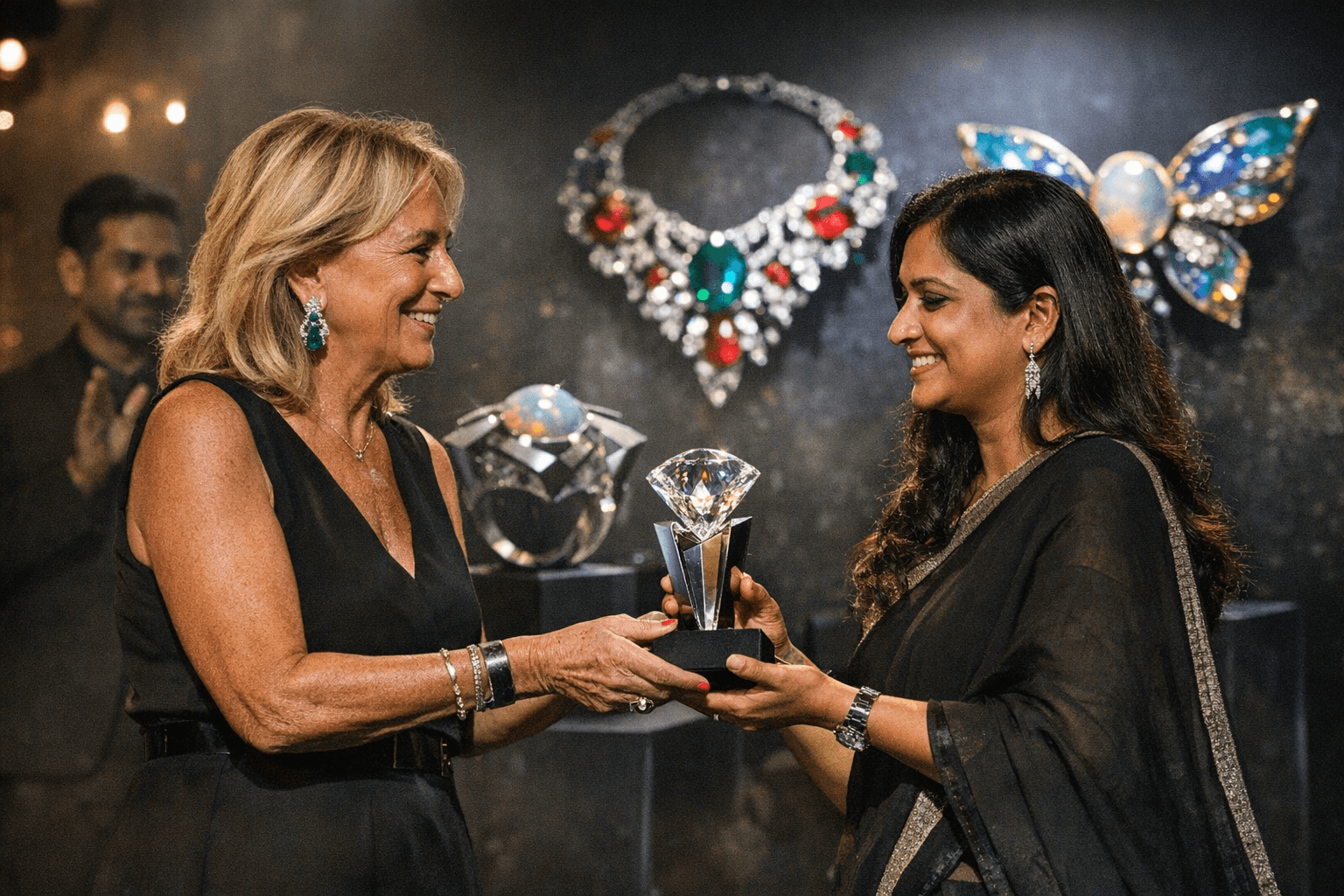
The awards, organized by India's Gem and Jewellery Export Promotion Council (GJEPC) and curated by trend forecaster Paola De Luca under the banner of The Futurist, drew more than 550 entries responding to the theme "Quantum Couture: Re-Engineering Beauty and Cultural Codes." Powered by GIA and supported by the World Gold Council, the ceremony was anchored by one of the most recognizable names in contemporary gem design: Lucia Silvestri, Creative Director and Gems Buying Director at Bvlgari, who presented the top honours. Her presence was more than ceremonial. Silvestri, the woman behind Bvlgari's Serpenti Maharani necklace carrying a 109.27-carat cabochon rubellite, has spent decades sourcing rare stones from Indian mines and translating them into Rome's most celebrated high jewellery. "I have always been deeply fascinated by India's extraordinary heritage in jewellery," she said at the event. "There is a beautiful balance between tradition and innovation, where legacy meets modern creativity."
That balance was the thesis of every piece on the floor. The jury, which included Amedeo Scognamiglio of RFMAS Jewellery Group, art historian Dr. Annapurna Garimella, Siddharth Kasliwal of Gem Palace, and Milan Chokshi of Moksh, assessed entries across three sub-themes, each one a distinct lens on how colored stones and craft techniques can coexist in the same structure. Ashish Borda, GJEPC's Convener for Promotions and Marketing, noted that designers "embraced heritage as a foundation to create something distinctly modern, reflecting the growing maturity of the talent pool." Here is what that maturity looked like in practice, and how it maps directly onto your birthstone brief.
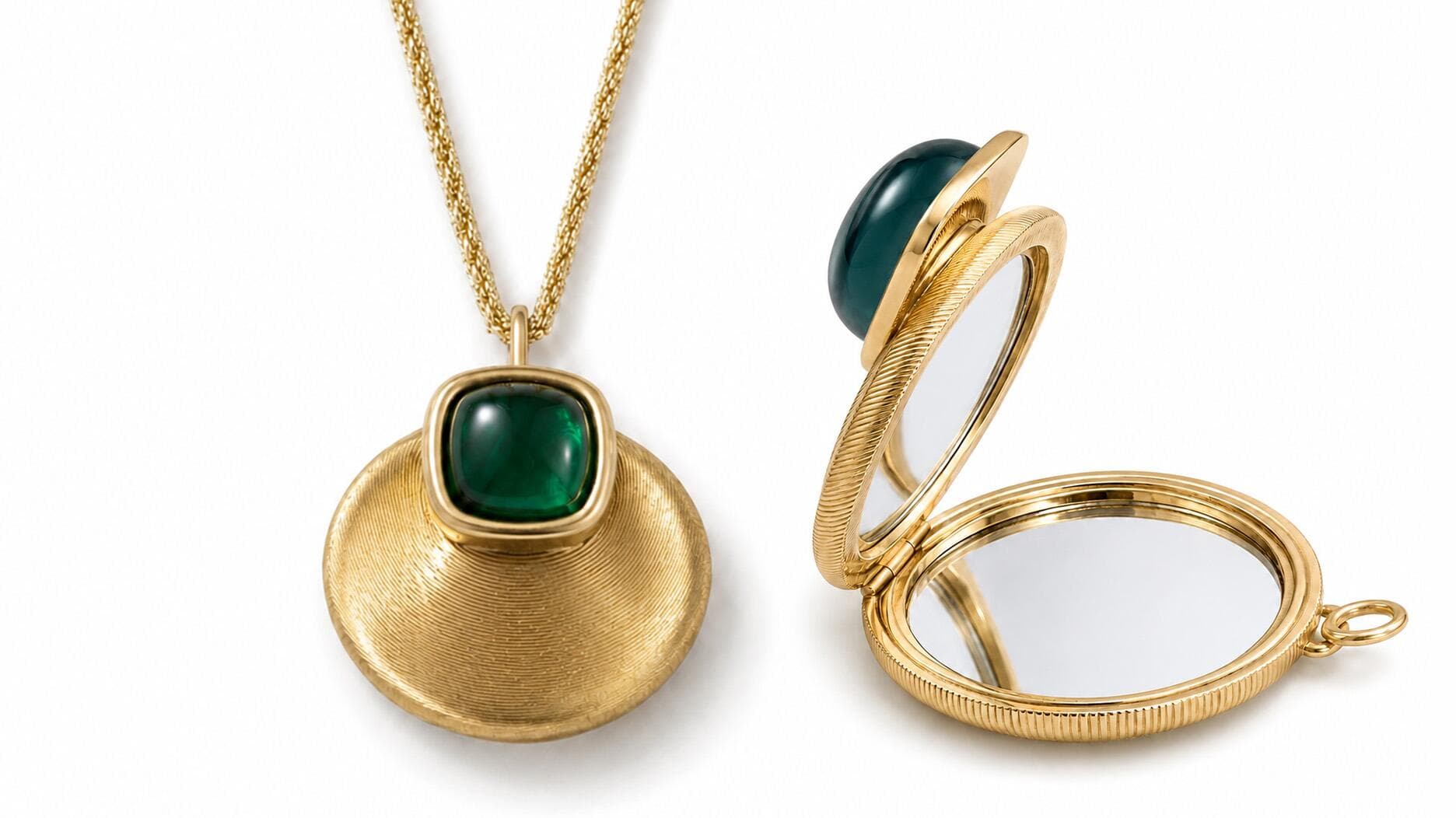
The first category, Embroidery, is the one most likely to transform how a birthstone pendant or ring is framed. In the hands of these finalists, textiles became architecture. Lace, brocade, thread, and beadwork were not referenced as motifs but rebuilt in metal: filigree evolved into skeletal frameworks, jali work behaved like lace, and micro-pearl weaving created surfaces that have the visual weight of couture fabric without the physical mass. The structural base throughout was yellow gold and white metal, chosen because the contrast between warm and cool metals allows a colored stone to read clearly at the center. For a birthstone commission in this direction, consider a September sapphire or a May emerald set inside a filigree cage rather than a conventional bezel, the metal drawn around the stone like embroidered thread rather than a solid collar. The stone should be brilliant-cut if you want the lacy surround to refract light back through the gem; a cabochon works if you want the surface to read as a solid jewel pressed into textile-like metalwork.
The second category, Micro-Painting, is the one most underused in birthstone jewelry and the one with the richest historical precedent. Finalists drew from meenakari, the Rajasthani enamelling tradition in which colored vitreous glass is fused into gold grooves; jadau, the Mughal-era technique of embedding uncut stones into a pure gold matrix; kundan setting; micro-mosaic; and miniature painting translated into engraved or carved surfaces. Each piece in this direction functioned as a narrative object, a wearable story told at a scale that requires a jeweler's loupe to fully read. The birthstone implication is significant: if your stone is an October opal, a July ruby, or an August peridot, the Micro-Painting approach says the stone itself need not carry all the meaning. The surrounding enamelwork, the engraved border, the carved vignette in the gallery beneath the gem: these are where personal symbolism lives. Commission a piece that uses your birthstone as the focal point of a miniature composition, not merely as a colored insert. Ask your goldsmith about meenakari grounds in a complementary hue, a deep cobalt or forest green enamel behind a January garnet, a warm terracotta behind a November citrine.
The third category, Poetic Layers, is where the Artisan Awards pushed furthest from conventional jewelry grammar. Finalists explored jewellery as multi-dimensional form, stacking organic shapes, layering textured planes, and allowing nature and emotion to drive construction rather than geometry. These pieces felt, in the language of the award brief, "fluid, sculptural, and deeply expressive." For a birthstone brief, this translates to freeform settings rather than calibrated stones, asymmetrical compositions rather than centered solitaires, and textured metal surfaces, hammered, oxidized, or patinaed, that give the colored stone a landscape to inhabit rather than a socket to sit in. An aquamarine cut en cabochon nestled into a hammered wave of oxidized silver; an amethyst in a freeform bezel of rose gold with layered petal-like flanges; a moonstone set into a sculptural cuff where the metal flows like water frozen mid-movement. The category rewards stones that have personality in their cut: pear shapes, freeforms, and cushions rather than rounds and princess cuts.
The broader signal from all three directions, taken together, is that 2026's most interesting colored-stone jewelry is refusing to let the birthstone be passive. The stone is no longer simply the point of the piece; it is in dialogue with setting technique, surface treatment, and cultural memory. Silvestri, whose eye for rare colored stones has shaped Bvlgari's high jewellery identity for four decades, put it plainly: "I am honoured to be part of India's enduring legacy of jewellery and craftsmanship." That legacy, as the Mumbai finalists demonstrated, is not being preserved. It is being rewritten.
When you walk into a jeweler to commission a birthstone piece this year, bring these questions: Ask for the stone's country of origin and whether it comes with a gemological certificate from GIA, AGL, or Gübelin. Specify whether you want a Mughal-derived setting technique such as jadau or meenakari, and ask your jeweler whether they have a craftsperson in-house or are outsourcing that work. Request that the setting be designed to allow the stone to be reset if needed, since birthstone jewelry is often inherited and stones outlive their mounts. If you are drawn to the Embroidery direction, ask to see filigree samples and confirm the gauge of wire used; fine filigree under 0.3mm requires a specialist. If Poetic Layers is your reference, bring a reference image and ask the goldsmith to sketch before fabrication begins. And if your stone is colored, insist on seeing it in both natural and artificial light before the commission is finalized: the difference between a ruby that sings in sunlight and one that dies under tungsten is the difference between a piece you wear and a piece you store.
The breastplate of Aaron held twelve stones for twelve tribes because the ancients understood that identity and gemstone were inseparable. The designers in Mumbai on April 8 understood something more: that the way a stone is held matters as much as the stone itself.
This article was produced by Prism’s automated news system from verified source data, official records, and press releases, then run through automated quality and moderation checks before publishing. The system is built and supervised by the people who set the standards it runs under. Read our full AI policy.
Did this article answer your question?