15 playful diamond jewelry pieces that stole Las Vegas Market Week
Vegas diamond jewelry got playful fast, with boombox pendants, glasses motifs, and horse charms signaling a season of storytelling, charms, and bolder natural stones.
Las Vegas Market Week did not reward solemnity. The diamond pieces that lingered longest were the ones with a story built into the setting, from a boombox rendered in yellow gold and pavé to charms that turned glasses, horseshoes, and cowgirl hats into fine jewelry shorthand. National Jeweler’s joy-driven roundup and JCK’s show-floor reporting point to the same direction: more personality, more charms, more sculptural diamonds, and more formats that sell as gifts as much as as statements.
Boombox nostalgia
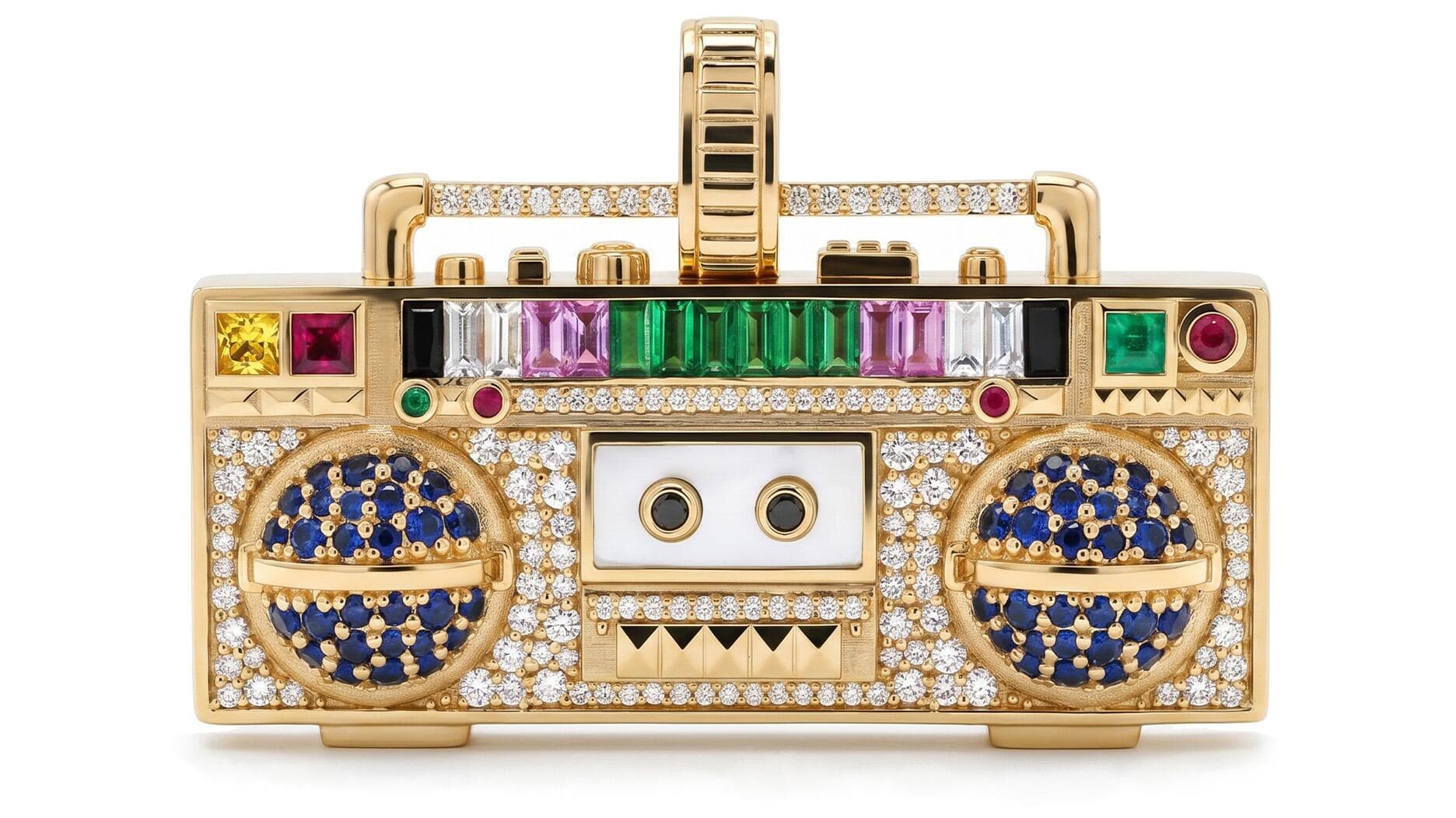
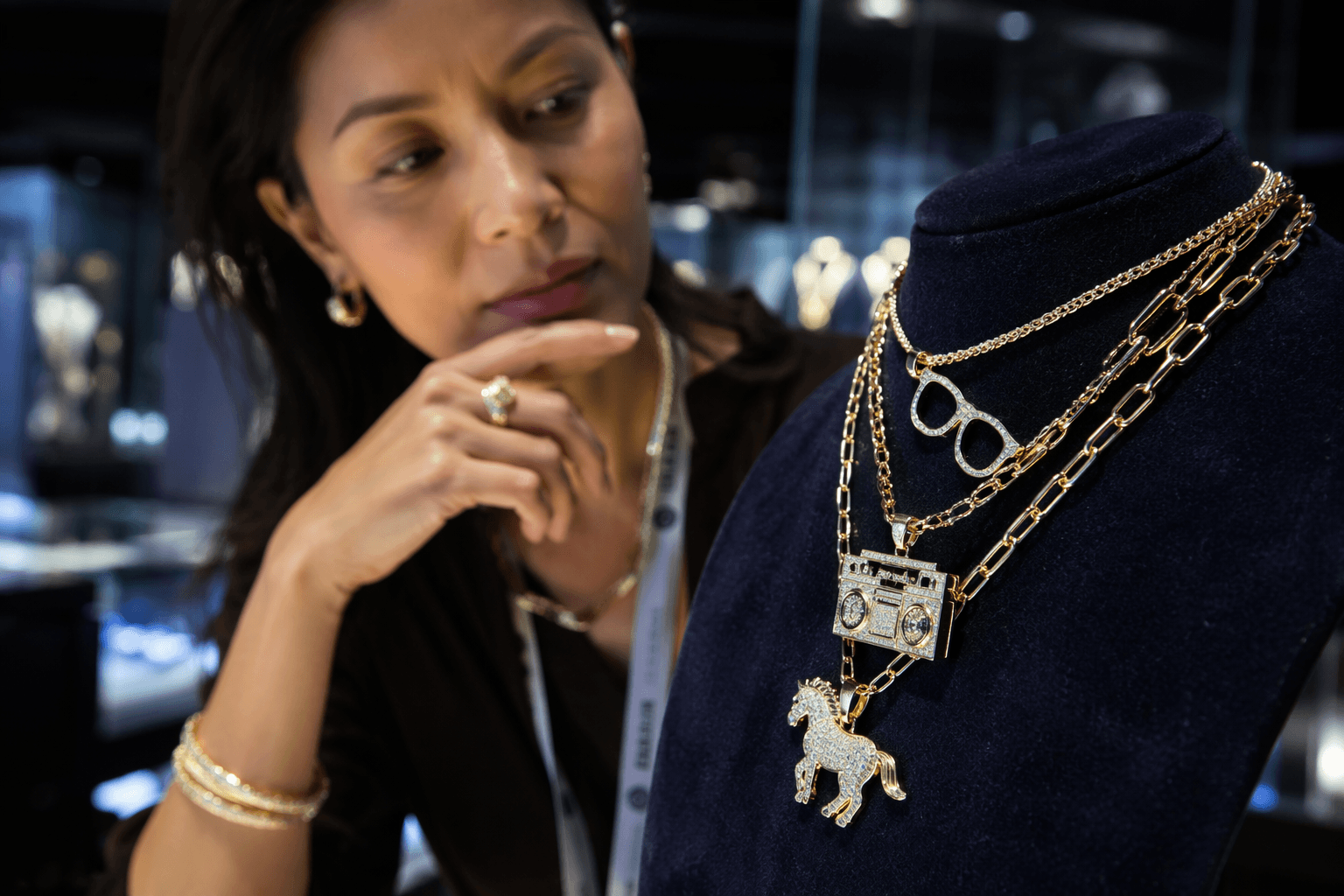
NeverNot’s “Feel The Rhythm” pendant distilled the week’s most convincing instinct: make the diamond piece feel like a memory. The design uses 18-karat yellow gold, colored gemstones, and diamond pavé to recreate a boombox, which gives the pendant both humor and technical precision; the pavé is not decoration here, but the thing that makes the object read instantly. That kind of referential piece belongs in merchandising as a conversation starter, especially in display cases where buyers are looking for novelty without losing craftsmanship.
Glasses with attitude
Edina Kiss’s “Sunglasses” pendant turned a familiar accessory into a hinged jewel with real movement, and that mechanical detail matters as much as the motif. The 18-karat yellow gold pendant uses 1.1 carats of blue sapphires and 1.05 carats of pink sapphires, priced at $21,900, and its articulated arms open and close like a real pair of glasses. Pieces like this tell retailers that playful design can still justify a luxury price when the construction is clever and the materials are exacting.
Tiny worlds on a chain
Xiao Wang’s bookstore charm, part of her “Ice Cream Candy” line, took the charm category in a more whimsical direction by turning a place of refuge into a jewel. The piece is 14-karat yellow gold with diamonds, and it sat alongside a jewelry store and a tea shop, which makes the whole suite feel like a miniature city of personal interests. For next season, this points to charms that are less about initials and more about identity, especially when they can be merchandised as collectible groups.
Pet rocks, remade for 2026
Lauren Harwell Godfrey’s “Gold Rush” version of her bejeweled take on Pet Rocks is a neat reminder that nostalgia sells best when it is sharpened by polish. The piece, part of her “1975” collection, is 14-karat yellow gold with diamonds, and the joke lands because the execution stays firmly in fine-jewelry territory. That balance, cheeky reference plus serious materiality, is exactly what makes a piece easier to buy into now and easier to stock as an alternative to more literal diamond classics.
Horseshoes as luxury symbols
Sylva & Cie’s “Micro Mosaic Horseshoe” pendant shows how a Western motif can be made elegant rather than theme-y. The pendant uses micro mosaic tiles inside an 18-karat yellow gold frame and carries a $27,500 price tag, which places it firmly in collector territory even as the motif reads instantly across a sales floor. Horseshoe jewels like this suggest that Western references are not a passing costume moment; they are becoming part of the core visual language for gold and diamond buying.
The Fire Horse effect
Harwell Godfrey’s “Fire Horse” brooch kept the Western story moving, but with a more graphic, wearable edge. Set in 18-karat yellow gold with diamonds and priced at $12,250, it brings motion and symbolism together in a way that makes a brooch feel current rather than formal. Pieces like this will matter to buyers who want diamond jewelry that can pin to a jacket, a bag, or a collar, expanding the use cases beyond the neck and hand.
A cactus with polish
Lionheart’s “Cactus” charm translated the Southwest into a jewel that feels compact enough for daily wear. Made in 18-karat yellow gold with turquoise and emeralds and priced at $3,850, it leans on color first and symbolism second, which keeps the piece from feeling overworked. That combination signals a merchandising sweet spot next season: smaller diamond-adjacent charms that can be layered into a broader story without demanding a full head-to-toe themed look.
Lockets are having a quiet revival
Monica Rich Kosann’s “Horseshoe” locket reminded the market that sentimental forms still have commercial power when they are made with better materials. The piece features emeralds in 18-karat yellow gold and hangs from a one-of-a-kind emerald beaded chain, priced at $24,695, which gives the locket the presence of a jewel box rather than a trinket. For retailers, that is a useful template: traditional formats can feel fresh again when the chain, setting, and surface treatment do the storytelling.
Rings that carry the motif further
Brooke Gregson’s one-of-a-kind “Horseshoe” ring proves that the motif story does not have to stop at pendants. Hand-engraved 18-karat yellow gold and diamonds give the design texture and depth, and the $8,635 price places it in the range where craftsmanship is the selling point, not just the idea. Rings like this are especially important for buyers looking to extend the Western narrative into core categories, not just accent pieces.
The bolo gets dressed up
Ophelia Eve’s “Starburst” bolo necklace gave one of the week’s most familiar Western references a sharper, more decorative outline. Set with diamonds in 18-karat yellow gold and priced at $14,200, it takes a format associated with function and turns it into a polished statement piece. That kind of hybrid design suggests strong demand for necklaces that feel collectible but still easy to style with denim, silk, or a simple knit.
Huggies with a spur motif
Harwell Godfrey’s “Spur” huggie earrings are a compact lesson in how to make a themed piece feel expensive. The 18-karat yellow gold earrings, set with diamonds and priced at $6,375, keep the motif tight enough to read from a distance but refined enough to sit in a fine-jewelry case. Earrings like these are especially well suited to next season’s buying because they offer story, scale, and a reachable price point in one format.
Cowgirl hats, cut down to size
Buddha Mama’s “Cowgirl Hat” charm pushed the Western story into pure collectible territory. Cast in 20-karat yellow gold with diamond accents and priced on request, it works because it does not try to be subtle; it declares the trend and leaves the styling to the wearer. Charms like this are likely to remain merchandising winners because they can live on chains, bead necklaces, and leather cords, which expands their retail shelf life.
Mini charms are still the smartest entry point
The best thing about Liberté’s half-moon charm was its scale. In 18-karat yellow gold with 0.31 carat total weight in diamonds and a $1,888 price, it shows how a small charm can still deliver the sparkle and symbolism buyers want without overcommitting to a larger jewel. JCK’s show coverage also made clear that charms were everywhere in Vegas, often offered as simple add-ons or paired with leather cords and bead necklaces to keep price points flexible.
Marquise shapes feel newly sharp
Pietre’s large diamond pendant brought the marquise cut back into the conversation in a way that felt fashion-forward rather than retro. Set in 18-karat gold with diamonds and offered at price on request, the piece fits the broader Vegas appetite for fancy shapes and sculptural outlines, especially when the silhouette does some of the visual work before the buyer even notices the carat weight. That matters for merchandising because shape has become a selling tool again, not just a technical detail.
Mixed cuts and open forms point ahead
Jacquie Willow’s Aspen earrings and Willow Diamonds’ Mystere necklace, along with Rahaminov Diamonds’ open ring, captured the week’s shift toward diamonds that feel more architectural than delicate. JCK noted that natural diamonds were appearing in bigger, bolder ways across earrings, rigid gold collars, and mixed fancy shapes, while National Jeweler’s post-Vegas report said the season’s dominant currents would carry through the rest of 2026 and into 2027. That suggests the smartest buying next season will favor sculptural settings, mixed shapes, and versatile pieces that can move between statement and everyday wear without losing their edge.
This article was produced by Prism’s automated news system from verified source data, official records, and press releases, then run through automated quality and moderation checks before publishing. The system is built and supervised by the people who set the standards it runs under. Read our full AI policy.
Know something we missed? Have a correction or additional information?
Submit a Tip