Affordable engagement rings spotlight lab-grown diamonds as budgets shrink
Lab-grown diamonds now drive budget-minded ring shopping as the average spend falls to $5,200, making cut and setting the smartest places to splurge.
What affordable means now
The cheapest-looking mistake in engagement rings is often the most expensive one: paying for size, branding or a busy setting when the stone itself does not sing. The Knot’s 2024 Jewelry & Engagement Study puts the average engagement ring at $5,200, down from $5,500 in 2023, $5,800 in 2022 and $6,000 in 2021, and that slide says a lot about how couples are buying now. The market is getting more practical even as rings get more visible, and lab-grown stones have become central to that shift.
That change is not subtle. The Knot found that lab-grown diamonds made up 52% of all engagement rings in 2024, while mined diamonds accounted for 22%, down 3 percentage points from the year before. A decade ago, lab-grown stones were still a niche choice for many shoppers. Now they are the budget-conscious default for anyone who wants a larger, brighter look without letting the center stone swallow the whole budget.
Where the money shows on the hand
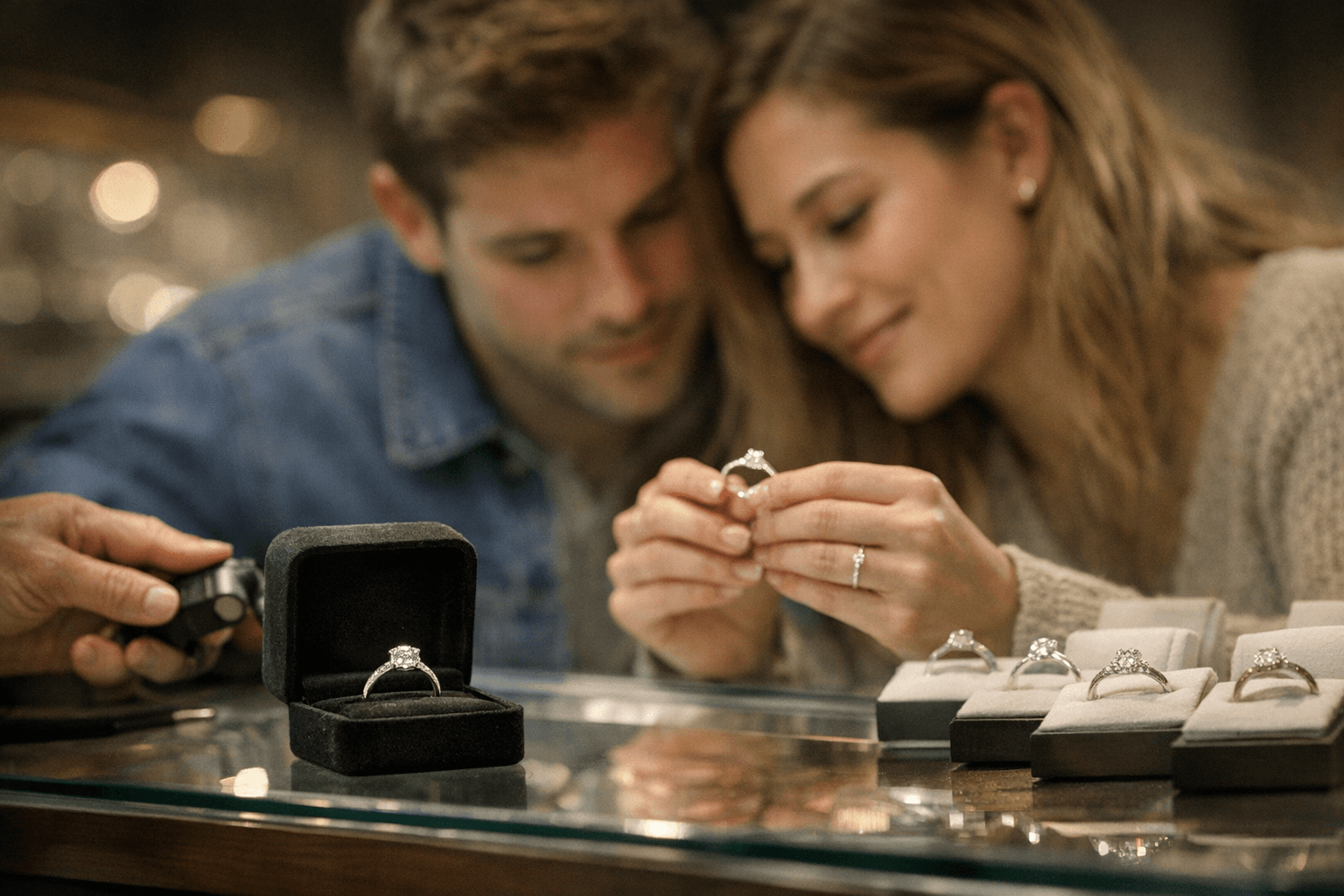
If the budget is tight, the smartest place to spend is on cut. A well-cut diamond throws light, gives the ring presence from across a room and often looks more substantial than a heavier stone with mediocre proportions. Carat matters, but it should be treated as a visual decision rather than a numbers chase. A slightly smaller stone with better polish and proportions can look more elegant, and more expensive, than a larger one that sits flat or dull.
Setting choice is the next big lever. A simple solitaire, a thin halo or a clean bezel can preserve the budget for the center stone, while ornate pavé shoulders and heavy metalwork quietly push the total upward. Brand name also matters, but usually less on the finger than in the invoice. When affordability is the goal, the best value often comes from buying less metal drama and more visible brilliance.
That is the real meaning of “affordable” in April 2026. Under the current average of $5,200, shoppers are not being asked to settle for a compromise ring. They are being asked to decide where the eye will land first, on the diamond, the silhouette or the label.
Lab-grown is no longer the fallback option
The rise of lab-grown diamonds has changed the price conversation and the ethics conversation at the same time. For readers who want beauty without the old markup, these stones can deliver a larger center stone, a cleaner color grade or a more substantial setting for the same budget. That is why budget guides now feature lab-grown options as a standard, not a concession.
The paperwork matters here. The Federal Trade Commission’s Jewelry Guides are designed to help consumers get accurate information about gemstones and their laboratory-created and imitation substitutes. That means a jeweler should clearly disclose whether a stone is laboratory-created or imitation, not bury the distinction in vague language that sounds reassuring but says nothing. If a salesperson cannot make that difference plain, the claim is too soft to trust.
Gemological Institute of America reports add another layer of clarity. GIA says lab-grown diamond reports include laser inscription of the report number and the phrase “Laboratory-Grown,” which makes the stone easier to identify and trace. GIA introduced its redesigned Laboratory-Grown Diamond Report in October 2020 in a digital-only format, another sign that the category has become fully institutionalized rather than experimental.
Jewelers of America has also treated the natural-versus-lab-grown conversation as a live sales issue. Its March 5, 2025 tool, “Counter Intelligence: Just the Facts about Natural & Lab-Grown Diamonds,” was built to help retail associates explain the difference more clearly. When an industry group feels the need to arm sales staff with a fact sheet, it is a useful reminder that shoppers are still sorting through a lot of mixed messaging.
How to shop the budget without losing the romance
A budget-conscious ring does not need to look budget-conscious. The key is to decide what will read from a normal social distance and what will not. Cut and shape are seen immediately. Clarity details and a premium brand story are often felt more by the bank account than by the eye. If the budget is firm, choose the features that create optical impact first, then use the setting to frame them cleanly.
For many shoppers, that means putting more of the budget into the center stone and less into elaborate side details. It also means thinking hard about whether a natural diamond is worth the premium. A mined stone still carries emotional and symbolic weight for many couples, but the 2024 numbers make clear that lab-grown has become the more common route. If the proposal ring needs to look generous without straining the budget, lab-grown is where the value now lives.
What the retailer mix tells you
Forbes Vetted’s April 14 buying guide rounds up affordable engagement rings from Rare Carat, Blue Nile, Quince, Brilliant Earth, James Allen and Ritani, and that list itself tells the story of the market. Affordable no longer points to one narrow aesthetic. It stretches from comparison-shopping platforms to more customized diamond houses and leaner direct-to-consumer options, which gives shoppers room to decide how much control they want over the stone, the setting and the final price.
That spread matters because the best value is not always the cheapest listing. Sometimes value means more customization, so the ring feels personal. Sometimes it means a more stripped-back setting so the center stone can do the talking. Sometimes it means choosing the retailer that makes the certification and disclosure easiest to read, especially if you are comparing lab-grown and natural diamonds side by side. The right shop is the one that lets you see the trade-off clearly before you spend.
For budget buyers, the strongest strategy is simple: spend where the ring is seen, save where it is not, and demand exact language on every stone. In a market where lab-grown diamonds now make up more than half of engagement rings and the average spend has fallen to $5,200, the smartest ring is the one that looks expensive for the right reasons.
This article was produced by Prism’s automated news system from verified source data, official records, and press releases, then run through automated quality and moderation checks before publishing. The system is built and supervised by the people who set the standards it runs under. Read our full AI policy.
Did this article answer your question?