Diamond Tassels and Floating Settings Lead Spring Jewelry Trends
Diamond jewelry is turning more sculptural, with tassels and floating settings giving spring’s strongest stones movement, color, and a sharper sense of identity.
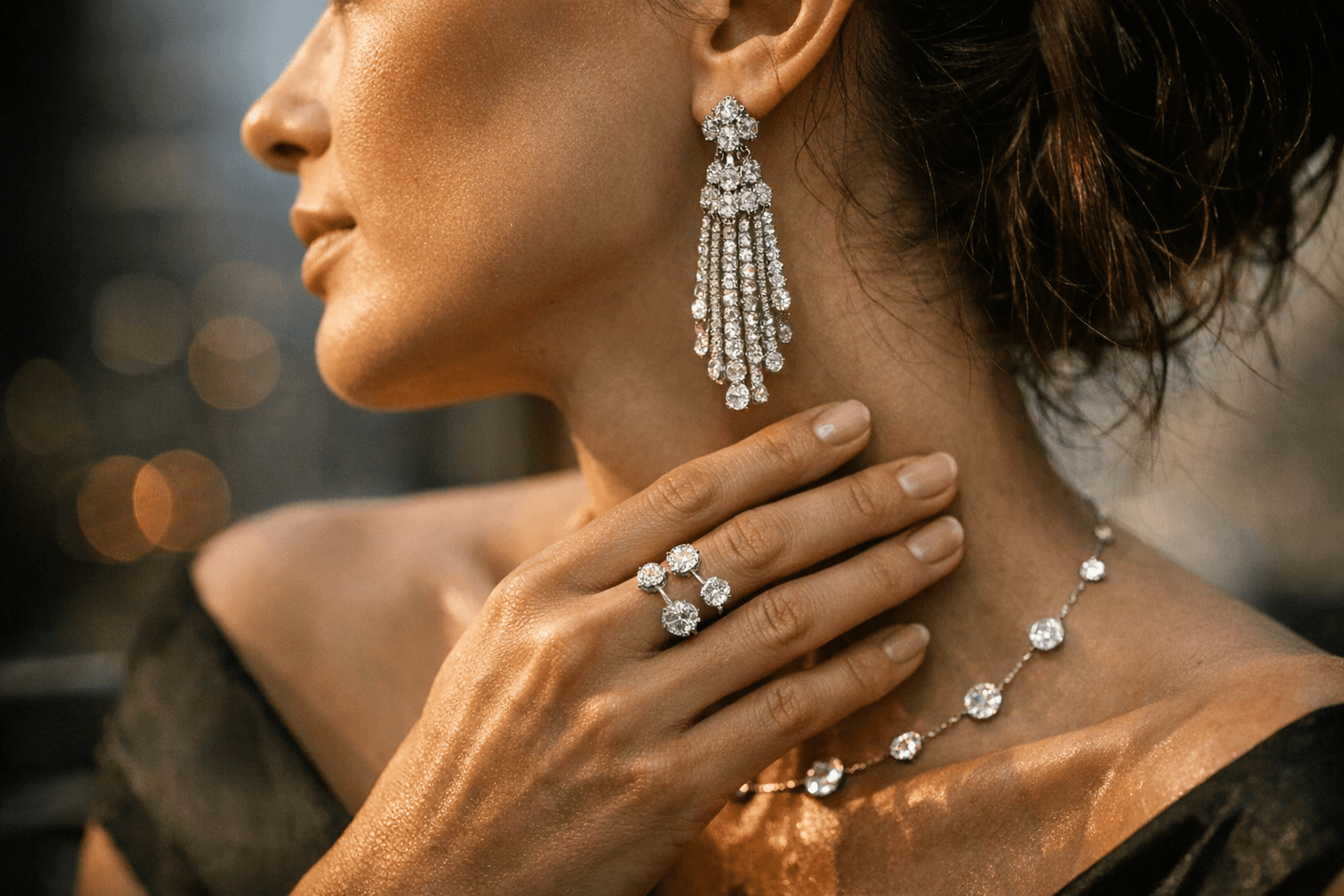
Tassels, but make them diamond
A diamond tassel no longer hangs politely at the edge of a look. It swings, catches light, and turns the body into part of the design. That is the new language of spring jewelry: stronger silhouettes, richer color, and mixed materials, with tassel necklaces and floating-illusion settings leading the conversation.
The shift matters because it changes how diamonds are worn, not just how they are set. Instead of sitting as static points of brightness, they are being asked to move, elongate, and define the line of the body. That is why the season feels less like a return to minimalism and more like a recalibration of drama, with diamonds used as architecture rather than mere decoration.
Why tassels suddenly look modern again
Tassels are the clearest example of the season’s appetite for motion. L'Officiel’s spring jewelry guide identifies tassel necklaces as a key silhouette for spring 2026, noting that they return in pearls, beads, or diamonds and carry both 1920s Art Deco discipline and 1970s bohemian sway. The look is not nostalgic in a dusty sense; it is nostalgic in the way a great evening dress can be, pulling from the past while feeling entirely ready for now.
The history is deeper than the current mood board. The Natural Diamond Council says diamond tassels date back at least to the 18th century, with references to Marie Antoinette and Georgian-era opulence. That historical thread matters because it explains why tassels feel so persuasive today: they are not a novelty trend, but a form with real jewelry lineage, the kind that can survive changing tastes because movement itself never goes out of style.
A diamond tassel suits someone who wants the eye drawn downward in a graceful line. It works especially well with open necklines, sleek knits, and evening dressing that can tolerate a little theater. What it replaces is the flattened, barely-there pendant of recent seasons. This version is less about restraint and more about controlled excess, which is exactly why it feels fresh.
Floating settings make the stone look lighter, not smaller
If tassels bring motion, floating settings bring illusion. The Boucheron look highlighted in the spring guide uses the maison’s serti aérien technique, which gives diamonds the effect of hovering in space. The result is not empty spectacle, but a studied lightness, as if the stone has been untethered from the metal that usually frames it.
That idea is deeply aligned with Boucheron’s identity. The house was founded in 1858 and opened on Place Vendôme in 1893, and Frédéric Boucheron’s 1879 Question Mark necklace already showed an interest in making precious materials behave like fabric. Under Claire Choisne, that technical instinct still reads as modern, because the best floating settings do not hide craftsmanship. They make craftsmanship disappear just enough to let the diamond feel airborne.
For real life, floating settings are the right answer when you want maximum sparkle with minimal visible structure. They flatter collectors who already own classic solitaires and now want something more architectural, as well as buyers who prefer a clean profile that still feels inventive. Where a heavy bezel or dense prong setting can read practical or familiar, the floating look feels sensual and precise at once.
The market is rewarding bigger gestures
The style shift is backed by hard numbers. The Natural Diamond Council’s 2025 overview shows U.S. natural diamond jewelry sales at specialty jewelers rose 2.1 percent last year, while the average price of natural diamond jewelry climbed 10 percent. Those figures come from more than four million transactions across 2,500 specialty jewelers, which makes the data especially useful because it reflects actual buying behavior, not just aspiration.
The strongest takeaway is that consumers are not retreating from diamonds under pressure from tariffs, inflation, or higher gold prices. They are still buying, and they are buying with more intention. Holiday jewelry sales rose more than 6 percent to close out 2025, marquise jewelry grew 12 percent, and jewelry with 2.00-2.24 carat center stones rose 9 percent. That points to a broader preference for stones that register clearly from across the room, rather than whispering in fragments.
This is where the fashion story and the market story meet. Stronger silhouettes and richer color are not just design notes; they are a response to a customer who wants a jewel to be legible, distinctive, and worth remembering. The contemporary diamond is no longer content to disappear into the setting.
Color, mixed materials, and the end of all-white formality
L'Officiel’s other key point is that color and materiality now sit beside silhouette as equal forces. Rising gold prices are part of that calculation, but so are technological advances that give designers more freedom to combine materials, contrast finishes, and rethink how a jewel is built. In practical terms, that means warmer metals, more visible texture, and combinations that soften the old platinum-only, ice-white expectation.
WWD’s Paris Fashion Week roundup from October 2025 framed spring 2026 jewelry as a season of self-expression, heirloom references, colorful accents, sinuous shapes, geometric interplays, and modern interpretations of pearls. Read together, those signals suggest the diamond is being used less as a solitary token and more as a partner in composition. A diamond now works harder when it is set against a colored stone, a tactile surface, or a shape that gives it narrative weight.
That is why diamond-forward pieces from Cartier, Tiffany & Co., Christina Caruso, and Boucheron feel so of the moment. They are not competing on novelty alone. They are showing how diamonds can be made more expressive through proportion, movement, and contrast, whether the result is polished, sculptural, or deliberately fluid.
How to wear the trend in daily life
The smartest way to wear spring’s diamond language is to let one strong idea do the work. A tassel necklace already brings movement, so it needs room to swing. A floating setting already creates drama through lightness, so it benefits from simpler surroundings.
- Wear a diamond tassel with a neckline that leaves space, especially silk shirts left open, low-cut knits, or a pared-back evening dress.
- Choose floating settings when you want the diamond to feel larger and lighter at once, especially in rings and pendants that you will wear often.
- Let mixed materials speak through contrast, not clutter. One warm metal, one diamond texture, one sharp silhouette is enough.
- If you are building a wardrobe, start with a piece that can move between day and night. The best of these designs do not only belong at a gala; they sharpen a blazer as easily as they finish a dress.
The calendar still favors jewelry that can carry emotion and occasion. Natural diamonds account for 16 percent of annual sales across Valentine’s Day and Mother’s Day, and 47 percent of couples get engaged between November and February, according to The Knot. That makes spring jewelry feel like a continuation of the same emotional cycle: gift, ceremony, memory, and self-purchase all compressed into one season of visible desire.
What looks new, then, is really a return to jewelry’s oldest power. Diamonds are being worn as movement, as signal, and as personal narrative. The strongest spring pieces do not just sparkle, they declare themselves in motion.
This article was produced by Prism’s automated news system from verified source data, official records, and press releases, then run through automated quality and moderation checks before publishing. The system is built and supervised by the people who set the standards it runs under. Read our full AI policy.
Did this article answer your question?