Boucheron’s Human Being high jewelry explores individuality through one silhouette
Boucheron turns one cluster necklace into five distinct readings of humanity, pairing 14,000 hours of handwork with diamonds, morganite, rose quartz and smoky quartz.
Boucheron’s Human Being treats a single cluster-necklace silhouette as a test of character. Unveiled during Paris Haute Couture Week, the Carte Blanche project stretches one form across five sets, Rain, Flower, Light, Tattoo and Checkers, and uses gemstones, surface treatment and handwork to ask what individuality looks like in high jewelry. The house says the suite took more than 14,000 hours to create, which makes the collection as much a study in labor as in beauty.
A Carte Blanche idea built around people, not product
Human Being sits inside Boucheron’s Carte Blanche program, the part of the house that gives creative director Claire Choisne complete freedom. The concept is direct: Boucheron says the project is about “what is most precious of all: the human being.” That framing matters because it pushes the collection away from the usual high-jewelry script of size, rarity and sparkle alone, and toward a more exacting question of how one shape can hold both commonality and difference.
This is not the house’s first time using Carte Blanche as a laboratory for a single idea. In July 2023, Boucheron unveiled More is More, then Or Bleu in July 2024, which focused on water as a vital and precious resource, and Impermanence in July 2025, a meditation on nature’s gradual disappearance. Human Being continues that sequence, but the subject has shifted from material scarcity to human identity itself. The progression gives the collection a clear place in the house’s recent history: each year, one concept, sharpened into jewelry.
Boucheron’s own history makes that move feel even more deliberate. Frédéric Boucheron opened the first boutique at 26 Place Vendôme in 1893, and that address still anchors the house’s identity. The new collection may be experimental, but it comes from a firm Parisian lineage, one that has always treated design, craft and presentation as inseparable.
The shared silhouette, read five ways
The collection’s central design move is simple to describe and hard to execute: one cluster-necklace silhouette, reinterpreted five times. That shared framework is what lets the differences register so sharply. Instead of changing the overall shape, Boucheron changes the emotional temperature through gemstone choice and technique, so each set feels like a separate character rather than a variation on one theme.
Rain is the clearest example of that discipline. It uses hollow rock-crystal droplets filled by hand with more than 4,800 diamonds. The effect is less about a single headline stone than about movement and refraction, with the crystal acting as a shell around the diamonds inside. Technically, that is a striking choice because it turns a familiar symbol of abundance, the diamond, into something that reads as suspended, fleeting and liquid.
Flower moves in the opposite direction, from optical drama to surface intimacy. The set relies on individually hand-painted rose quartz, which gives the cluster a softer, more tactile presence than white diamond alone could achieve. Hand-painting matters here because it pulls the eye toward the stone’s color and nuance, not just its cut or carat weight. In a market where many houses use rose-toned gems to imply romance, Boucheron is making the point more literally through craft.
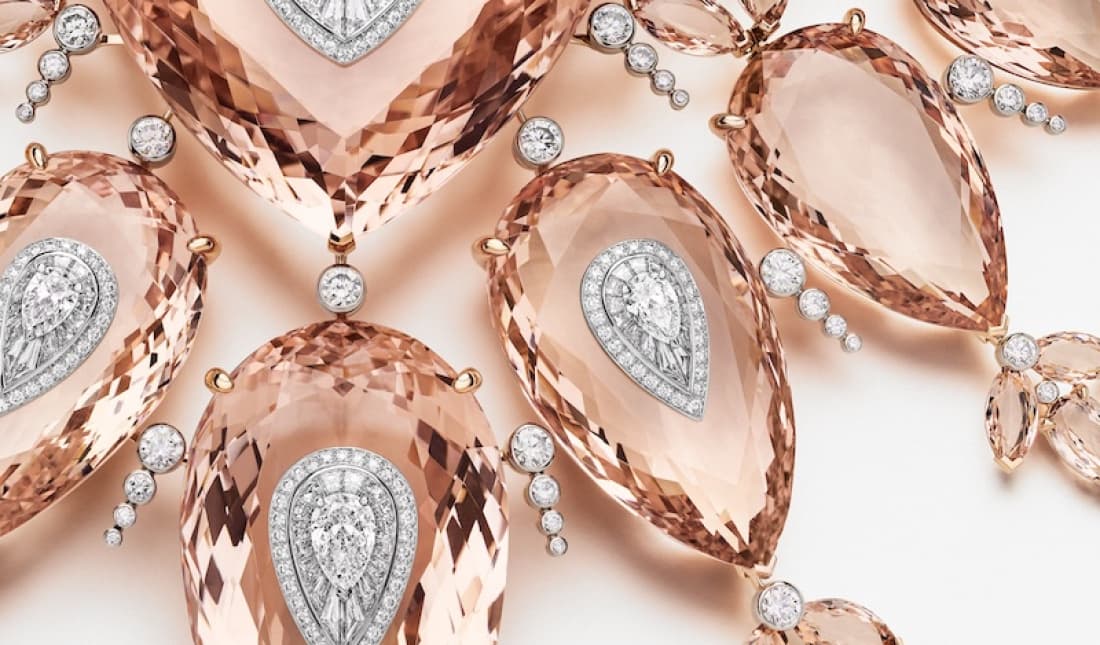
Light is the most physically assertive of the group. Boucheron says it uses more than 1,500 carats of morganites and diamonds set directly into the stones. That is an important distinction: the stones themselves carry the architecture, so the setting does not simply support the gems, it becomes part of their mass and brightness. The result should read as volume, not fragility, and it shows how high jewelry can look architectural without abandoning softness.
Tattoo shifts the collection into a darker, more graphic register. Here the house uses glyptics carved into smoky quartz, a lapidary approach that treats the stone as a surface to be incised rather than only polished and mounted. Smoky quartz brings depth and shadow, while carving gives the work a more personal, almost bodily edge. In the language of the collection, Tattoo is where individuality becomes mark-making.
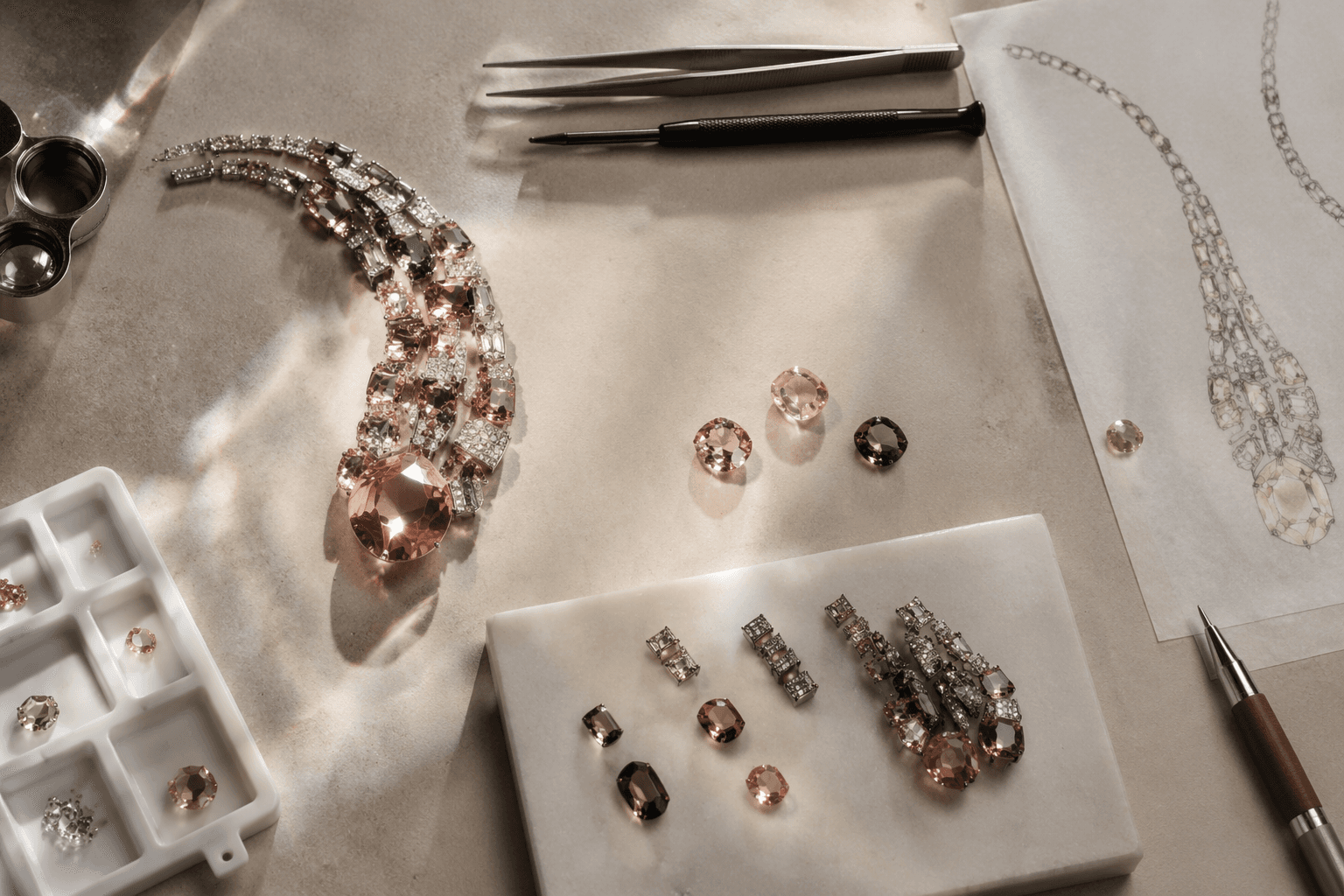
Checkers completes the five-part suite and keeps the project from settling into a single emotional note. Boucheron does not lean on the same material description here that it does for Rain, Flower, Light and Tattoo, which makes the set feel like the conceptual hinge in the group. Even without a gem-heavy breakdown, its name signals pattern, order and graphic rhythm, all of which fit the collection’s larger argument that one form can hold very different identities.
What the craftsmanship tells you
For anyone reading high jewelry with an eye on value, the most telling detail in Human Being is not a headline number of carats. It is the way each set uses a different labor language: filling hollow crystal by hand, painting rose quartz individually, setting morganite and diamonds directly into the stones, carving smoky quartz with glyptics. Those techniques are not decorative footnotes. They are the evidence that the collection is built from distinct kinds of expertise rather than from a single repeated formula.
That distinction matters because luxury storytelling is crowded with vague claims about uniqueness. Human Being is more specific than that. It names its materials, names its techniques and ties them to a single silhouette, so the viewer can measure how much of the drama comes from gemstone choice and how much comes from workmanship. The collection’s emotional range depends on that precision.
- Rain reads as motion and suspension, with the diamonds visually trapped inside crystal droplets.
- Flower feels softer and more intimate, because hand-painted rose quartz brings color to the fore.
- Light is the most materially emphatic, with more than 1,500 carats of morganites and diamonds built into the stones themselves.
- Tattoo gives the set a carved, graphic gravity through smoky quartz glyptics.
- Checkers completes the argument that pattern and repetition can still produce individuality when the silhouette stays constant.
Seen together, the five sets make a clear case for where Boucheron wants high jewelry to go next. The house is not treating humanity as a vague theme; it is translating it into structure, surface and labor, one necklace silhouette at a time.
This article was produced by Prism’s automated news system from verified source data, official records, and press releases, then run through automated quality and moderation checks before publishing. The system is built and supervised by the people who set the standards it runs under. Read our full AI policy.
Did this article answer your question?