GIA clarity scale shows why VS and SI diamonds can look alike
FL and IF are the prestige end of diamond clarity, but for most buyers the real visual question starts in VS and SI, where the naked eye often sees no difference.
The diamond world loves the language of perfection, yet most shoppers end up choosing between stones that look nearly identical once they are set. GIA’s clarity scale explains why a VS1 and an SI2 can read as different on paper while appearing clean in the hand, and why paying more does not always mean seeing more.
Why the clarity grade is only part of the story
GIA’s clarity scale runs from Flawless, or FL, through Internally Flawless, VVS1 and VVS2, VS1 and VS2, SI1 and SI2, then down to I1, I2, and I3. That 11-grade system turns clarity into something measurable, but it does not turn it into a simple beauty contest. The real question is not whether a diamond has a mark somewhere inside it, but whether that mark changes the way the stone looks once it is cut, mounted, and seen at normal viewing distance.
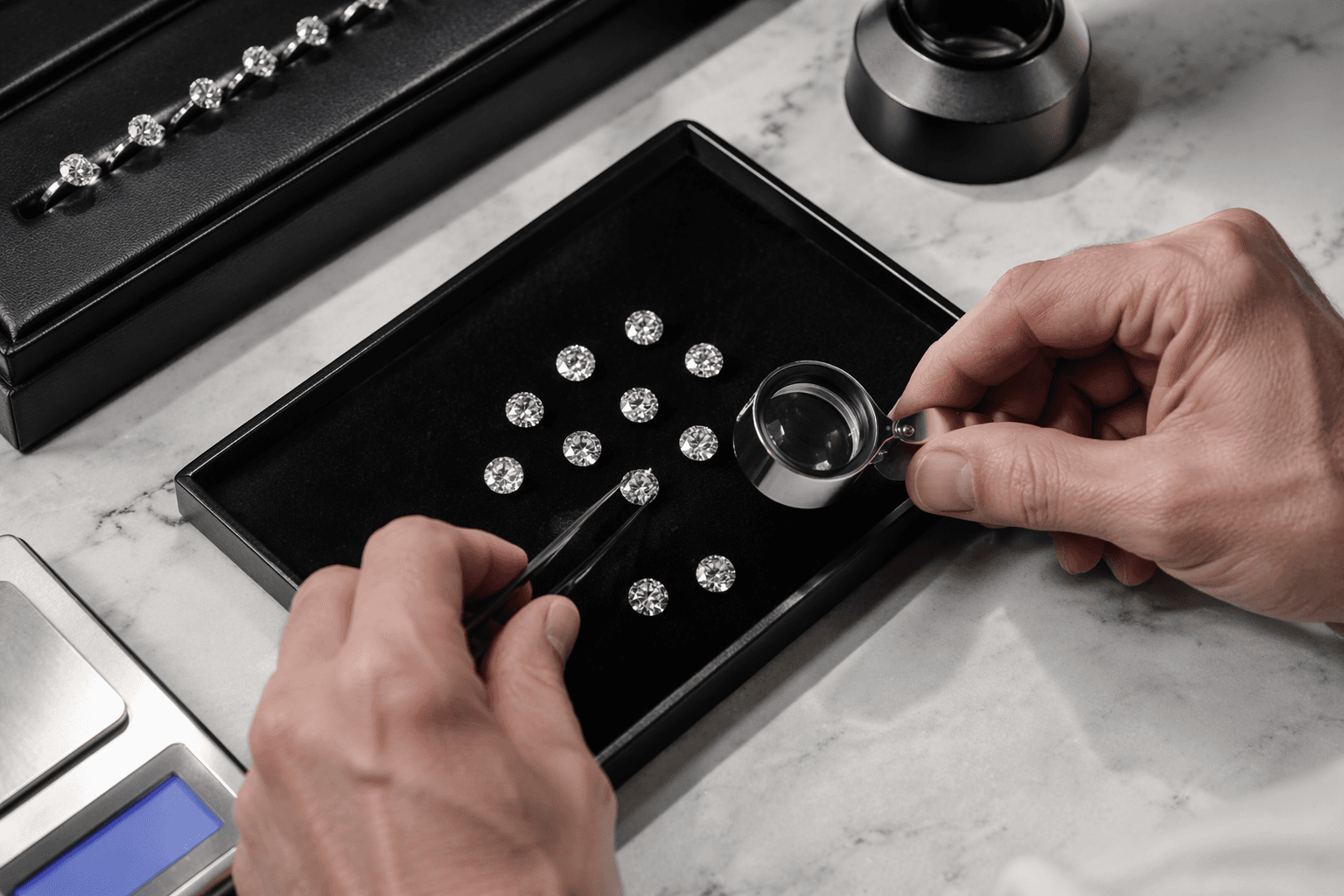
GIA grades clarity under 10x magnification and weighs the size, nature, position, color or relief, and number of clarity characteristics. That matters because a tiny inclusion tucked near the edge of a stone behaves very differently from a larger one sitting squarely under the table. In other words, clarity is less about purity in the abstract than about visibility in the real world.
Why VS and SI often win the buying battle
For most buyers, the commercially relevant range begins in VS and SI, not at the top of the scale. GIA says most diamonds sold in jewelry stores fall between VS and SI, which is the clearest sign that these grades are not a compromise so much as the market norm. The fantasy of shopping only FL or IF is appealing, but it is not how most beautifully worn diamonds are actually chosen.
GIA also notes that VS1 and SI2 diamonds may look exactly the same to the naked eye. That is the point where clarity becomes a true shopper’s shortcut: if a diamond looks clean face-up without magnification, the grade on the report may matter more to resale language than to daily wear. In almost all cases, the clarity features in VVS and VS diamonds cannot be seen with the unaided eye, and the price gap between VVS and VS can reach as high as 40%.
What collectors are really paying for at the top end
FL and IF sit at the prestige end of the scale because rarity drives value. GIA describes clarity as the absence of internal inclusions and external blemishes, and notes that diamonds without these birthmarks are rare. That rarity is real, and it explains why top grades carry a premium even when the visual payoff is subtle or, for many shoppers, invisible.
There is also a practical reality that often gets missed in the store: GIA says most jewelers may never see a flawless diamond in their careers. That is useful context for anyone who assumes FL is the baseline for a serious stone. It is not; it is the exception, and one that lives closer to collector psychology than to ordinary engagement-ring shopping.
How to read the report, not just the grade
The clearest way to understand a diamond’s clarity is to look at the plotting diagram on a GIA Diamond Grading Report. GIA maps characteristics such as feather, crystal, cloud, and bearded girdle onto that diagram, which supports the clarity grade and shows where the stone’s features actually sit. The diagram also serves as an identification tool because no two diamonds have the same plot.
That report matters because the grade tells you the category, while the plot tells you the geography. A stone may be VS on paper, yet its inclusion can sit in a place that is effectively invisible once the diamond is mounted. GIA issues Diamond Grading Reports for loose natural diamonds weighing 0.15 carats or more, and for standard round brilliant cut diamonds in the D-to-Z color range, the report also includes a cut grade.
Why the system became the trade’s common language
The clarity scale did not appear by accident. GIA says the 4Cs began in the early 1940s, when founder Robert M. Shipley helped frame the modern language of diamond quality, and Richard T. Liddicoat’s International Diamond Grading System became a universal standard in 1953. GIA issued its first diamond grading reports that same year, and those reports became the jewelry industry’s benchmark.
That history matters because it explains why clarity grading carries so much authority in the trade. Before the standardized system, diamond quality was more open to interpretation, and interpretation invites inconsistency. The modern scale gave buyers, sellers, and graders a common vocabulary, which is why a VS2 means something concrete whether the stone is in New York, London, or Hong Kong.
Where the market is heading now
GIA’s standards remain the reference point, but the market around them keeps evolving. In June 2026, De Beers said its U.S. consumer study surveyed 18,500 women and found that natural diamonds remain the most desired luxury jewelry product. The same research said average purchase prices have increased 25%, Gen Z is now the second-largest generation buying diamonds, and non-bridal occasions account for three-quarters of overall U.S. demand.
That shift widens the relevance of clarity beyond engagement rings. When a diamond is bought for anniversaries, milestones, and self-purchase, the calculation often changes: the stone still needs to look beautiful, but the buyer may care less about chasing a top label than about getting the best face-up appearance for the money. De Beers has also tried to strengthen consumer confidence at the counter, launching a free education app for U.S. retailers in 2025 and a retail-counter verification device in 2024.
The practical sweet spot for most shoppers
The cleanest buying rule is not to chase the highest clarity grade you can afford, but to buy the cleanest-looking stone you can see with your own eyes. In many cases, that sweet spot sits in VS or SI, where the diamond can appear bright and tidy without the steep premium attached to the rarest grades. The difference between a diamond that is technically cleaner and one that looks cleaner is exactly where the market often asks for more money than the eye can justify.
That is why clarity works best when it is read alongside cut, size, and budget. A diamond with subtle, well-placed inclusions can still wear as an elegant, high-jewelry stone, while a technically superior grade may offer little visible advantage once the ring is on the hand. The smartest clarity purchase is not the rarest one on the chart; it is the one whose beauty survives the distance between the grading loupe and real life.
This article was produced by Prism’s automated news system from verified source data, official records, and press releases, then run through automated quality and moderation checks before publishing. The system is built and supervised by the people who set the standards it runs under. Read our full AI policy.
Did this article answer your question?