Bridal rings turn personal with vintage cuts, bold gold and custom details
Before you spend a dollar on a diamond, the new bridal equation is cut, color, customization and creativity. The smartest rings now feel personal, not packaged.
The new four C’s
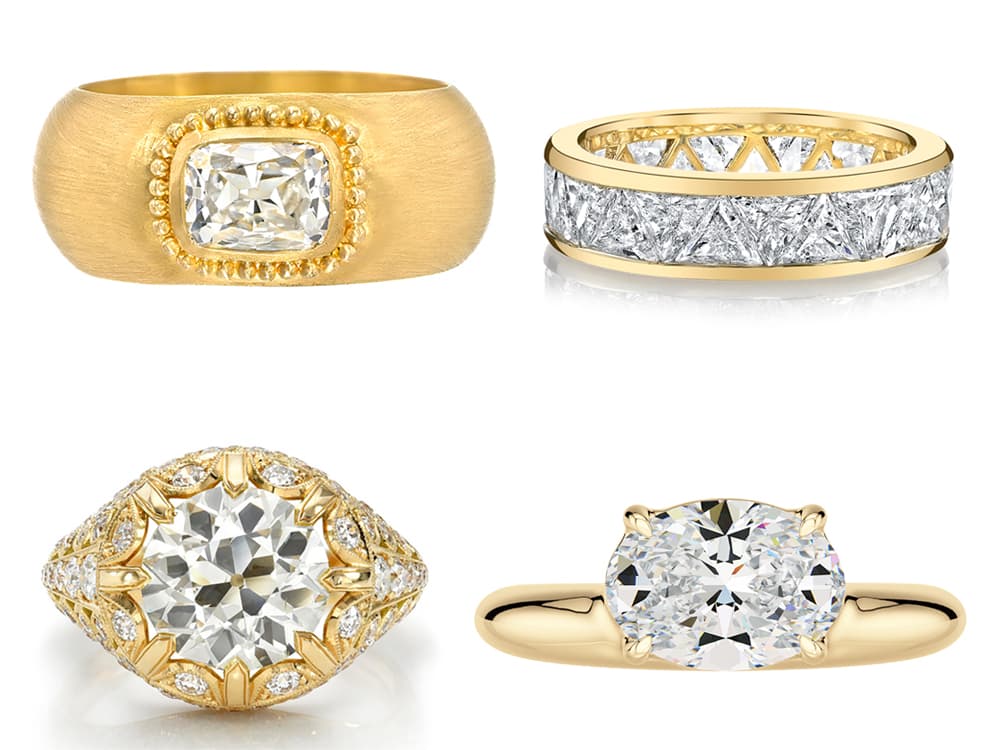
Before you spend a single dollar on a diamond, decide what kind of ring you want to live with every day. The bridal market has moved beyond a one-ring-fits-all formula, and the new language of buying is cut, color, customization and creativity. That shift is visible in the details buyers are choosing now: elongated center stones, east-west settings, old cuts in contemporary shanks, chunky yellow gold and wedding bands that feel more like personal signatures than matching afterthoughts.
Cut: shape is doing more of the talking
The center stone is no longer expected to be round to be considered correct. Oval, pear, marquise, kite and shield cuts have become more visible, and their appeal is practical as much as aesthetic: they can create stronger finger coverage and make a ring feel larger and more dramatic without relying only on carat weight. If you are working within a budget, shape is one of the easiest ways to get visual impact without simply buying a bigger stone.
This is also why the old halo formula is losing ground in some stores. When a shape is strong enough on its own, the setting does not need to shout. What to ask your jeweler: how the proportions read on the hand, whether the pointy ends are protected, and whether the setting is meant to emphasize length, width or balance.
Color: the metal changes the mood
Yellow gold is especially hot, but platinum and white gold are gaining ground in some markets, including New York. That matters because the metal does more than frame the diamond; it changes the tone of the whole ring. Yellow gold gives a stone warmth and depth, while platinum and white gold can make the same diamond read cooler and sharper.
For buyers, metal choice is where style and durability meet. Chunkier gold settings tend to feel more sculptural and substantial, while slimmer white-metal mounts can make a stone look cleaner and more minimal. What to ask your jeweler: how the ring will wear in daily life, whether the shank is thick enough for long-term use, and how much maintenance the finish will require over time.
Customization: the ring becomes personal
The strongest thread running through bridal right now is personalization. At JCK’s June 4 panel, experts made clear there is not just one type of engagement ring, and the custom details they described were telling: hidden birthstones, zodiac signs and bespoke designs built around a couple’s own story. That is the difference between a ring chosen from a display case and a ring that feels authored.
Customization can be as subtle as an engraving inside the band or as visible as a setting built around a specific motif. It usually costs more in labor than a ready-made mounting because it requires design time, bench work and often CAD development, but the payoff is distinction. What to ask your jeweler: what portion of the price is stone, what portion is setting, and which details are structural rather than purely decorative.
Creativity: east-west settings and the new bridal silhouette
The east-west setting has become one of the clearest symbols of the shift toward originality. JCK traced the style back to the 15th century, noted its biggest audience in the 1920s and showed how it has returned with fresh force, helped along by Zendaya’s ring reveal. Searches on eBay for east-west rings rose 30 percent from December 2023 through December 2024, a reminder that the look has moved well beyond niche design circles.
This style is for buyers who want a familiar stone to feel newly considered. It can be especially effective with oval, marquise, pear or shield-shaped stones, because the horizontal orientation changes the ring’s presence on the hand without needing extra stones around it. Cost-wise, an east-west setting can be a smarter use of budget than a halo, but custom fabrication may add labor. What to ask your jeweler: whether the stone is securely held, whether the ring will sit comfortably beside a wedding band and whether the setting needs a custom basket or prong arrangement.
Old cuts: antique character in a modern frame
Antique diamonds are no longer a secret language known only to specialists. Perpetuum was founded in 2013 to supply designers, metalsmiths and bench jewelers with loose antique stones for wedding and commitment rings, and older cuts like old mine cuts and rose cuts are now far more widely understood than they were 20 years ago. That broader fluency has changed the market: an old cut no longer reads as obscure, only distinctive.
The appeal is emotional as well as visual. Old cuts tend to have softer, less mechanical flashes than many modern stones, and when they are set into contemporary shanks, the contrast can be striking. They are for buyers who want history in the stone itself, not just in the idea of vintage. What to ask your jeweler: whether the diamond has been recut, whether any chips or edge wear need protection and whether a low-profile setting will better preserve the stone’s character.
Nontraditional details: the wedding band is part of the story
The rise of nontraditional wedding bands tells you how far bridal has moved from symmetry for its own sake. A band no longer has to mirror the engagement ring exactly; it can be textural, sculptural or deliberately unexpected. That is where creativity becomes useful rather than merely decorative, especially for couples who want the set to feel collected rather than prescribed.
National Jeweler’s trend coverage has continued to point toward fancy-shaped center diamonds and sculptural settings, and that larger movement explains why bold yellow gold, old cuts and personalized motifs keep showing up together. Halo styles may still have their place, but the market clearly favors rings that feel intentional and individual. What to ask your jeweler: how the engagement ring and wedding band will sit together, whether the design leaves room for future stacking and whether the nontraditional detail will still feel elegant years from now.
Buying in a softer market
The bridal business has had its own pressure points. Signet Jewelers said its engagement ring business was soft, with fiscal fourth-quarter same-store sales down 10 percent and full-year same-store sales down 12 percent, even as Virginia C. Drosos projected U.S. engagement rates would rise 5 percent to 10 percent in fiscal 2025 versus fiscal 2024. For a buyer, that can translate into leverage: ask for transparent pricing, ask what is included in custom work and ask whether the ring is priced as a complete piece or as a stone plus setting.
The best engagement ring now is the one that knows exactly what it is trying to say. Whether that means an east-west oval, a rose cut in a modern shank, a chunky yellow-gold mount or a hidden birthstone only two people will ever see, the most persuasive bridal jewelry today does not chase sameness. It turns the stone, the metal and the setting into a single, personal decision.
This article was produced by Prism’s automated news system from verified source data, official records, and press releases, then run through automated quality and moderation checks before publishing. The system is built and supervised by the people who set the standards it runs under. Read our full AI policy.
Did this article answer your question?