Spring Floral Jewelry Blooms With Diamond-Heavy Designs, Oscar Heyman and Tacori Lead
Spring’s floral jewelry turns sharper and more diamond-led, with Oscar Heyman and Tacori showing how petals can read sculptural, not sugary.
The new floral code
Before you buy a single diamond flower, look at the silhouette. Spring 2026’s floral jewelry is less about literal blossoms and more about shape, structure, and shine, with petals translated into sculptural metalwork and diamond surfaces that feel deliberately modern. National Jeweler’s April 17 roundup shows a clear shift: flower motifs are appearing in more collections, but the look is spreading beyond the expected gold-and-diamond formula into titanium, suede, horn, and hand-painted porcelain. That broader material palette matters because it signals that floral jewelry is no longer being treated as a seasonal novelty. It is being used as a design language.
The most current pieces have a strong architectural read. Instead of tiny, naturalistic blossoms that can feel sentimental or dated, the new floral jewelry leans into crisp petal outlines, polished negative space, and diamond placement that makes the motif feel edited rather than decorative. That is why the most interesting pieces this season are not merely floral in theme. They are floral in structure.
Oscar Heyman’s high-jewelry bloom
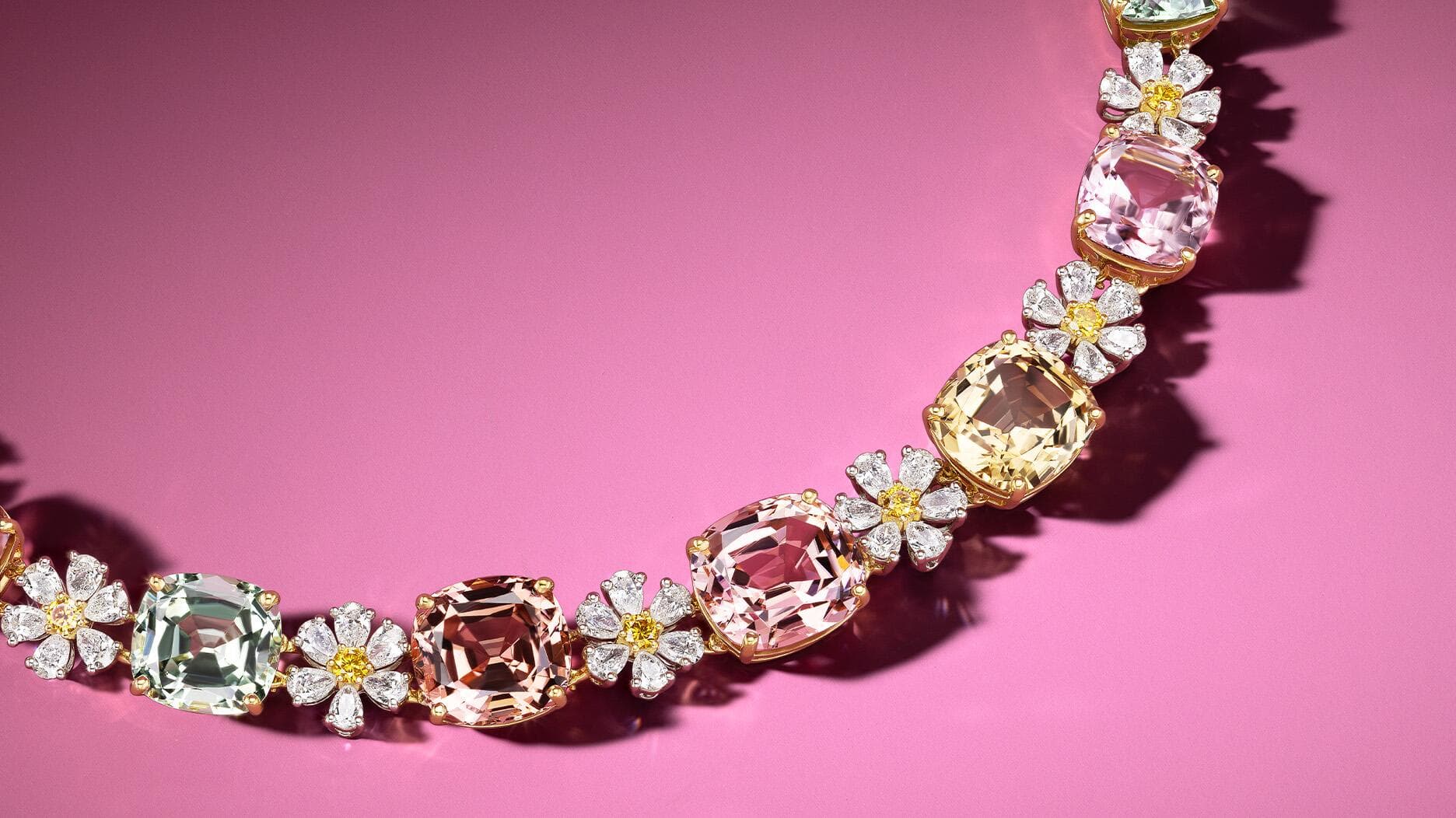
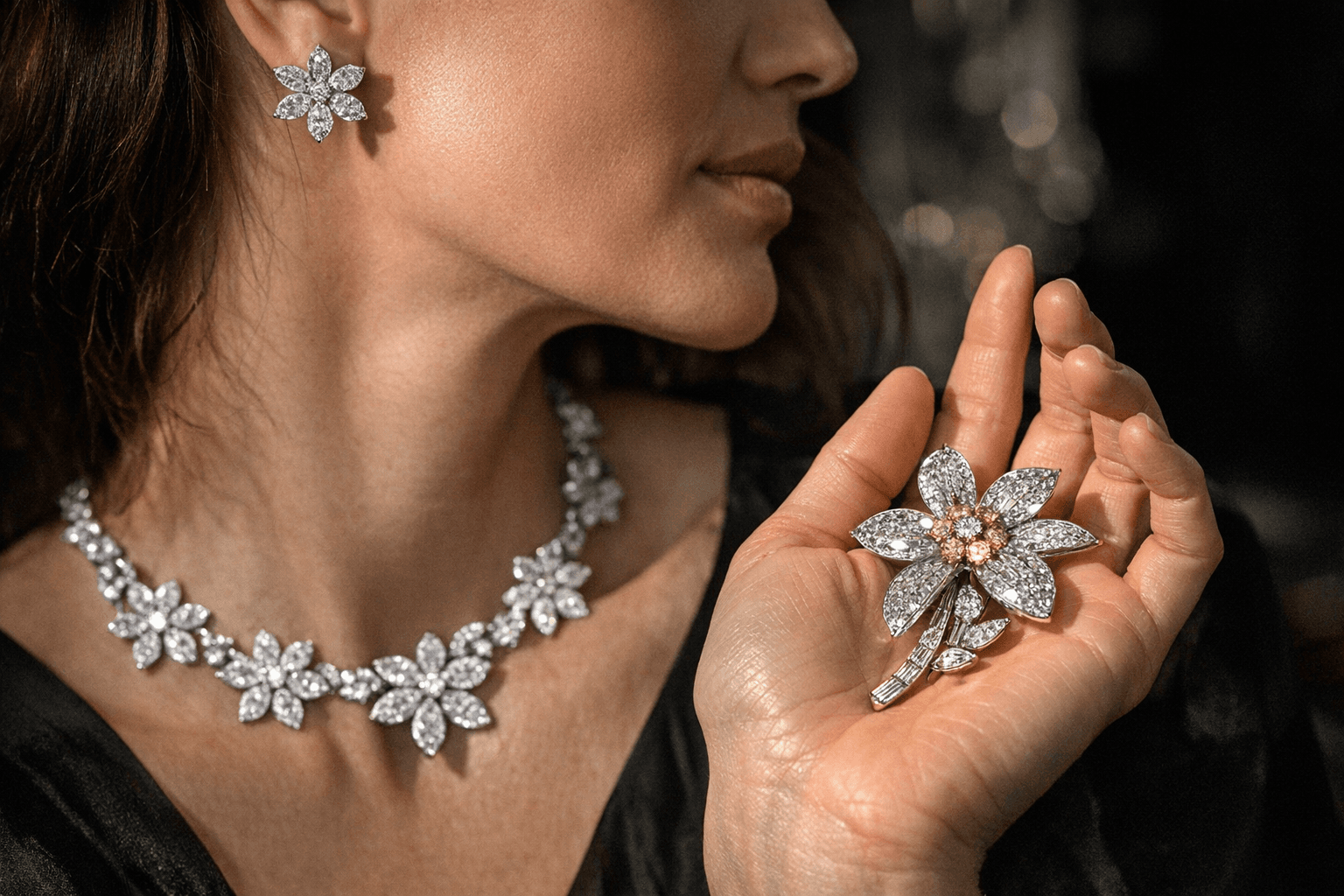
Oscar Heyman is the clearest example of how far the category can be pushed when the materials are treated as seriously as the motif. Its featured Flower necklace is priced at $400,000, and the number alone tells you what kind of object this is: not a sweet accessory, but a high-jewelry statement built to anchor a collection. The necklace combines cushion-cut multi-color tourmalines, pear-cut white diamonds, and round-cut fancy color diamonds, a combination that gives the bloom movement, depth, and contrast rather than a flat, monochrome sparkle.
That mix of cuts is one of the strongest clues to what feels fresh in floral jewelry now. Cushion cuts supply volume and softness, pear cuts suggest petals and droplets of light, and round fancy color diamonds keep the surface lively without turning the piece into a costume flower. Oscar Heyman, which says it has been creating signed and numbered fine jewelry since 1912, makes the case for floral design as heirloom craft rather than seasonal ornament. The brand’s New York City atelier and worldwide gemstone sourcing reinforce the idea that these pieces are built for collectors who value provenance as much as presentation.
The company’s spring catalog deepens that point. National Jeweler’s March 30 catalog coverage noted 35 one-of-a-kind pieces, and that scale matters: it shows nature motifs are not just one isolated necklace or pair of earrings, but a full merchandising direction. For shoppers, the takeaway is simple. In the high-jewelry tier, the floral look becomes most compelling when it behaves like a miniature garden with disciplined engineering, not a daisy chain of diamonds.
Why the strongest floral designs feel sculptural, not sweet
The difference between a piece that feels current and one that feels dated often comes down to how literally it imitates a flower. The most relevant 2026 designs do not copy nature too closely. They abstract it. Petals become angles, stems become lines of metal, and diamond pavé is used to sharpen the outline rather than bury it in sparkle.
This is where the material conversation becomes commercially useful. Gold and diamonds remain the core, but the wider use of titanium, suede, horn, and porcelain suggests designers are testing how far floral imagery can travel across categories. That makes the motif more versatile for buyers. A floral piece can read elegant, edgy, or artisanal depending on its base material, and the diamond-heavy versions are the ones most likely to survive beyond one season because they rely on structure rather than trend color.
Tacori’s wearable version of the bloom
If Oscar Heyman is the collector’s answer, Tacori is the everyday translation. The brand’s pavé round-cut engagement rings are handcrafted in California and are designed with a seamless path of diamonds leading to the center stone, a detail that gives the ring a clean, continuous shimmer rather than a heavy, overworked look. Tacori also says these round-cut engagement rings can be explored as solitaires, with a bloom, or as part of a three-stone design, which makes the floral idea feel adaptable instead of fixed.
That flexibility is what makes the Tacori approach commercially smart. A solitaire with a bloom detail feels subtle enough for daily wear, while a three-stone version reads more ceremonial and wedding-focused. The floral rings themselves are described as petal-inspired, using diamonds and metalwork to suggest a flower without spelling one out literally. In other words, Tacori is selling a floral mood that can live on a hand every day, not just on a special occasion.
For buyers, this is the clearest entry point into the trend. You do not need a six-figure necklace to participate in floral diamond jewelry. A well-executed pavé engagement ring or a petal-shaped ring can carry the same design idea in a much more wearable format. The key is whether the piece uses diamond weight and metal contour to create definition, or whether it simply adds a blossom shape and calls it design.
How to buy the look without buying the cliché
The smartest floral diamond jewelry for Spring 2026 shares a few traits. It feels dimensional. It uses diamonds to define form, not just to increase sparkle. And it avoids the overly literal flower shape that can quickly feel costume-like.
- Choose pieces with petal-like metalwork or pavé that traces the outline of a bloom.
- Favor sculptural settings over flat motifs, especially when the piece is meant for frequent wear.
- Look for mixed diamond cuts, such as round, pear, or cushion, when you want the floral shape to feel animated.
- Treat high-jewelry floral pieces, like Oscar Heyman’s necklace, as statement objects, while Tacori’s engagement rings are the cleaner route for everyday wear.
There is also a useful market read buried in the spring coverage: floral jewelry often becomes more diamond-heavy in fall and winter, so the 2026 spring emphasis is not a rupture but an escalation. Designers are refining a familiar spring motif into something sleeker, brighter, and more architectural. That is why this season’s best floral jewelry does not simply bloom. It holds its shape.
This article was produced by Prism’s automated news system from verified source data, official records, and press releases, then run through automated quality and moderation checks before publishing. The system is built and supervised by the people who set the standards it runs under. Read our full AI policy.
Did this article answer your question?