Diamond Buyers Prioritize Price as Lab-Grown Gap Widens
The diamond case is no longer romance versus romance, but price versus price, as lab-grown stones get cheaper and natural diamonds fight back.
Price has become the language of diamond buying
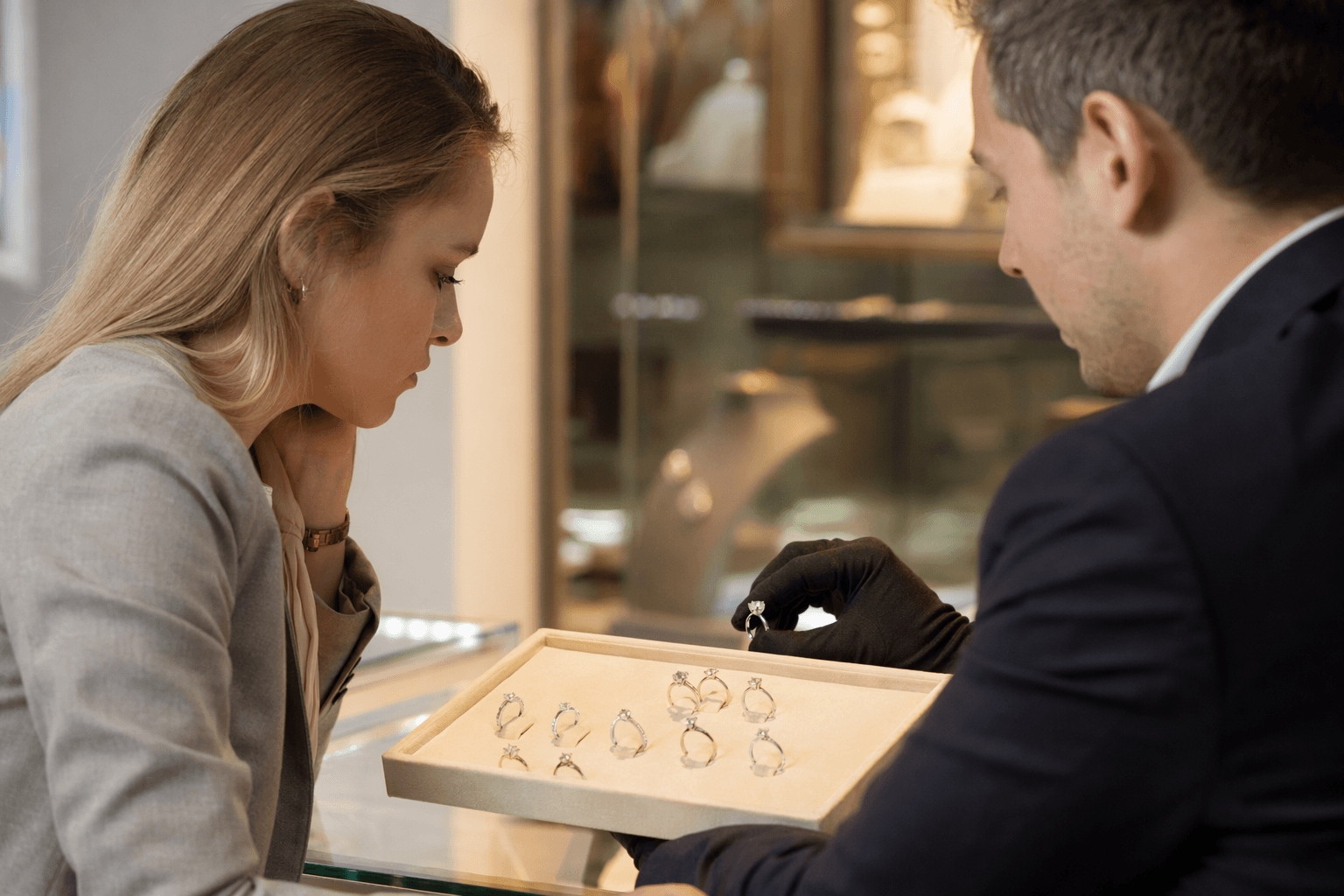
The diamond market is shifting from sentiment to arithmetic. Buyers are no longer being won over only by legacy, rarity, or the old promise of forever; they are comparing visible price gaps, and that comparison is reshaping what lands in the case, what gets promoted online, and which category is winning on volume.
That change is showing up in the most practical places. Global diamond-jewelry demand contracted 3% to 4% in 2024, and U.S. demand, which accounts for just over half of diamond-jewelry sales, fell 2% year on year. Even with a short-term rebound early in the year after India’s voluntary rough-diamond import moratorium and a post-holiday lift in American demand, the broader market stayed soft. The message is hard to ignore: the buyer has become far more price-sensitive than the category’s traditional storytelling assumed.
The price gap is now impossible to miss
Lab-grown diamonds have not merely entered the market. They have compressed it. De Beers’ Lightbox brand cut retail prices on May 10, 2024, lowering them to as little as $500 per carat from $800 per carat, a move that acknowledged how quickly synthetic-diamond pricing had fallen across the sector. Lightbox had launched with a fixed $800-per-carat model, but that price point no longer looked anchored to the realities of the market.
That kind of reduction matters because jewelry buying is visual, but it is also comparative. Once a lab-grown stone is priced far below a natural diamond of similar size and appearance, the conversation changes from aspiration to trade-off. The natural category may still carry emotional and geological cachet, but the lab-grown side now offers a sharper, simpler answer to the question many buyers are actually asking: how much diamond can I see for the money I am spending?
What buyers are choosing, and why it matters
Consumer data underline the new behavior. The Knot’s 2024 Jewelry & Engagement Study found that the average engagement-ring cost fell to $5,200 in 2024 from $6,000 in 2021. At the same time, the average center stone grew from 1.5 carats to 1.7 carats. That combination tells a clear story: shoppers are not necessarily spending more, but they are expecting more size for the same budget.
Rapaport adds another useful lens. In a January-to-July period in the United States, lab-grown stones accounted for 44% of engagement-ring sales by volume, but only 25% by value. That split captures the market’s central tension. Lab-grown stones can dominate unit sales because they are cheaper and easier to trade up into by size, yet they still generate a smaller share of revenue. Volume is tilting one way, value another.
The Natural Diamond Council’s estimate that a 1.5-carat lab-grown diamond has lost 83% of its value over the past nine years explains why price now sits at the center of the category conversation. When a product declines that sharply, it stops behaving like an aspirational luxury and starts behaving like a highly competitive commodity.
Retailers are being forced to choose a side
This is no longer just a consumer preference story. It is a merchandising strategy story. Pandora has made lab-grown diamonds central to its growth plan, while De Beers has moved in the opposite direction, retreating from the consumer lab-grown segment and trying to reinforce the case for natural stones.
Pandora says its lab-grown diamonds are created using advanced technology, are identical to mined diamonds in every way, and offer exceptional quality, a known origin, and a significantly lower carbon footprint. The brand also completed a transition to 100% recycled silver and gold in 2024, then added carbon-footprint labeling to its lab-grown diamond pages in May 2026. Chief executive Berta de Pablos-Barbier framed that move as a response to increased consumer demand for sustainability. In other words, Pandora is not selling lab-grown diamonds as a compromise. It is selling them as a cleaner, more transparent luxury proposition with an easier entry price.
De Beers, by contrast, announced in June 2024 that it would stop producing lab-grown diamonds for jewelry and focus those efforts on industrial uses. That decision was more than a product adjustment. It was a confession that the economics of consumer lab-grown jewelry had changed too quickly to defend profitably under the old assumptions.
The branding battle now sits beside the price battle
Price may be driving the sale, but classification is deciding the story around the sale. The Natural Diamond Council has been publishing material to clarify terminology, sustainability claims, pricing, and the distinctions between natural and laboratory-grown stones. At the same time, the Gemological Institute of America has emphasized that lab-grown diamonds share nearly the same physical and optical properties as natural diamonds and require specialized identification.
That tension is important because it shows the market’s real divide. These stones can look remarkably similar under the eye, but they do not carry the same geological history, and they do not behave the same way in resale or long-term value. The customer may initially enter through price, yet the final decision still turns on what kind of meaning a buyer wants the stone to hold.
What this means for diamond jewelry now
The practical effect of all this is visible across the category. Retailers are splitting assortments, brands are sharpening their language, and consumers are learning to read carat weight against cost with far more sophistication than before. Natural diamonds still command the strongest emotional narrative, especially for buyers who value rarity and provenance. Lab-grown diamonds, however, now own the clearest value proposition.
That is why the current market feels less like a passing trend than a reordering. Diamond buying is being decided by the distance between the tags, not just the story told beside them. And as that gap widens, the industry is being forced to prove, stone by stone, what luxury means when price becomes the first question.
This article was produced by Prism’s automated news system from verified source data, official records, and press releases, then run through automated quality and moderation checks before publishing. The system is built and supervised by the people who set the standards it runs under. Read our full AI policy.
Did this article answer your question?