Diamond fluorescence, what buyers need to know about value and appearance
Fluorescence is usually a quiet note on the report, but in the right color range it can change how a diamond looks and how hard you should negotiate.
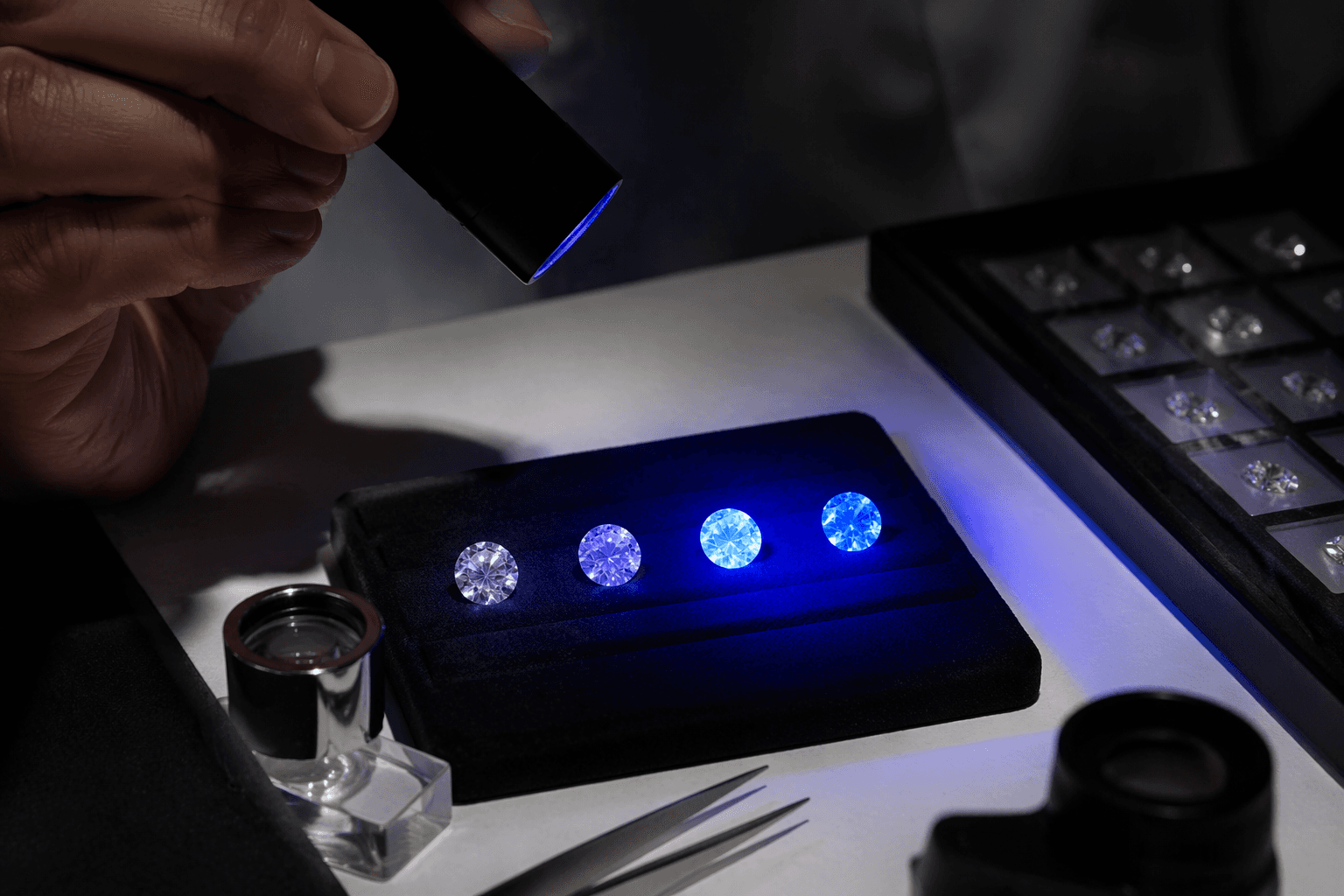
A diamond can look pristine under showroom lighting and still behave very differently under ultraviolet light. That behavior is called fluorescence, and on a GIA Diamond Grading Report it is a measurable note about how strongly the stone reacts to long-wave UV. Fluorescence is often a minor detail, sometimes a pricing lever, and only rarely a reason to walk away.
What fluorescence means on the report
GIA treats fluorescence as an identifying characteristic, not a 4Cs grading factor. It is not part of color, clarity, cut, or carat weight, yet it still appears on the report and can influence how a diamond is perceived in the real world. If the stone shows Medium, Strong, or Very Strong fluorescence, the color of the glow is also noted. At GIA, more than 95% of fluorescent diamonds glow blue.
Roughly 25% to 35% of diamonds submitted to GIA show some degree of fluorescence.
When it changes appearance, and when it does not
For most diamonds, fluorescence has no widely noticeable effect on appearance. A fluorescent diamond is not structurally weak, and fluorescence does not compromise a diamond’s structural integrity.
The real outlier is the tiny fraction that looks hazy or oily. Fewer than 0.2% of fluorescent diamonds submitted to GIA show that effect, and that is the scenario that should make you slow down and inspect the stone under different lighting. If a seller uses vague language like “it has personality” or “it glows nicely,” ask what the stone looks like face-up in daylight, under spot lighting, and in diffused light, because those are the conditions that expose whether fluorescence is simply present or actually visible.
There is also a cultural habit in the market to treat fluorescence as a flaw by reflex. That instinct is too crude. GIA research has long shown that some observers even prefer medium to strong fluorescence, and the old trade superstition that fluorescence automatically hurts beauty does not match the lab’s findings.
Color range is where the conversation gets serious
Fluorescence is not equally important across all diamond colors. In higher-color stones, especially the near-colorless range, buyers tend to care more because they are already paying for a cleaner, whiter look. That is where blue fluorescence can become a negotiating point even if the stone is beautiful, because the trade has historically applied discounts that are sometimes disconnected from the actual face-up effect.
Rapaport lists blue-fluorescence discounts ranging from about 1% for faint fluorescence to as much as 25% for very strong fluorescence, depending on color and clarity. That is not a reason to reject a diamond outright; it is a reason to ask whether the discount is justified by what you can actually see. In a high-color stone, especially one priced as a top-tier white diamond, even a small discount can matter because the buyer is paying for nuance, not just weight and sparkle.
In lower-color diamonds, fluorescence is often less decisive. A stone with a warmer body color can already carry more tint, so a blue fluorescence note may be less visually consequential and sometimes even help the diamond look a little cooler in some lighting.
How to read the grading language without overreacting
The report language gives you the first filter: fluorescence is described by strength, and only Medium, Strong, or Very Strong stones have the color specifically noted. The lab is separating routine presence from more salient reactions. If the stone is F, G, or H color, the question is usually not “Is fluorescence bad?” but “Does this particular stone show any visible effect worth trading on price?”
A practical way to use the report is to match the fluorescence line to the rest of the diamond’s profile:
- High color, especially in the D-to-G range: inspect carefully and use fluorescence as a price-negotiation point if the seller is asking top money.
- Near-colorless to faintly tinted stones: fluorescence often matters less to the eye than it does to the invoice.
- Very Strong fluorescence: look for transparency issues, especially haziness under bright light.
- Faint fluorescence: often little more than a line item, unless the seller is trying to charge a premium for rarity.
A seller who talks only about “sparkle” without showing you the report is leaving out the fluorescence line.
Natural diamonds, lab-grown diamonds, and the UV clue
GIA research shows natural fluorescent diamonds typically glow brighter under long-wave UV than under short-wave UV, while laboratory-grown diamonds often show the opposite pattern. Phosphorescence, a lingering glow after the UV source is turned off, is uncommon in natural diamonds but is seen more often in HPHT lab-grown stones.
That does not make fluorescence a standalone authentication test. It is one clue among several, but it is a meaningful one, especially when combined with the full disclosure on modern lab-grown reports. GIA laboratory-grown diamond reports also include added identification features such as laser inscription on the girdle, so fluorescence sits inside a larger system of disclosure rather than acting as a mystery signal on its own.
Why the lighting in the room can change the verdict
GIA’s 2021 research on blue fluorescence found that UV intensity in the light source affects table-down color, face-up color, and brightness. A diamond can behave one way under strong UV-rich light and another way under softer interior lighting, so the store environment matters when you are judging whether fluorescence is an asset, a wash, or a liability.
GIA cites the 127.01 ct Portuguese diamond as a classic example of a stone that can appear oily or hazy under very strong blue fluorescence. It shows the extreme end of the spectrum without implying that every fluorescent diamond behaves that way.
This article was produced by Prism’s automated news system from verified source data, official records, and press releases, then run through automated quality and moderation checks before publishing. The system is built and supervised by the people who set the standards it runs under. Read our full AI policy.
Know something we missed? Have a correction or additional information?
Submit a Tip