Diamond vs simulants: how cubic zirconia and moissanite compare
Cubic zirconia and moissanite can mimic diamond’s look, but they differ sharply in chemistry, wear, and value, and the label on your paperwork matters.
Cubic zirconia and moissanite can flash diamond-bright on a hand or at the ear and still tell a different story once they meet a tester, a setter, or an insurance form. Both are used to capture the look of diamond, but they are not interchangeable with natural diamond, and they do not behave the same way in daily wear or in the market. Lab-grown diamond complicates the picture further because it is still diamond, which is why the language on a receipt matters as much as the stone itself.
What a simulant actually is
A simulant is a material that looks like another gem but has a very different chemical composition, crystal structure, and optical and physical properties. Simulants, moissanite, and lab-grown diamonds are distinct categories, which is exactly the distinction many casual buyers blur when they say “fake diamond.”
Lab-grown diamond belongs in the diamond family, not the simulant category. It shares the same basic chemistry as natural diamond, even though it is created in a laboratory. That is why a lab-grown stone can be described accurately only when it is called what it is, rather than folded into the catchall language of imitation jewelry.
Cubic zirconia: the classic diamond lookalike
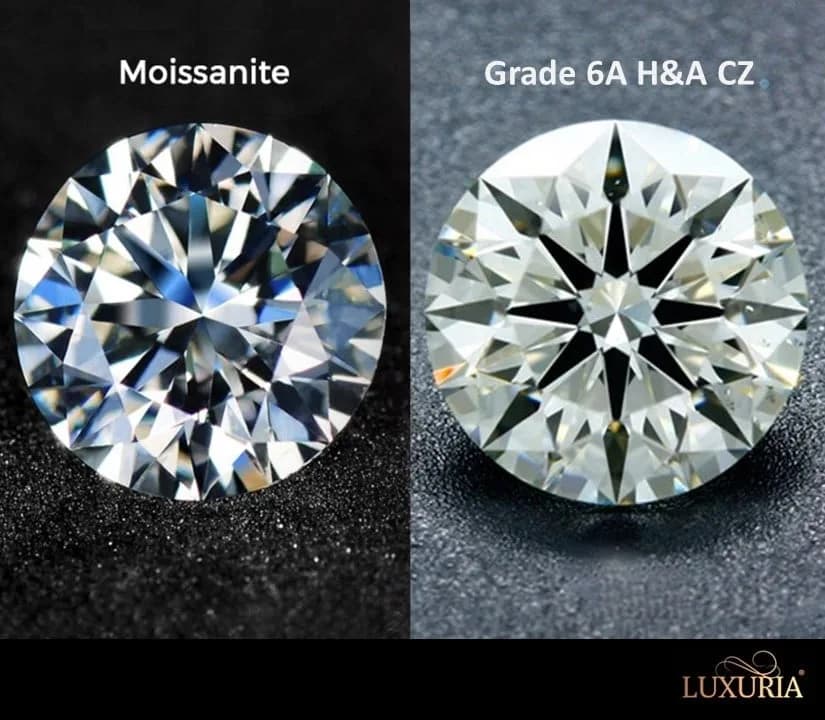
Cubic zirconia is the most familiar diamond simulant in fashion jewelry, and it earned that role because it can look bright, clear, and convincingly sparkly at a glance. It is not diamond, though, and its physical behavior is different enough that it belongs in the budget-friendly fashion lane rather than in the same category as mined or lab-grown diamond. Cubic zirconia is one of the most common simulants in the modern market for affordable shine.
Its appeal is straightforward: it gives the silhouette of diamond jewelry without the mineral identity of diamond itself. That makes it useful in earrings, cocktail rings, and trend-driven pieces where the goal is a polished look rather than a long-term value story.
Moissanite: not a diamond, not a simulant, and not subtle
Moissanite sits in a more complicated place because consumers often compare it to cubic zirconia even though the two stones are not the same material and do not behave the same way. French chemist Henri Moissan first identified it in 1893 in material from Meteor Crater in Arizona, which gives the gem a scientific pedigree that most diamond alternatives lack. Natural moissanite is extremely rare, so the material used in jewelry is laboratory-grown.
Moissanite has its own composition and optical character, which is why it can throw a different kind of sparkle from diamond and why jewelers rely on specialized testing methods to tell the two apart. In engagement rings and fashion settings, it has become a popular choice for buyers who want a diamond-like look without buying a diamond itself, but its light return is not identical to diamond.
How gemologists tell the difference
Identification is not about guessing by eye. Real separation depends on measurable properties such as thermal and electrical behavior, optical characteristics, and magnification evidence, not simple appearance. That is why basic diamond testers can be useful but not definitive: moissanite and diamond can overlap on thermal tests, so more advanced screening may add electrical conductivity and optical checks.
A stone may look diamond-like in daylight, under boutique lighting, and in a photo, yet reveal another identity under a tester or microscope.
Why disclosure and paperwork matter
The Federal Trade Commission requires jewelry sellers to describe products accurately, and lab-created diamonds must be disclosed as laboratory-created rather than mined. It protects the buyer from paying one category’s price for another category’s material, which is especially important when the stone is being sold as a gift, an heirloom, or a milestone purchase.
Written disclosure should carry through to the appraisal and the insurance schedule. Natural diamond, lab-grown diamond, moissanite, and cubic zirconia are valued differently, so incorrect naming can create coverage problems or confusion at claim time. The paperwork should match the stone in the setting, whether that stone is a mined diamond, a lab-grown diamond, or a simulant chosen for its look and price point.
How to buy with confidence
The simplest way to shop well is to ask the right material question before you fall in love with the sparkle. If the answer is not specific, the price and the promise are both suspect. A clear receipt, a clear appraisal, and a clear disclosure tell you whether you are buying diamond, lab-grown diamond, moissanite, or cubic zirconia.
- Ask for the exact material name, not just “diamond-like.”
- Request written disclosure that matches the stone in the setting.
- Confirm the return policy and any upgrade policy before you leave the counter.
- Check that insurance and appraisal documents use the same material description as the jewelry itself.
This article was produced by Prism’s automated news system from verified source data, official records, and press releases, then run through automated quality and moderation checks before publishing. The system is built and supervised by the people who set the standards it runs under. Read our full AI policy.
Did this article answer your question?